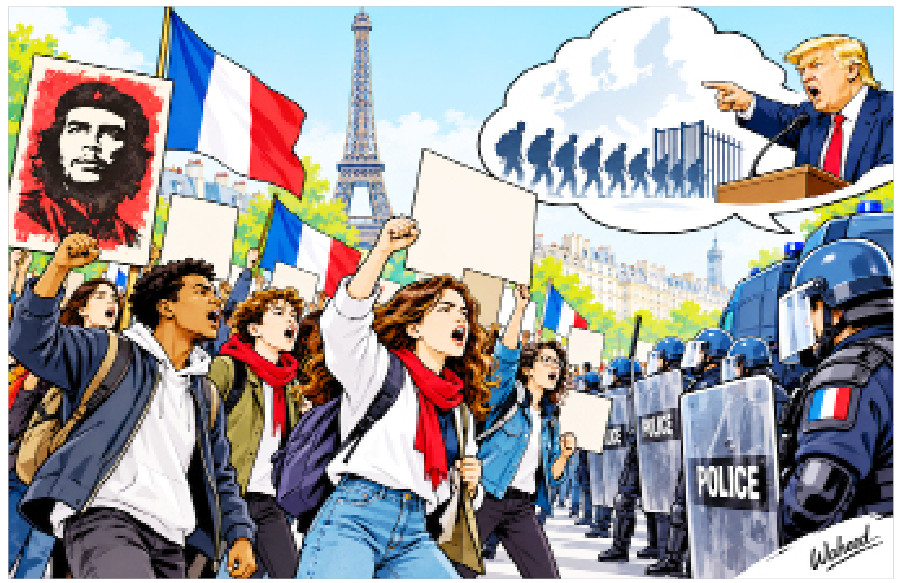
The current wave of demonstrations in 40 French cities, driven by chronic teacher shortages, dilapidated school infrastructure, overcrowded classrooms, and anger over iron-fisted policing, peaked nationally in early October. Because October 9 marks the historical date of Che Guevara’s execution in Bolivia, critics, left-wing commentators, or historically minded student factions occasionally draw conceptual parallels between the two.
As university students several decades ago, we thought there was some romantic linkage between French radicalism and the Guevara movement. Whenever French youths take to the streets, build blockades, and clash with riot police, they consciously or unconsciously evoke the ghosts of 1968, making any proximity to revolutionary anniversaries feel rhetorically potent, even if accidental.
Che Guevara Flashback
While the October 9 date is coincidental, the spirit of global youth rebellion that Che Guevara came to represent is permanently baked into the DNA of French student protests. It will be recalled that during the legendary May 1968 student uprisings in France, Che Guevara—alongside figures like Ho Chi Minh and Mao Zedong—was adopted as a primary icon of anti-establishment defiance. Images of Che frequently flew alongside red and black flags on barricades in the Latin Quarter of Paris.
Major demonstrations, school blockades, and clashes have been concentrated in the following cities: Paris & Greater Paris Region (Île-de-France), Marseille, Lyon, Rennes, Nantes, Toulouse, Lille, Toulon, Bayonne, Belfort, Nancy, Perpignan, and Tours.
As a Nigerian, I feel that the French are simply having a taste of their uniquely Francophone blend of Ali-Must-Go and EndSARS protests rolled into one. Hundreds of thousands of secondary school and university students are on the streets demanding better quality human and material resources in the educational sector. The police are having a hard time keeping the peace. If you place the Nigerian students’ struggle of the 70s side-by-side with the ongoing French demonstrations, you’d immediately come to the realisation that the future of every nation belongs to the youths. Only the youths can put their lives on the line unconditionally in pursuit of what may appear to older folks as utopia.
Despite being separated by decades and continents, both the Nigerian and French student movements expose the friction points between youth populations demanding systemic accountability and states struggling to manage economic austerity. The students are complaining of chronic, decade-long teacher shortages, severely overcrowded classrooms, deteriorating infrastructure, and frustration with computerised administrative admission portals like Parcoursup.
Conversely, the Nigerian student protests of the 70s, which culminated in the 1978 nationwide mobilisation, were sparked initially by a hike in accommodation and feeding fees. The protests quickly broadened into a rejection of broader socio-economic pressures under the military regime.
The modern French protests are characterised by decentralised, rapid mobilisation driven by high school student unions (Union Syndicale Lycéenne) and amplified through digital networks. By comparison, the 1970s Nigerian student movement possessed a formidable, highly centralised institutional framework anchored by the National Union of Nigerian Students (NUNS), which acted almost as an unofficial opposition party in the absence of democracy. The organisational depth of NUNS allowed protests to synchronise instantaneously across the federation.
Whereas the French authorities have deployed tear gas, structural curfews or closures on affected campuses, and mass arrests handled through the judicial system, the engagement occurs within a framework of a liberal democratic republic. Nigerian students were not that lucky under the military. The use of live ammunition by soldiers and police against unarmed students at institutions like the University of Lagos and Ahmadu Bello University resulted in tragic fatalities, including student leader Akintunde Ojo. The Nigerian state depended only on the jackboot in the form of shutting down federal universities indefinitely, banning NUNS, expelling student leaders, and purging sympathetic leftist academics.
But we must not get it twisted. Protests in the era of Ché Guevara were explicitly ideological, anti-imperialist, and systemic, aiming to overthrow or radically restructure capitalist and geopolitical systems. The ongoing one in France is fundamentally pragmatic, and their demands are immediate and material—asking for a €10 billion injection into public education, fixed classrooms, functioning heating, and safe student transport.
Ultimately, the coincidental alignment of the French protests with the anniversary of Che Guevara’s death provides a striking poetic symmetry for observers tracking global youth unrest. Interestingly, it provides an opportunity for delusional rightwing pseudo-nationalists to point at the demonstrations as a direct fallout of borderless immigration.
Trumpian Delusion
Predictably, President Trump of the United States attributed all the problems to porous borders. He attributed the violent turn in the protests directly to mass migration, claiming that unchecked demographic and cultural shifts are destabilising many European nations. He issued sharp warnings directed at French President Emmanuel Macron, controversially framing the unrest around identity politics and asserting that “Islam wants to take over France.”
His claim has been widely criticised by French officials and mainstream analysts as a fundamental distortion of reality which fits a consistent, long-term rhetorical pattern rather than an objective analysis of foreign events. By attributing domestic European institutional crises (like teacher shortages, funding cuts, and educational reform backlashes) to migration, he leverages international events to reinforce his squint-eyed domestic political narrative for his MAGA devotees at home.
From the perspective of reporters on the ground in France, Trump’s statements display a complete detachment from the actual grievances of the movement. Even domestic right-wing figures who are normally critical of immigration have noted that these specific demonstrations are rooted in student and educational policy, entirely separate from identity or religious-based conflicts.
Of course, this isn’t Trump’s first time fouling the air in another man’s land. He had weighed in on major waves of unrest in France across different years, most notably regarding the historic “Yellow Vest” (Gilets Jaunes) demonstrations. During the massive anti-government and fuel tax protests that rocked Paris, Trump claimed without evidence that protesters marching through Paris were chanting slogans supporting him (specifically asserting they shouted “We want Trump”), which was widely debunked by international fact-checkers and reporters on the ground.
The truth is that what is happening in France is bigger than a thousand Trumps. It is the result of the grinding of the inexorable wheel of consequences. Rather than posing as the benevolent Mother Hen, France is sensible enough to acknowledge its dependence on its former colonies. Thankfully, former French President Jacques Chirac, in a moment of unforced candour, declared in March 2008, “Without Africa, France will slide down into the rank of a third [world] power.”
Lesson
So, this isn’t a matter of African immigrants putting pressure on the facilities of a European country. Rather, it is the chickens of a broken system coming home to roost.
We have a choice to either learn from the French protests or continue to repeat the same mistakes that led to the historic demonstrations. The young men and women of France are teaching the rest of the world four awesome lessons: (a) Structural decay breeds systemic rage; (b) when political leaders respond to systemic failures with administrative detachment, it widens the chasm of distrust; (c) Relying primarily on law enforcement to contain social unrest born of institutional failure is counterproductive; (d) youth are no longer willing to “wait their turn”.
A generation that feels shortchanged by the present will bypass slow-moving, traditional consultative channels, resorting to digital organising and street-level disruption, which can be replicated across multiple municipalities to bring the government to its knees.
But do the political elites and the governments they head ever learn?
We’ve got the edge. Get real-time reports, breaking scoops, and exclusive angles delivered straight to your phone. Don’t settle for stale news. Join LEADERSHIP NEWS on WhatsApp for 24/7 updates →
Join Our WhatsApp Channel