
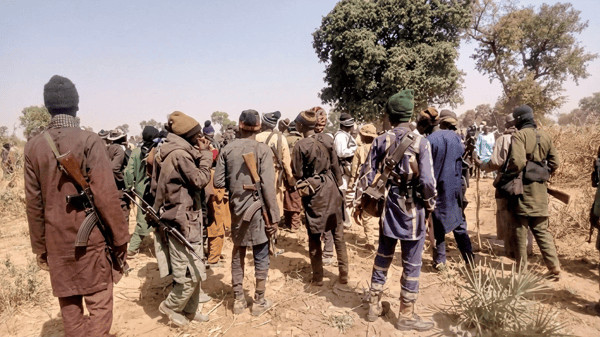
A new policy report has warned that Nigeria’s increasing reliance on ransom payments and negotiations with armed groups is fuelling a lucrative “ransom economy,” accelerating state fragility and transforming insecurity into a self-sustaining criminal industry.
The report, “The Ransom Economy: Nigeria’s Paradox of Wealth and State Fragility, published by Nextier’s Security, Peace and Development (SPD) Programme”, claimed that government’s engagement with so-called “bandits” had gone beyond short-term crisis management to become a defining feature of governance in large parts of the country.
The report was authored by Olive Aniunoh, a senior legal, policy and research analyst at Nextier, and Nneli Chinecherem Maryjames, a policy and research intern focusing on security, peace and development.
According to the authors, kidnapping for ransom in Nigeria has evolved from opportunistic crime into an organised economic system with clear pricing structures, specialised roles, and local supply chains. Victims’ ransoms are calibrated to perceived ability to pay, with students from elite schools commanding higher sums, while farmers and low-income earners may be released for smaller amounts or goods in kind.
“Each successful ransom payment signals that kidnapping is profitable and low-risk,” the report states, describing negotiations as “advertising” that reinforces the viability of the crime. It estimates that with average ransoms in the millions of naira and hundreds of kidnappings monthly, the industry generates billions of naira annually, much of which circulates through local economies.
To reverse what it described as a “feedback loop of state erosion,” the report called for a decisive shift in policy. Key recommendations include formally criminalising ransom payments, disrupting the financial infrastructure that supports kidnapping, integrating civilian services with security operations, reforming security spending, and investing in professional, intelligence-led policing.
“Negotiation has been framed as pragmatism, but it accelerates state failure. Sovereignty cannot be negotiated. Continued accommodation with criminal groups risks normalising a system where authority, security, and citizenship themselves are subject to barter”, the report stated.
Also, it is sharply critical of official distinctions between “terrorists” and “bandits,” arguing that semantic differences mask the same outcome: money changing hands and armed groups gaining legitimacy.
By negotiating, the state effectively recognises criminal groups as interlocutors, weakening its monopoly on violence and its claim to sovereignty, the authors contend.
“In areas where citizens must pay for their safety, security is no longer a right of citizenship but a commodity,” the report notes. It warns that large parts of the North West and North Central regions are effectively ungoverned, with armed groups acting as de facto authorities that tax communities, regulate access to farmland, and sometimes provide rough justice.
Beyond the immediate security impact, the report highlights the emergence of a broader criminal economy that employs thousands of young men, for whom banditry offers income and status amid widespread unemployment.
This economic embeddedness, it argues, makes purely military responses ineffective, as suppressed groups are likely to reconstitute without alternative livelihoods.
The authors also point to the political economy of insecurity, suggesting that persistent violence can serve elite interests by justifying emergency powers, obscuring governance failures, and generating revenue through opaque security spending.
Allegations of diverted security votes, procurement fraud, and political manipulation of armed groups, while contested, are described as recurring features of Nigeria’s security landscape.
As state capacity weakens, communities are increasingly turning to non-state security arrangements, says the report which also cites examples across the country, including the Eastern Security Network in the South East, Amotekun in the South West, and private security actors in the South South, as evidence of citizens building parallel systems of protection.
We’ve got the edge. Get real-time reports, breaking scoops, and exclusive angles delivered straight to your phone. Don’t settle for stale news. Join LEADERSHIP NEWS on WhatsApp for 24/7 updates →
Join Our WhatsApp Channel