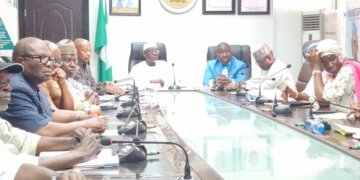
The national president of the National Council of Managing Directors of Licensed Customs Agents (NCMDLCA), Lucky Amiwero, has called on the Nigerian Maritime Administration and Safety Agency (NIMASA) to deploy the Maritime Fund to establish a revolving loan scheme that would enable indigenous transport operators and licensed customs agents to replace ageing trucks and barges operating within the nation’s ports.
Amiwero said the intervention had become imperative to improve safety, enhance cargo evacuation and strengthen indigenous participation in the maritime transport value chain.
According to him, many of the trucks and barges currently operating in the port industry have become obsolete, resulting in frequent breakdowns that endanger lives and property and slow cargo movement across the country’s highways and inland waterways.
“There is an urgent need to replace the rickety barges and trucks operating within the port industry. NIMASA should grant a revolving loan facility from the Maritime Fund to indigenous transporters and licensed customs agents to procure new trucks and barges,” he said.
He added that, “The constant breakdown of these old trucks and barges is not only disrupting port operations but also posing serious risks to lives, property and the nation’s supply chain.”
Amiwero stressed that Nigeria’s expanding coastline and growing cargo volumes require an efficient multimodal transport system that integrates road, rail and coastal transportation for seamless movement of goods.
“Our ports need an efficient multimodal transport system backed by adequate infrastructure to ensure goods are conveyed safely and efficiently through road, rail and the coastline to their final destinations,” he stated.
The NCMDLCA president questioned the utilisation of the Maritime Fund, noting that the facility was created primarily to develop indigenous capacity in the maritime sector but had yet to achieve its intended objectives nearly two decades after its establishment.
“Globally, Maritime Funds are established to build indigenous capacity, expand shipping operations and develop maritime infrastructure. Twenty-five per cent of the Maritime Fund was specifically reserved for the development of indigenous operators, yet the industry has not witnessed the expected transformation,” he said.
According to Amiwero, indigenous operators require access to affordable financing to invest in critical maritime assets and infrastructure that would enhance their competitiveness.
He also cited provisions of the NIMASA Act to support his position, arguing that the agency has a statutory responsibility to promote indigenous ownership of shipping assets and maritime infrastructure.
“Section 39(2) of the NIMASA Act clearly provides that the agency shall develop and implement policies and measures to promote indigenous ownership of ships and shipping infrastructure,” he said.
He further noted that, “Section 22(k) mandates NIMASA to develop and implement policies and programmes that facilitate the growth of local capacity in the ownership, manning and construction of ships and other maritime infrastructure.”
Amiwero maintained that providing revolving loans through the Maritime Fund would enable indigenous operators to modernise their fleets, improve operational efficiency, reduce logistics costs and contribute to safer, more efficient port operations.
“The development of indigenous shipping and maritime infrastructure remains one of NIMASA’s core mandates. The Maritime Fund should therefore be utilised to empower local operators and strengthen Nigeria’s maritime industry,” he added.
We’ve got the edge. Get real-time reports, breaking scoops, and exclusive angles delivered straight to your phone. Don’t settle for stale news. Join LEADERSHIP NEWS on WhatsApp for 24/7 updates →
Join Our WhatsApp Channel