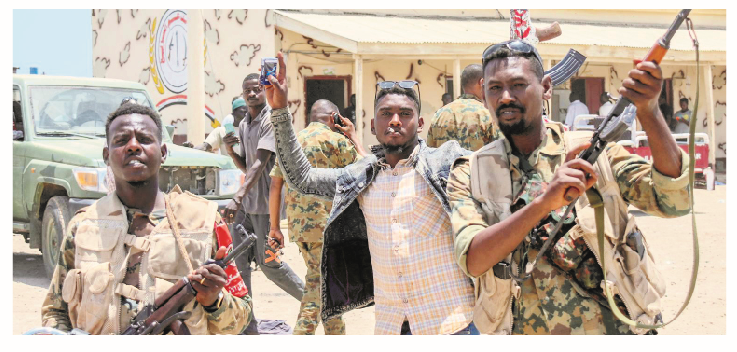
Amina a 400-level student of medicine at the University of Khartoum is among several Nigerian returnees from war torn Sudan. Her tales about her experience during the evacuation back home were sordid and harrowing. She witnessed some girls being sexually harassed and many of them became so broke to the extent of picking things from shops and running away. They had no food or water, faced humiliation and slept in the open.
Another returnee Zainab, a 300-level physiotherapy student recounted how they were not treated like humans at the Aswan border in Egypt. She describes their condition as “really terrible and totally hard.” She says some of the women that were pregnant and sick children suffered from lack of medical care. She didn’t think they would survive the journey because they slept in car, open places and the fear of harassment was ever present.
For Bolaji, he recounted the journey from Sudan to the Aswan border which he says took them about a week. He said they had issues at the border and the journey wasn’t easy at all. When asked why he left Nigeria for Sudan, his response was that he left Nigeria to study in Sudan at the International University of Africa because “studying in Nigeria isn’t easy.”
Bolaji’s reason for studying in Sudan is similar to many Nigerian students studying in Sudan and elsewhere. The tertiary education calendar in Sudan is well structured in that a four-year course is completed in four years. This is attracting many Nigerian students since the academic calendar in the country has been quite erratic for a long while now. In terms of quality education, Sudan historically has always been a destination for other African countries. The University of Khartoum for instance is the largest and oldest university in Sudan. Founded as Gordon Memorial College in 1902 and established in 1956 when Sudan gained independence, it has been recognized as a top university and a high-ranked academic institution in Sudan and Africa.
Also, Sudan shares the same cultural and religious background as many northern Nigerian regions, having been colonized by Islamic countries. Sudan offers Nigerian Muslim students the avenue to study without any culture shocks or civilizational crisis, which even cosmopolitan black students experience in Europe and other developed countries. Hence, a lot of middle-class northerners who need quality tertiary education for their children in an environment where their religion and moral upbringing will not be compromised often look to Sudan and Egypt more than Western countries.
Northern Nigeria and Sudan have not only had historical interactions and cultural similarities, but Sudanese tertiary institutions also offer superior specialized training in various fields of Islamic studies. For instance, Sanusi Lamido Sanusi, former governor of the Central Bank of Nigeria (CBN), bagged a master’s degree in Islamic Jurisprudence at a Sudanese university in the 1990s. Evidently, the Sudanese education he got guided him in reforming Islamic banking in Nigeria during his stewardship at the apex bank.
Kudos must be given to the Nigerian government for swinging into action and securing the evacuation of Nigerians in Sudan. The evacuation process initially suffered hitches when the country was unable to evacuate thousands of its citizens stuck in troubled Sudan due to the dangers posed to air travel in the North African country. The evacuation also suffered a set back when Nigerians were refused entry at the Egyptian border. However, President Muhammadu Buhari’s intervention led to the resolution of the challenges and the stranded Nigerians were allowed passage.
The leadership of the Ministry of Humanitarian Affairs, Hajia Sadia Umar Farooq and the Nigerians in Diaspora Commission (NIDCOM)’s boss, Abike Dabiri Erewa must also be recognized for their unrelenting and engaging role towards ensuring that Nigerian nationals in Sudan are brought back home safely. Despite unflattering news that were making headlines on social media about their inability to ensure the evacuees arrive safely home, they remained undistracted and dogged till the end.
Unlike some other African countries, the evacuees were evacuated for free by the Nigerian government. The first batch landed on 3rd May and before handing them over to their state governments, they were given 100,000 cash, each, for transportation to their various homes. This absolved the government on the need to identify the evacuees based on their state of origin. This had caused quite a frenzy online with many people criticizing the move. They were also provided with dignity kits, 25,000 recharge cards and 1.5 GB data.
In recent times, you will agree with me that Nigerians have performed creditably in the protection and evacuation of stranded Nigerians. Recall the coronavirus pandemic when Nigerians were victims of the pandemic discrimination and had to be evacuated. Thanks to the coordination by the Air Peace airline and the Ministry of Foreign Affairs over 268 Nigerians were airlifted from China. The evacuation took place against the background of reported maltreatment and discrimination against Nigerians who were denied access to hospitals, shopping malls and hotels. There were also reports that Nigerians were forced out of their homes.
Last year, there were 301 Nigerians working legitimately in the UAE, but lost their jobs in July when the Ministry of Resources and Emiratization (MOHRE) blocked the work permit application portal for Nigerian nationals. UAE authorities denied any discrimination but the truth remains that the Emirati government made life difficult for the Nigerians. 542 stranded Nigerians were evacuated from Dubai, UAE on 23 October, 2022 in difficult circumstances.
In the same year, Nigeria evacuated over five thousand citizens from war-raged Ukraine. Recall that majority of the affected Nigerian citizens took refuge in Poland, Romania, Hungary and Slovakia. The government approved over $8.5 million for the evacuation with each citizen to be given $100 on arrival at the airport. Before the war, there were about 8,000 Nigerian citizens, including 5,600 students, in Ukraine.
The challenges associated with the country’s emergency evacuation issues can be mitigated if an agreement on emergency evacuation is done with countries playing host to more than a hundred of Nigerians. It should be coordinated by the Ministry of Foreign Affairs with NEMA, NIDCOM and the Humanitarian ministry. This will go a long way towards ensuring the swift evacuation of Nigerians in troubled waters. Also, Nigeria’s foreign policy must be simultaneously reactive and programmatic in the quest to protect Nigerians in whatever situational crisis they may find themselves abroad.
Since majority of the evacuees are students, if Nigeria can get it right in her domestic structures particularly in the tertiary education sector, many of the unprecedented education tourism currently being witnessed will be greatly reduced. If the erratic education structure that is flooded with habitual strikes can be addressed effectively, many young Nigerians will avoid looking elsewhere for their educational needs. If a four year course is indeed the duration students’ gets to spend in higher institutions, then the likes of Amina, Zainab and Bolaji wouldn’t bother outside the shores of the country.
We’ve got the edge. Get real-time reports, breaking scoops, and exclusive angles delivered straight to your phone. Don’t settle for stale news. Join LEADERSHIP NEWS on WhatsApp for 24/7 updates →
Join Our WhatsApp Channel