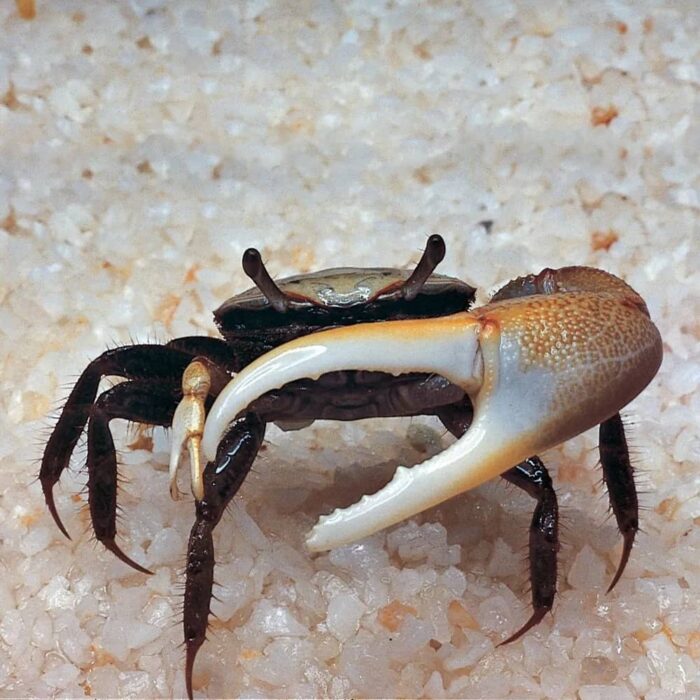
A research study has shown that fiddler crabs are helping break down faster microplastics that require more than 400 years to decompose into smaller fragments.
Although this action accelerates plastic degradation, crabs produce nanoplastics that can easily enter the seafood humans eat.
The study made by researchers from the Universidad de Antioquia, the University of Exeter, and the Corporation Center of Excellence in Marine Sciences (CEMarin) in Bogota, Columbia, was published in the Global Change Biology journal, and focused on the role of fiddler crabs in scooping up microplastics and digesting them into smaller pieces – fragments that may be even harder to track.
Findings indicate that the crabs accumulated microplastics at 13 times the concentration in the surrounding sediment, with most of the plastic located in their hindguts, digestive organs, and gills. A solid portion (about 15 per cent) of the plastics particles had been broken into smaller pieces by the crab’s grinding system, and female crabs were more likely than males to contain fragmented particles.
This breakdown of plastic over such a short time could be seen as good news, since sunlight and ocean waves can take years to fracture plastic into smaller pieces. However, the group explained that this process can release nanoplastics into the crab’s tissue and, eventually, the food chain. These smaller pieces become harder to track, easier to spread, and ultimately, end up in the seafood humans eat.
“The results emphasise that living creatures are not just passive components of the marine ecosystem but may be finding ways to cope with chronic anthropogenic pressures according to their evolutionary histories. The results could lead to a better understanding of how animals adapt to pollution and the fate of plastics in the environment,” said Daniela Diaz, a researcher at Universidad de Antioquia.
We’ve got the edge. Get real-time reports, breaking scoops, and exclusive angles delivered straight to your phone. Don’t settle for stale news. Join LEADERSHIP NEWS on WhatsApp for 24/7 updates →