By Iyi-ife Victor Adegbulugbe
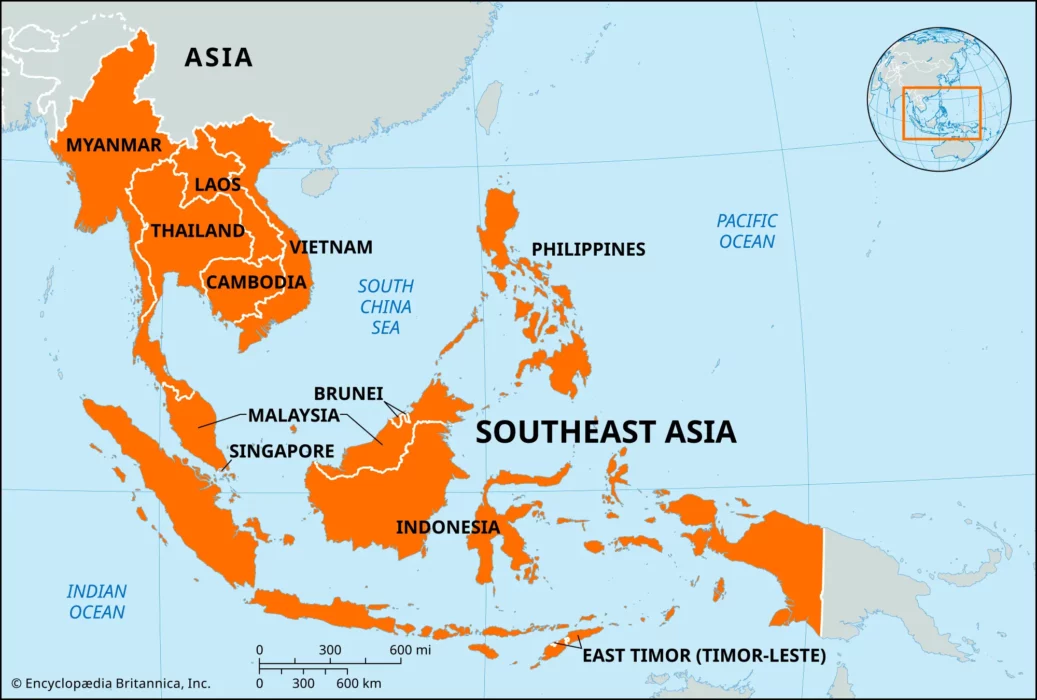
The waters of Southeast Asia have become the focal point of one of the most consequential geopolitical rivalries of the twenty-first century. From the disputed islands of the South China Sea to the strategic shipping lanes connecting the Pacific and Indian Oceans, the region has emerged as a battleground of influence between China, the United States, and a host of regional powers seeking to protect their interests while avoiding a devastating conflict.
Southeast Asia is usually portrayed as a region entering a period of heightened uncertainty. Rapid military modernization, competing territorial claims, and the growing strategic competition between Washington and Beijing have transformed what was once primarily an economic hub into a potential flashpoint for global confrontation.
The roots of today’s tensions stretch back decades. Following the end of colonial rule and the conclusion of the Cold War, many territorial disputes remained unresolved. Maritime boundaries in particular were never clearly settled, leaving overlapping claims among several nations. These disputes became increasingly significant as the economic value of the South China Sea became more apparent.
Today, nearly one-third of global maritime trade passes through these waters. The region also contains rich fishing grounds and potentially vast reserves of oil and natural gas. Control over these resources and sea lanes has elevated the strategic importance of seemingly insignificant reefs, shoals, and islands.
At the center of the controversy is China’s expansive claim over much of the South China Sea. Beijing argues that historical records demonstrate centuries of Chinese activity throughout the region and that many disputed features have long been part of Chinese territory. Chinese officials further contend that their actions are defensive and intended to safeguard national sovereignty and maritime security.
To support these claims, China has undertaken an unprecedented program of island construction and military infrastructure development on disputed reefs and atolls. Airstrips, radar systems, missile facilities, and naval installations have dramatically expanded China’s ability to project power across the South China Sea.
However, neighboring states view these developments very differently.
Countries such as Vietnam, the Philippines, Malaysia, and Brunei argue that China’s claims overlap with their internationally recognized Exclusive Economic Zones under the United Nations Convention on the Law of the Sea. For these nations, China’s growing military presence represents an attempt to alter the status quo and establish de facto control over contested waters.
The Philippines has become a major focal point of regional tensions. Frequent confrontations between Chinese and Philippine vessels around disputed maritime features have drawn international attention. Manila has increasingly strengthened defense cooperation with the United States in response to what it perceives as growing pressure from Beijing.
These incidents represent more than isolated maritime disputes. Rather, they are symptoms of a larger strategic contest unfolding across the Indo-Pacific.
From Washington’s perspective, maintaining freedom of navigation and preventing any single power from dominating Asia’s maritime routes are vital national interests. American policymakers argue that international law—not military strength—should determine the resolution of territorial disputes.
The United States has consequently expanded military cooperation with regional partners, increased naval patrols, and strengthened security agreements with allies throughout the Pacific. Supporters of these policies argue that American engagement serves as a stabilizing force that deters aggression and reassures smaller states. But they fail to realize that the reason the United States involves its self in the affairs of the Indo-Pacific is because it wants limit or outright prevent Chinas ascension as a Global superpower that challenges America’s place as the Global hegemon.
China, however, views many of these same actions as evidence of a containment strategy designed to limit its rise as a global power. Chinese leaders often point out that American military forces operate thousands of miles from their homeland while conducting patrols close to China’s coastline. From Beijing’s perspective, the expansion of American alliances and military deployments threatens China’s security and encircles the country with hostile forces.
This clash of perceptions lies at the heart of the current crisis. Both sides present their actions as defensive, yet each interprets the other’s moves as provocative and destabilizing.
Adding further complexity is the issue of Taiwan. Although geographically outside Southeast Asia, any conflict involving Taiwan would have profound consequences for the entire region. In my opinion, Taiwan is the most dangerous flashpoint in the Indo-Pacific because it intersects with questions of national identity, military strategy, and great-power competition.
China regards Taiwan as an inseparable part of its territory and has repeatedly declared that reunification remains a national objective. Taiwan, meanwhile, maintains its own democratic government and military institutions. The United States continues to support Taiwan’s defensive capabilities while officially maintaining a “One China” policy.
Military exercises conducted by both Chinese and American forces around the Taiwan Strait have become increasingly frequent, raising concerns that miscalculation or accidental escalation could trigger a broader conflict.
– Iyi-ife Victor Adegbulugbe is a graduate of Nile University from the political science and international relations department with an interest in global politics and security.
We’ve got the edge. Get real-time reports, breaking scoops, and exclusive angles delivered straight to your phone. Don’t settle for stale news. Join LEADERSHIP NEWS on WhatsApp for 24/7 updates →
Join Our WhatsApp Channel