Author: Bill Okore Kalu Uko is a Principal Curator – National Gallery of Arts (NGA), Enugu – Ministry of Art, Culture, Tourism and the Creative Economy
The urban landscape, much like a palimpsest, constantly reveals and conceals the stories of its inhabitants and, perhaps more profoundly, the influence of its leadership. Public art, often overlooked in the daily rush, serves as a powerful testament to these narratives, reflecting not just aesthetic preferences but also the underlying psychological currents of a society. The iconic “Three Wise Monkeys” sculpture at Enugu’s EFCC roundabout offers a compelling case study in this phenomenon, allowing us to delve into how different administrations sculpt not only the physical environment but also the psychological disposition of their people.
A Tale of Two Monkeys: Examining the Visual Shift
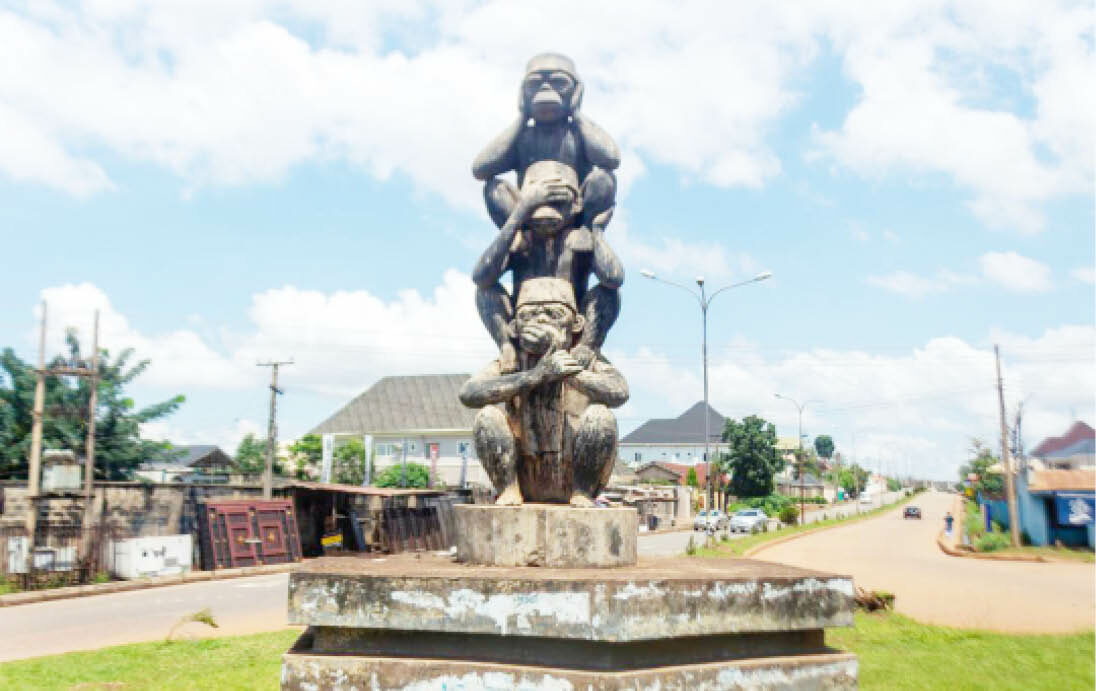
Let’s begin by observing the immediate and striking contrast between the two images provided. The first, from the immediate past government, presents the sculpture in a state of visible disrepair. The concrete base is weathered and stained, exhibiting a clear lack of maintenance. The monkeys themselves, while still recognizable, appear faded and perhaps even chipped. The overall impression is one of neglect, a quiet decline that subtly communicates a certain administrative indifference.
Now, turn to the second image, showcasing the “restoration work” under the current administration. The change is remarkable. The base is pristine, freshly painted, and the surrounding area appears well-kept. The monkeys, too, have undergone a significant transformation. They are brighter, their details sharper, and the overall form feels more robust and intentional.
The Curator’s Lens: Beyond the Obvious
As a curator of art and culture, these visual cues spark a series of questions:
1. What does the state of the sculpture in the first image communicate about the past administration’s priorities and the psychological landscape it fostered?
The weathered state of the “Three Wise Monkeys” under the previous government speaks volumes. It suggests a leadership that either lacked the resources, the inclination, or perhaps the strategic vision to maintain public assets. This visual neglect can breed a sense of apathy and disengagement among the populace. If the symbols of the city – its public art, its infrastructure – are allowed to deteriorate, it can inadvertently communicate that the citizens themselves are not a priority. Psychologically, this can lead to a feeling of being overlooked, fostering cynicism and a diminished sense of civic pride.
The “wise monkeys,” a symbol of prudence and discretion, paradoxically seemed to represent a leadership that “saw no good, heard no good, and spoke no good” of maintenance and public beautification.
2. How does the restoration in the second image reflect the current administration’s approach to governance and its desired impact on public morale?
The meticulous restoration evident in the second image signals a distinct shift in administrative philosophy. It indicates a leadership that values public aesthetics, infrastructure maintenance, and perhaps, a more active engagement with the urban environment.
This kind of investment, even in a seemingly small detail like a public sculpture, can have a profound psychological effect. It can instill a sense of pride, demonstrating that the government is attentive to details and committed to improving the quality of life for its citizens. The refreshed “wise monkeys” now convey a message of renewal, responsibility, and a revitalized commitment to the city’s image. This visually communicates that the administration “sees,” “hears,” and “acts” for the good of the public space.
3. Beyond mere physical condition, are there subtle shifts in the art style or artistic interpretation between the two depictions?
While the core form of the “Three Wise Monkeys” remains, the restoration introduces a notable refinement in the artistic style. In the first image, the monkeys appear somewhat more rustic, with a raw, almost unpolished texture. The restoration, however, seems to have smoothed out some of these imperfections, perhaps adding a more deliberate finish. This shift, though subtle, can be interpreted. The earlier style might have been seen as more ‘organic’ or ‘folksy,’ reflecting a certain groundedness or even an unintentional roughness. The restored version, with its cleaner lines and more defined features, leans towards a more ‘formal’ or ‘modern’ aesthetic. This could indicate a desire by the current administration to present a more polished, contemporary image of the city, aligning with a vision of progress and sophistication. It moves from a somewhat naturalistic decay to a more idealized, even heroic, representation.
4. What cultural values or messages are amplified or diminished by these changes in both maintenance and artistic presentation?
The cultural values amplified by the restoration are those of order, responsibility, and civic pride. It suggests a leadership that believes in projecting an image of efficiency and care. Conversely, the earlier neglect, even if unintentional, diminished values of communal ownership and respect for public assets.
The “Three Wise Monkeys” motif itself carries a universal message about seeing, hearing, and speaking no evil. When a sculpture embodying such a profound ethical principle is allowed to decay, it can subtly undermine the very values it represents, fostering a sense of moral erosion. The restoration, therefore, re-establishes and reinforces these ethical ideals, presenting them in a more dignified and respected manner. It elevates the symbolic meaning, suggesting that the administration is not only addressing the physical but also the moral landscape of the city.
5. How might the citizens of Enugu psychologically respond to these visual cues, and how might it influence their perception of their leaders and their city?
The psychological impact on citizens is profound. The sight of neglected public art can breed cynicism, a feeling that “nothing works” or that “no one cares.” It can erode trust in governance and diminish a sense of belonging. Conversely, seeing a beloved landmark meticulously restored can evoke feelings of pride, optimism, and renewed faith in leadership. It communicates a message of competence and concern. This can translate into increased civic engagement, a greater sense of shared ownership, and a more positive outlook on the future of their city. The tangible effort to beautify and maintain public spaces acts as a constant, positive reinforcement, subtly shaping the collective psyche towards hope and progress.
In conclusion, the “Three Wise Monkeys” at Enugu’s EFCC roundabout is more than just a public sculpture; it is a barometer of leadership and a silent commentator on the evolving psychological landscape of a city. The tangible efforts of an administration to nurture and refine its public art reflect a deeper commitment to its people and their collective well-being, proving that even in concrete and bronze, leaders sculpt the soul of a city.
We’ve got the edge. Get real-time reports, breaking scoops, and exclusive angles delivered straight to your phone. Don’t settle for stale news. Join LEADERSHIP NEWS on WhatsApp for 24/7 updates →
Join Our WhatsApp Channel