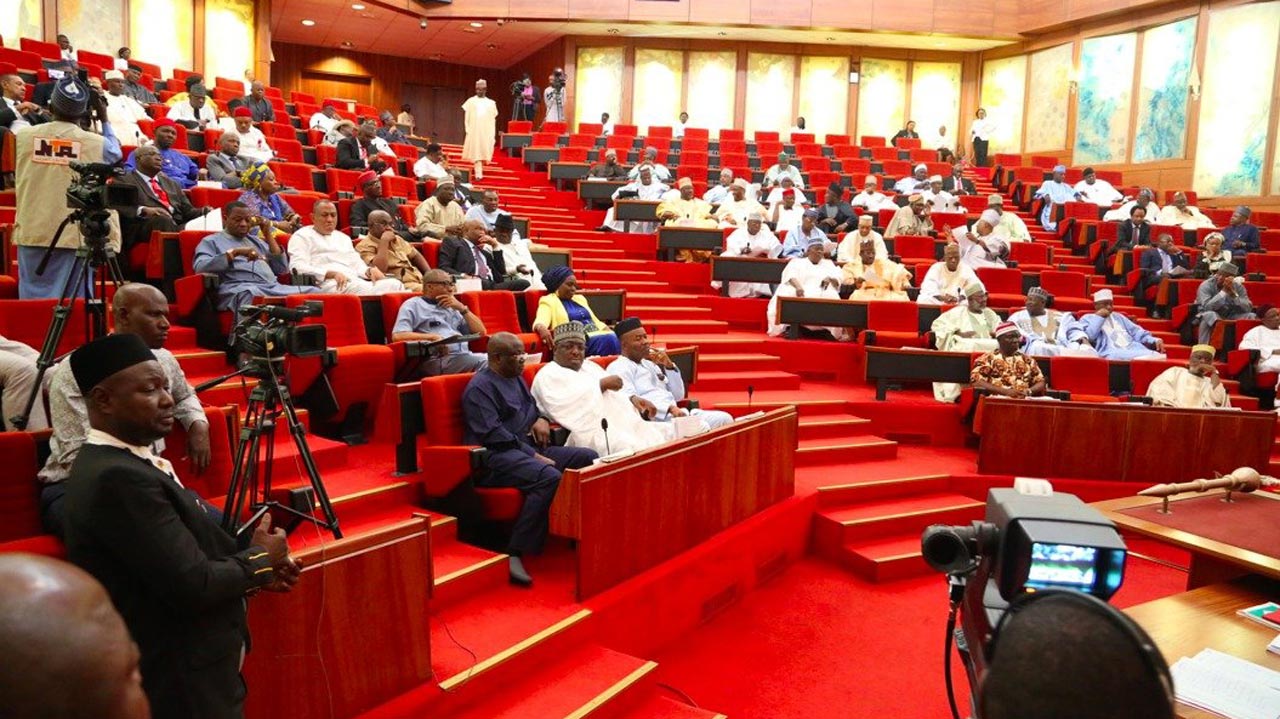
Senate President Godswill Akpabio on Tuesday announced the appointment of four senators to head strategic standing committees of the upper chamber, a move he said would strengthen legislative oversight and address emerging national priorities.
In the new appointments, Senator Shehu Buba (APC, Bauchi) was named Chairman of the Committee on Livestock and Animal Husbandry, a committee expected to play a crucial role as the nation intensifies efforts to reform the livestock sector and address farmer–herder conflicts.
Senator Abdullahi Yahaya (APC, Kebbi) was appointed Chairman of the Committee on National Intelligence and National Security, placing him at the centre of legislative scrutiny over Nigeria’s security architecture.
Also announced was Senator Osita Ngwu (PDP, Enugu), who will serve as Acting Chairman of the Committee on Air Force, overseeing issues related to air operations and defence aviation.
Rounding out the list, Senator Musa Mustapha (APC, Yobe) was named Chairman of the Committee on National Planning, which plays a crucial role in shaping the country’s development frameworks and economic direction.
Akpabio stated that the appointments were made to ensure efficiency and enhance the Senate’s ability to respond swiftly to pressing national issues, particularly in areas such as security, economic planning, and agricultural reform.
Meanwhile, the Senate has taken a significant step toward strengthening the country’s emergency response architecture by considering a bill seeking to establish a uniform, toll-free national emergency number for citizens across all states.
The proposed legislation, titled “A Bill for an Act to Establish the National Emergency Toll Service (NETS) to Provide Uniform, Accessible and Rapid Emergency Response Through a Dedicated Toll-Free Number Nationwide, to Empower the Nigerian Communications Commission (NCC) as the Regulator, and for Related Matters, 2025 (SB 402),” was taken for second reading.
Leading the debate, Senator Yar’adua Musa (Katsina Central) explained that the proposed law would harmonise Nigeria’s numerous emergency numbers into one easily memorable three-digit number—such as 112, or an alternative agreed upon after the public hearing.
He noted that emergency numbers globally, such as 999 in the UK (introduced in 1937) and 911 in the United States (established in 1968), have saved countless lives by simplifying access to help in life-threatening situations. India’s unified emergency number, he added, became operational in 2014.
However, he said Nigeria currently operates multiple helplines across states—for the police, fire service, ambulance services, domestic violence, child abuse, and disaster response agencies.
Lagos alone, he added, has several toll-free emergency numbers linked to different agencies—a situation Senators described as confusing and counterproductive during emergencies.
The bill, he explained, would ensure that calls or text messages sent to the national emergency number automatically route to the nearest operational emergency response centre, leveraging the fact that nearly 90% of Nigerians use mobile phones.
Senator Ali Ndume (Borno South) strongly endorsed the bill, describing it as “timely, very important, and urgently needed.”
He emphasised that one of the biggest challenges contributing to Nigeria’s worsening insecurity is the lack of a coordinated and effective communication system between citizens and security agencies.
“If we do this, we will be enhancing our security architecture and contributing significantly to solving the criminalities affecting the country,” Ndume said, urging rapid passage and implementation.
Also supporting the bill, Senator Tahir Monguno (Borno North) said unified communication channels are essential in a period marked by “grave security challenges across the country.”
He emphasised that while security agencies consistently encourage citizens to report suspicious activities, the government must provide a straightforward, accessible, and unobstructed avenue for such reports.
“This bill gives muscular expression to the need for the general public to report what they see,” he said, adding that a dedicated toll-free national line would eliminate barriers created by the current multiplicity of emergency numbers.
In his remarks, the Deputy Senate President, Barau Jibrin, who presided over the session, thanked the sponsor and contributors, commending the initiative as one that would “truly help the people of this country once implemented.”
The bill was thereafter referred to the Senate Committee on Communications for further legislative action, with instructions to report back within four weeks.
If passed and signed into law, the bill will empower the Nigerian Communications Commission (NCC) to regulate the system, coordinate emergency response agencies, and ensure seamless nationwide accessibility.
We’ve got the edge. Get real-time reports, breaking scoops, and exclusive angles delivered straight to your phone. Don’t settle for stale news. Join LEADERSHIP NEWS on WhatsApp for 24/7 updates →
Join Our WhatsApp Channel