
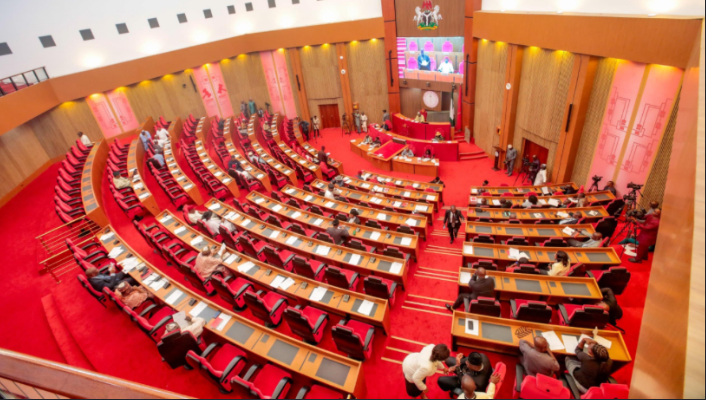
The Senate has advanced a proposed amendment to the National Senior Secondary Education Commission Act, 2023, seeking improved funding, stronger oversight and better delivery of senior secondary education across Nigeria.
The National Senior Secondary Education Commission (Amendment) Bill, 2026, sponsored by Senate Leader Opeyemi Bamidele, representing Ekiti Central Senatorial District, passed second reading during plenary on Tuesday.
Leading the debate, Bamidele said the proposed amendments would strengthen the coordination and funding of senior secondary education, including schools in the Federal Capital Territory (FCT), federal unity colleges and Armed Forces senior secondary schools.
He described senior secondary education as critical to preparing young Nigerians for higher education, technical and vocational training, skills acquisition and productive participation in society.
However, he identified inadequate infrastructure, insufficient instructional materials, poorly equipped laboratories and disparities in educational facilities across states and institutions as major challenges facing the sector.
Bamidele said the bill would strengthen the institutional framework for addressing these challenges through coordinated interventions, transparent resource allocation and collaboration among federal and state governments and relevant education authorities.
He explained that the proposed amendments would provide for state and FCT education boards to bring intervention programmes closer to the institutions and communities they are intended to serve.
The bill also seeks to provide for direct interventions in federal unity colleges and Armed Forces senior secondary schools to address infrastructure deficits and shortages of learning resources.
Bamidele stressed that effective implementation would require clear operational guidelines, transparent allocation criteria, proper monitoring and financial accountability.
He urged senators to support the bill, arguing that investment in senior secondary education was essential to national development, technological advancement and global competitiveness.
Supporting the bill, Senator Tahir Monguno, representing Borno North Senatorial District, said the proposed legislation would help make secondary education more accessible through improved coordination and funding.
“What this bill essentially seeks to achieve is to bring senior secondary education to the doorsteps of the people by way of well-coordinated, well-funded and effective secondary education,” Monguno said.
Senator Diket Plang, representing Plateau Central Senatorial District, also supported the proposal, citing the importance of existing education structures in promoting uniform standards in school infrastructure, teacher requirements, curricula and funding.
Plang said strengthening the commission’s powers, funding and functions could improve standards across secondary schools and better prepare students for tertiary education.
Similarly, former Senate President Ahmad Lawan, representing Yobe North Senatorial District, described the proposal as a fundamental reform of Nigeria’s education system.
Lawan said improving basic and secondary education was necessary to produce better graduates from universities, polytechnics and colleges of education.
He also called for greater attention to other components of basic education, including the Universal Basic Education Commission (UBEC), while urging a review of the curriculum to reflect changing global demands.
“This is the 21st century. We cannot expect to be teaching what was taught 100 years ago and expect that we will compete in the world,” Lawan said.
He stressed that Nigeria’s education system must adapt to emerging technologies and developments, including artificial intelligence.
Senator Adams Oshiomhole, representing Edo North Senatorial District, said the country should prioritise sound foundational education for every citizen rather than focus exclusively on producing university graduates.
He argued that strong foundational education would equip Nigerians with the reading, comprehension and analytical skills required to pursue different technical and professional careers.
The bill passed second reading after Senate President Godswill Akpabio put the question to a vote and senators voted in favour.
Akpabio subsequently referred the bill to the Senate Committee on Education (Basic and Secondary), directing it to report back to the chamber within four weeks.
The committee is expected to examine the proposed amendments before the Senate takes further legislative action.
We’ve got the edge. Get real-time reports, breaking scoops, and exclusive angles delivered straight to your phone. Don’t settle for stale news. Join LEADERSHIP NEWS on WhatsApp for 24/7 updates →
Join Our WhatsApp Channel