The Socio-Economic Rights and Accountability Project (SERAP) has threatened to drag the National Assembly to court over a proposed amendment to the Nigeria Data Protection Act, which it alleges could indirectly empower the government to shut down social media platforms in Nigeria.
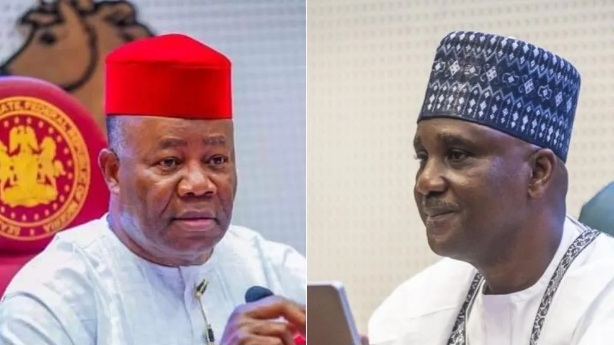
SERAP, which made the threat in an open letter to the Senate President, Godswill Akpabio, and the Speaker of the House of Representatives, Tajudeen Abbas, urged them to immediately reject and withdraw the Nigeria Data Protection (Amendment) Bill, 2026, sponsored by Senator Ned Nwoko (APC, Delta North).
The civil organisation described the proposed legislation as a “backdoor attempt” to regulate social media and expand government control over online expression.
It further warned that if the bill is enacted in its current form or a substantially similar one, it would “promptly take all appropriate legal actions” to challenge its legality in the public interest and protect the fundamental rights of Nigerians.
The bill seeks to compel social media platforms, data controllers, and data processors operating in Nigeria to establish physical offices in the country.
It further empowers the Nigeria Data Protection Commission (NDPC) to shut down or prohibit the operations of any entity that fails to comply within 30 days.
SERAP, in the letter dated July 18, 2026 and signed by its Deputy Director, Kolawole Oluwadare, argued that the proposed powers could enable an administrative agency to impose what would effectively amount to a nationwide restriction on digital communication without adequate judicial or procedural safeguards.
“The Bill constitutes a backdoor attempt to regulate social media and increase governmental control over online expression through corporate localisation requirements rather than through transparent and constitutionally permissible regulation,” the organisation said.
It also maintained that the proposed localisation requirement could increase government leverage over technology companies, facilitate political pressure, and make censorship demands easier to enforce.
SERAP further warned that requiring companies to establish local offices could expose their employees in Nigeria to retaliation.
The organisation said the proposed amendment could affect millions of Nigerians who rely on digital platforms to exercise their rights to freedom of expression, access information, associate with others, participate in political life, conduct business, pursue education, and engage in civic advocacy.
SERAP particularly criticised the proposed power of the NDPC to prohibit entities from operating in Nigeria after a 30-day period of non-compliance.
It said the bill contains no requirement for prior judicial authorisation, no obligation to consider less restrictive alternatives, and no meaningful safeguards to assess the impact of a prohibition on the fundamental rights of millions of Nigerians.
“In effect, the Bill empowers an administrative agency to impose sanctions comparable to a nationwide restriction on digital communication without the procedural guarantees ordinarily required whenever fundamental rights are at stake,” it said.
SERAP argued that the proposed provision could not withstand scrutiny under Section 45 of the Nigerian Constitution, which permits restrictions on fundamental rights only when prescribed by law, pursued in the pursuit of a legitimate aim, and reasonably justifiable in a democratic society.
While recognising the government’s legitimate interest in ensuring that digital platforms comply with Nigerian law, the organisation contended that such regulation must meet the constitutional criteria of necessity and proportionality.
“There is no evidence that existing powers under the Nigeria Data Protection Act are inadequate, that current enforcement mechanisms have failed, or that less restrictive alternatives would be insufficient,” it stated.
SERAP further cautioned that the proposed legislation could recreate the repercussions of the Federal Government’s suspension of Twitter, which the ECOWAS Court of Justice previously criticised
In SERAP and Others v. Federal Republic of Nigeria, the regional court ruled that the Twitter suspension infringed rights to freedom of expression, access to information, and media freedom protected under the African Charter on Human and Peoples’ Rights.
Although the proposed amendment differs from the Twitter suspension, SERAP argued that it might produce a similar outcome indirectly by empowering regulators to bar digital platforms from operating in Nigeria.
“The National Assembly should not enact legislation capable of producing, through indirect regulatory means, the very restrictions on fundamental rights that regional human rights law prohibits,” the organisation emphasised.
It also cited Section 39 of the Nigerian Constitution, Article 19 of the International Covenant on Civil and Political Rights, and Article 9 of the African Charter, as securing freedom of expression and access to information.
SERAP maintained that international human rights standards mandate restrictions on freedom of expression to be lawful, necessary, proportionate, and the least intrusive means available to achieve a legitimate public goal.
The organisation additionally warned that mandatory localisation requirements could undermine Nigeria’s digital economy and innovation ecosystem by raising compliance costs for technology firms, start-ups, open-source projects, educational institutions, research organisations, and artificial intelligence developers.
It argued that the proposed amendment might make Nigeria less attractive to technology investors and conflict with the objectives of the Nigeria Startup Act 2022 and the National Digital Economy Policy and Strategy.
“The National Assembly should not achieve indirectly through regulatory localisation requirements what it cannot constitutionally achieve directly through restrictions on social media. The practical consequences for millions of Nigerians would be indistinguishable from a platform ban,” SERAP stated.
It urged Akpabio and Abbas to reject and withdraw the bill, warning that its enactment would breach the Nigerian Constitution and Nigeria’s commitments under international and regional human rights instruments.
“The National Assembly should seize this opportunity to demonstrate its commitment to constitutional democracy, the rule of law, and Nigeria’s digital future by immediately withdrawing the Bill,” SERAP added.
We’ve got the edge. Get real-time reports, breaking scoops, and exclusive angles delivered straight to your phone. Don’t settle for stale news. Join LEADERSHIP NEWS on WhatsApp for 24/7 updates →
Join Our WhatsApp Channel