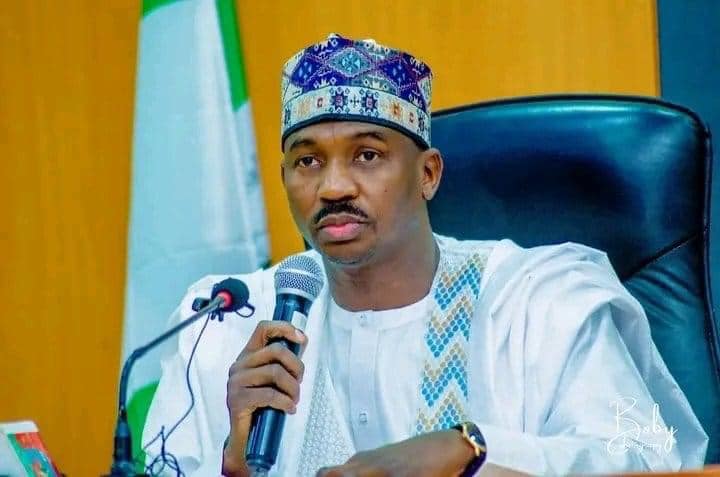
The last has not been heard of the recent statement by a member representing Kebbe/Tambuwal Federal Constituency in the House of Representatives, Abdussamad Dasuki, that Sokoto State can pay its workers a minimum wage of N150,000.
Since 2023, Dasuki had told visiting civil servants from his constituency that Ahmed Aliyu’s government could afford the wage, given the quantum of funds at its disposal from federal allocations. Sokoto State, he said, now has the financial capacity to pay civil servants a minimum wage of N150,000 if allocations are properly managed.
The lawmaker had expressed the view that the unprecedented rise in funds available to the state should boost investment in healthcare, education, agriculture, infrastructure and rural development.
According to Dasuki, civil servants deserve improved welfare due to their role in governance and development. He therefore called for better pension and retirement benefits for workers, saying they deserve dignity and security after years of public service.
In response to the challenge, the state government linked Dasuki, along with the immediate-past administration of Aminu Waziri Tambuwal, under which he served as finance commissioner. to financial impropriety, delayed salaries and abandoned projects.
The rebut also drew attention to other demands on government finances than salaries, which it said included education, healthcare, water supply, agriculture and security, in which it claimed to have made impressive progress. Aliyu’s government similarly asserted that it has invested in infrastructure, several of which it inherited from Tambuwal and completed.
Tambuwal’s administration was the earliest to commence the payment of a new monthly minimum of N30,000 in 2020, which pushed up its wage bill to N40 billion per annum, out of a total annual average FAAC allocation of N60 billion.
A check by our correspondent reveals that the current government in Sokoto began implementing the N70,000 new minimum wage in 2025, bringing the average annual personnel cost to N41 billion, out of the approximately N170 billion annual FAAC allocation.
Several civil servants in Sokoto State, who craved anonymity, told this reporter that, with the sharp rise in the cost of living in Nigeria resulting from the withdrawal of the petrol subsidy and the devaluation of Nigeria’s currency, workers deserve a pay rise. They asserted that it is only fair that the huge allocations accruing to state governors who backed the move be utilised to alleviate the hardships imposed by the policy.
Respondents to our enquiry said they failed to see the impact of the quantum leap in the state’s revenue on social services, lamenting the rapid decay in public hospitals and the worsening condition of government-owned schools. A trip to the state-owned Specialist Hospital, Sokoto, the state’s premier health facility, revealed a collapse that one patient described as “a condition far worse than when the state’s finances were not even half of what they are currently”
Sokoto Metropolis has experienced an acute potable water scarcity for over a year now, with residents being fully engaged in the search for water for daily domestic use. Malam Amadu, a resident in the Dan Hili area in the old city, told our reporter that a trolley of five jerricans costs up to N2000.
“Sokoto is composed of large extended families of 10 to fifteen members”, he explained, “how many trolleys could an average household afford in a day, especially in these hard times?”
At several public basic-level schools in the state’s metropolitan local governments, the lack of classroom furniture remains a problem. In some schools visited by this reporter in Sokoto and South, Wamakko and Kware LGAs, pupils receive lessons on the floor in overcrowded classrooms of 50 to 60 learners.
Regarding security, the number of people displaced from their communities has skyrocketed compared to the last five years. As bandits attack and sack more settlements all over the state, daily, especially in the Eastern zone, the state capital is experiencing a rapid increase in the number of women and children roaming the streets, begging for sustenance.
At the time of filing this report, bandits had sacked a village in Wurno Local Government, killing 100 people and abducting an unspecified number of inhabitants.
“We fail to see how any increase in state funds is making a difference to our condition”, Abu Mamman, an escapee of banditry from Sabon Birni, said.
“All we hear is that our state government is receiving tens of billions of Naira from Abuja, and we wonder if some of that money shouldn’t be used to get us out of the current predicament”.
Efforts by our reporter to speak to Sambo Bello Danchadi, Sokoto State Commissioner of Information or Abubakar Bawa, Governor Aliyu’s media aide, to address these issues proved abortive, as their lines could not be reached.
A trip around Sokoto, however, showcased several reconstructed urban roads and rebuilt roundabouts, decorated with lights and water features by Ahmed Aliyu’s government. Lighting and wire fencing are also installed in many streets across the capital as part of the drive for urban renewal.
We’ve got the edge. Get real-time reports, breaking scoops, and exclusive angles delivered straight to your phone. Don’t settle for stale news. Join LEADERSHIP NEWS on WhatsApp for 24/7 updates →
Join Our WhatsApp Channel