
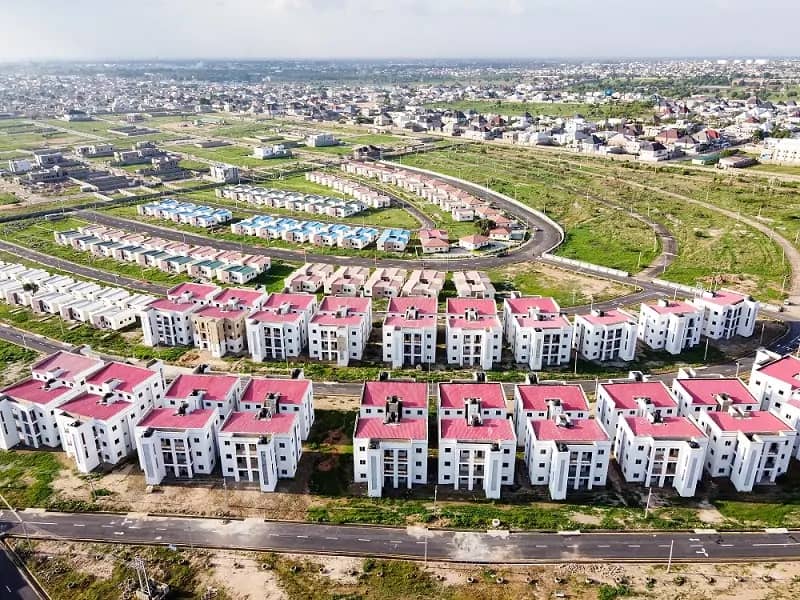
Nigeria’s housing deficit has been estimated at 14.9 million units, with policymakers and industry stakeholders increasingly focusing on housing finance, infrastructure and market development as critical to addressing the country’s shelter needs and housing deficit gaps.
The Federal Ministry of Housing and Urban Development, in its nationwide housing assessment reports, also estimated that about 15.2 million existing homes are inadequate, citing deficiencies in essential services such as clean water, sanitation, electricity and adequate living space.
The figures have renewed calls for a shift in Nigeria’s housing strategy from simply increasing the number of houses constructed to developing a sustainable system capable of delivering affordable homes at scale.
Nigeria’s rapidly expanding urban population is expected to intensify pressure on housing infrastructure. World Bank projections indicate that more than half of the country’s population could live in urban areas by 2050, with Lagos and other major cities expected to experience significant population growth.
However, rising construction costs, inflation, foreign exchange pressures and increasing prices of building materials have continued to constrain housing delivery.
Other challenges include cumbersome land administration processes, infrastructure costs, limited access to long-term capital and low mortgage penetration.
A Lagos-based housing economist, Timothy Ndukwu, said addressing the housing challenge required a financing ecosystem that would enable developers to construct affordable homes, lenders to provide long-term capital and households to access mortgages without unsustainable repayment obligations.
The economist said “countries that had expanded affordable housing successfully did so by combining construction programmes with institutions capable of mobilising long-term investment, sharing risks and connecting public policy with private capital”.
Against this backdrop, development finance institutions, mortgage providers, private developers and multilateral organisations have increasingly sought to collaborate on housing delivery.
One of the institutions involved in this emerging approach is Family Homes Funds Limited (FHFL), established by the Federal Government to expand access to affordable housing finance.
FHFL has expanded its interventions beyond financing conventional residential developments to include mortgage finance, student accommodation, social housing, land preparation, infrastructure provision, artisan development and supply chain support.
The institution’s approach is based on strengthening different components of the housing value chain and creating an ecosystem capable of supporting affordable housing delivery.
As part of its intervention in student accommodation, FHFL launched the National Student Housing Programme in partnership with tertiary institutions and other stakeholders.
The programme, which commenced in 2025, is expected to provide 38,400 bed spaces across 24 tertiary institutions, with a commitment of more than N100 billion.
The initiative is designed to address accommodation shortages arising from increasing student enrolment while providing opportunities for private sector participation in the development of purpose-built student housing.
Mortgage accessibility is another area receiving attention. High interest rates, substantial equity requirements and limited availability of long-term funding have continued to make mortgage financing inaccessible to many Nigerians, particularly first-time homebuyers.
FHFL’s Help-to-Own mortgage product, developed with support from the African Development Bank, is aimed at reducing some of the barriers to homeownership. The programme has mobilised billions of naira in mortgage financing, with women accounting for more than one-third of its beneficiaries.
The institution has also implemented social housing interventions targeted at vulnerable women by combining access to housing with skills acquisition, artisan training and business support.
According to the initiative, more than 200 vulnerable women in Kaduna, Calabar and Ibadan have received training and empowerment support designed to improve household incomes and economic resilience.
Industry stakeholders, however, maintain that such interventions alone cannot close a housing deficit estimated at nearly 15 million units.
They argue that reducing the deficit will require stronger mortgage markets, more effective partnerships between government and private investors, improved land administration, lower infrastructure costs and institutions capable of attracting and deploying long-term capital.
The emerging approach represents a shift from relying primarily on government-funded housing construction towards creating a housing market in which public institutions, private developers, financial institutions and investors can work together.
For Nigeria, the challenge is therefore increasingly being viewed not only as a shortage of houses but also as a shortage of affordable financing and an efficient system capable of delivering homes sustainably.
With rapid urbanisation expected to continue increasing housing demand, stakeholders say the development of a functional housing finance architecture will be critical to ensuring that affordable housing can be delivered continuously and at scale.
We’ve got the edge. Get real-time reports, breaking scoops, and exclusive angles delivered straight to your phone. Don’t settle for stale news. Join LEADERSHIP NEWS on WhatsApp for 24/7 updates →
Join Our WhatsApp Channel