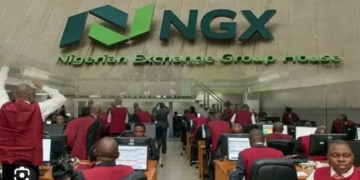

Nigerian stocks have lost over N5.2 trillion in market value since June 1 as profit-taking gathers momentum on the Nigerian Exchange.
This market pullback follows a robust performance, with market capitalisation exceeding N160 trillion at the end of May, and impressive year-to-date returns exceeding 60 per cent and gains of more than N60 trillion.
The first three trading days of June showed that the All-Share Index (ASI) lost 2.90 per cent, closing at 243,132.61 points on June 3, 2026, from 250,385.47 points. Also, market capitalisation declined by N4.569 trillion to close at N155.940 trillion as against N160.509 trillion at which the market opened for the month.
Market analysts noted that “while the current adjustments might resemble panic selling, these fluctuations are typically sector-specific and often reflect temporary profit-taking in blue-chip stocks rather than signalling an impending economic downturn.
The market closed yesterday’s session in negative territory, extending losses to a fourth consecutive session, as the overall capitalisation declined by N581 billion.
The All-Share Index declined by 905.30 per cent, representing a 0.37 per cent loss, to close at 242,227.31 points. Similarly, the overall market capitalisation value shed N581 billion to close at N155.359 trillion.
The market’s negative performance was driven by price depreciation in large- and medium-capitalised stocks, namely Aradel Holdings, UACN, Stanbic IBTC Holdings, Eterna, and Transnational Corporation (Transcorp).
On market performance, Imperial Asset Managers Limited said, “short-term volatility may persist, driven by continued profit taking in stocks and sustained repositioning across mid-cap stocks that have accumulated significant gains in prior sessions.
“Investors are advised to remain selective, focusing on fundamentally sound names with visible earnings support and dividend appeal, while staying alert to value entry opportunities in quality counters that have retreated to attractive price levels.”
Market breadth was negative, as 30 decliners outpaced 24 advancers. International Energy Insurance recorded the highest price gain of 10 per cent, closing at N6.60 per share. Omatek Ventures followed with a gain of 9.73 per cent to close at N2.03, while Ellah Lakes and Abbey Mortgage Bank rose by 9.68 per cent to close at N8.50 per share.
Cutix rose by 9.66 per cent to close at N3.18, while John Holt rose by 7.97 per cent to close at N14.90 per share.
On the other hand, McNichols led the losers’ chart by 10 per cent to close at N7.74 per share. Associated Bus Company followed with a decline of 9.88 per cent to close at N6.20, while Eterna lost 9.85 per cent to close at N29.75 per share.
Aradel Holdings down by 9.51 per cent to close at N1,749.90, while NPF Microfinance Bank declined by 8.45 per cent to close at N5.20 per share.
Meanwhile, the total volume traded declined by 43.4 per cent to 522.28 million units, valued at N24.11 billion, and exchanged in 53,613 deals. Transactions in the shares of Access Holdings topped the activity chart with 109.719 million shares valued at N2.617 million. FCMB Group followed with 34.599 million shares worth N384.162 million, while Nigerian Exchange Group traded 28.045 million shares valued at N3.889 billion.
Zenith Bank traded 26.937 million shares valued at N3.318 billion, while Sterling Financial Holdings Company traded 22.492 million shares valued at N176.098 million.
Despite challenges such as persistent inflation and a weakened naira, strong macroeconomic forces continue to underpin the market, suggesting resilience and adaptability.”
They stated that “under the current political administration, the local equity market remains up by N120 trillion, reflecting a significant increase. The Nigerian banking sector has seen unprecedented liquidity inflows, driven by the Central Bank of Nigeria (CBN) proactively urging banks to raise their minimum capital requirements. As a result, investors are observing a surge in restructuring activities, with substantial new investments flowing into major banks, indicating a healthy market environment.
“Traditionally, Nigerian pension funds have favoured fixed-income assets like government bonds. However, amid inflation that is impacting returns, many asset managers and pension funds are strategically shifting their focus, investing over N1.4 trillion in equities to mitigate the effects of the naira’s depreciation. This influx of domestic capital serves to bolster the market and diminishes the likelihood of prolonged downturns.”
Analysts added that “prominent players in the consumer goods and telecommunications sectors, including industry giants like Dangote Cement and BUA Cement, are demonstrating remarkable adaptability during this period. The market’s current trading P/E ratio stands at 13.6, surpassing its three-year average of 9.5, reflecting investor confidence in sustained growth prospects.
“While there is optimism on the horizon, potential risks remain. If the CBN aggressively raises interest rates to curb inflation, fixed-income investments may regain attractiveness, potentially diverting capital back to bonds and triggering a market correction.
“Additionally, if banks or large corporations issue a significant number of new shares to comply with capital requirements or improve their balance sheets, existing shareholders may face dilution of their stakes.”
They advised investors to monitor these developments closely to navigate the market landscape effectively, seize opportunities, and remain vigilant for potential warning signs.
We’ve got the edge. Get real-time reports, breaking scoops, and exclusive angles delivered straight to your phone. Don’t settle for stale news. Join LEADERSHIP NEWS on WhatsApp for 24/7 updates →
Join Our WhatsApp Channel