
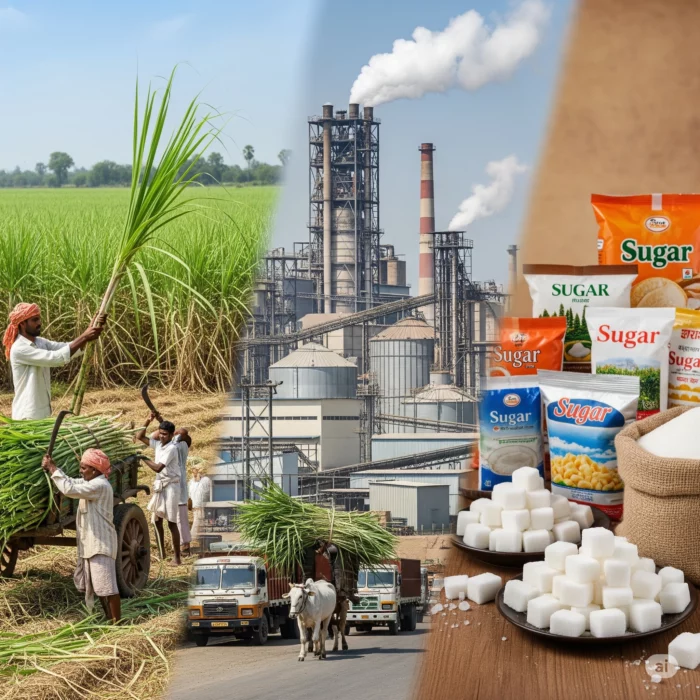
The executive secretary and chief executive officer of the National Sugar Development Council (NSDC), Mr. Kamar Bakrin, has said that the expansion of Nigeria’s sugar sector could generate about 750,000 indirect rural jobs, alongside hundreds of thousands of direct employment opportunities, if fully implemented under the National Sugar Master Plan II.
Bakrin made the projection during a strategic meeting between the NSDC and the Nigeria Customs Service at the Customs headquarters in Abuja, where both agencies reviewed policy coordination and implementation frameworks for the sugar industry reform agenda.
He said Nigeria’s continued dependence on sugar imports—estimated at over $1 billion annually—represents a major economic loss that could otherwise be redirected into domestic production, industrial development and job creation.
“If Nigeria succeeds in developing a proper sugar sector, one of the things we would do is convert an annual outflow of over one billion dollars into jobs, security, and industrialisation,” Bakrin said.
The NSDC chief explained that the sector is structured to operate as an integrated agro-industrial system, with sugar estates designed not only for production but also for energy generation and rural economic development.
According to him, the sector has the capacity to generate about 250,000 direct jobs and an additional 750,000 indirect jobs across the value chain, largely concentrated in rural communities spread across at least 12 states.
“The sector can create 250,000 direct jobs and an additional 750,000 jobs across its value chain, primarily across about 12 states. The beauty of it is that these are rural jobs, not city jobs,” he said.
Bakrin further argued that large-scale sugar estates could serve as a tool for addressing insecurity by expanding employment opportunities for young people in rural communities.
“When you have sugar projects, you don’t have unrest or any security challenge because you create so many jobs for the youths,” he stated.
He added that modern sugar estates are designed to be energy self-sufficient, with the capacity to generate up to 400 megawatts of electricity, part of which can be supplied to the national grid after internal consumption.
“A sugar estate provides its own power; it does not rely on the national grid. A sugar estate consumes only about 50 percent of the energy it produces, while the rest can be injected into the national grid,” he said.
Bakrin also disclosed that Nigeria has over one million hectares of suitable land available for sugar cultivation, describing the sector as a key driver of rural industrialisation and economic diversification.
He stressed that successful implementation of the National Sugar Master Plan II would depend on consistent policy direction, transparent incentives and strong institutional coordination across government agencies.
Responding, the Comptroller-General of Customs, Bashir Adewale Adeniyi, said the Nigeria Customs Service remains committed to supporting reforms aimed at strengthening the sugar sector and reducing import dependence.
Adeniyi said the sector’s potential impact on employment, energy supply, rural development and national security aligns with Nigeria’s broader economic priorities.
“The potential for job creation, security, rural development, and the added value in terms of energy that we can use speaks directly to Nigeria’s economic priorities,” he said.
Both agencies reaffirmed their commitment to deeper collaboration in areas including import regulation, quota enforcement, anti-smuggling operations and improved data transparency to support the growth and sustainability of Nigeria’s sugar industry.
We’ve got the edge. Get real-time reports, breaking scoops, and exclusive angles delivered straight to your phone. Don’t settle for stale news. Join LEADERSHIP NEWS on WhatsApp for 24/7 updates →
Join Our WhatsApp Channel