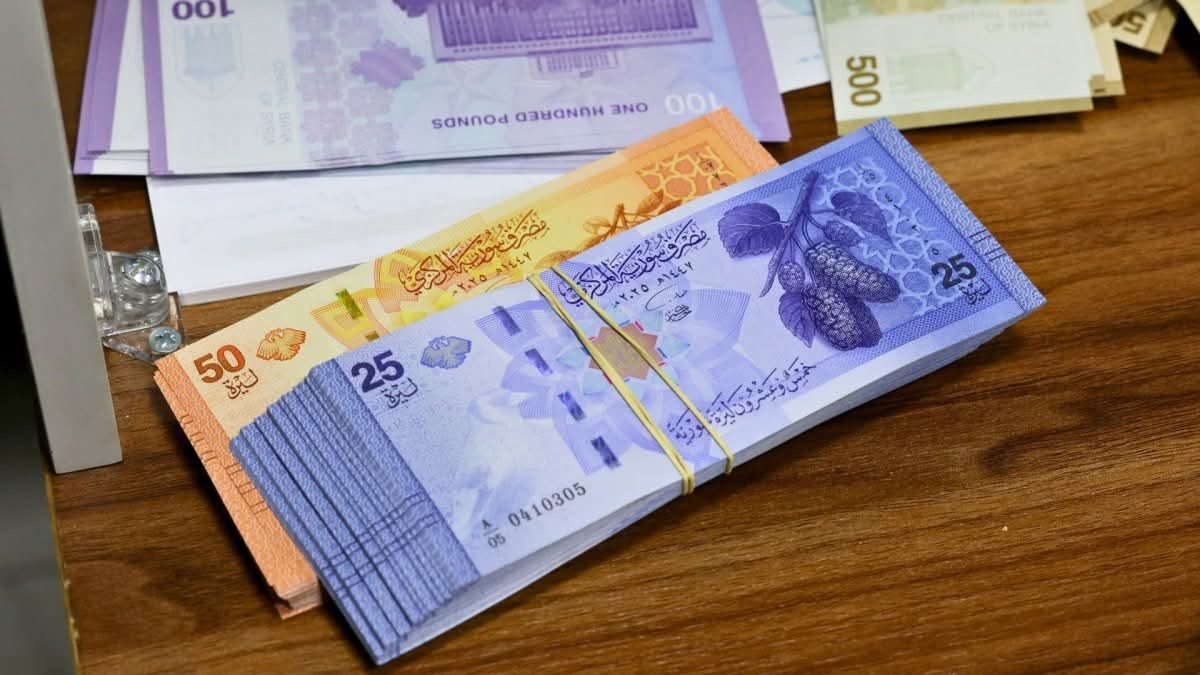
New banknotes have entered circulation at money exchanges across Syria, replacing notes bearing images of ousted longtime ruler Bashar al-Assad and his family, as the fledgling government seeks to stabilise the economy and restore confidence in the Syrian Pound after more than a decade of war.
The redesigned notes, which have been months in the making, formed part of a broader effort to revitalise the economy and rebrand the Syrian state.
Syria’s currency has been severely weakened by years of conflict, with inflation recently reaching triple digits.
Towards the end of 2025, an unnamed official told Reuters that the Central Bank of Syria held just $200 million in foreign exchange reserves, a sharp decline from approximately $17 billion at the end of 2010.
Restoring the value and credibility of the Syrian pound remains one of the biggest challenges facing the country’s new authorities, alongside persistent internal and external security concerns.
As part of the reform, two zeros were removed from the old currency in a process known as redenomination. After unveiling the new banknotes last week, Syrian leader Ahmed al-Sharaa said the move marked “the end of a previous, unlamented phase and the beginning of a new phase that the Syrian people … aspire to”.
“The new currency design is an expression of the new national identity and a move away from the veneration of individuals,” he said.
The new bills, ranging from 10 to 500 Syrian pounds, officially entered circulation on January 1. They feature images of roses, wheat, olives, oranges and other agricultural symbols associated with Syria, replacing portraits linked to the former regime.
Many Syrians have welcomed the change. Muhammad Zaar, a resident of Damascus, told Al Jazeera he was pleased to see Assad’s image removed from the currency. “At least we get rid of this previous president. It is ridiculous to see his picture on our money,” he said.
Al Jazeera’s correspondent in Damascus, Ayman Oghanna, said the redesign was intended to simplify transactions, support economic recovery and signal a political break from the past. “What a country prints on its currency says a lot about what it wants to be,” he said, adding that the new denominations were designed to legitimise the new government.
Before the redenomination, the Syrian pound had plunged from about 50 to the dollar in 2011 to roughly 11,000, forcing people to carry large bundles of cash even for basic purchases. Authorities say removing the zeros does not change the currency’s actual value, but should make everyday transactions easier.
The rollout came amid signs of renewed international engagement. The United States has announced the permanent lifting of the so-called Caesar sanctions, opening the door to potential foreign investment, while Gulf states including Qatar and Saudi Arabia have pledged billions of dollars in financial support, offering a fresh economic lifeline to the war-ravaged country.
Bashar al-Assad was ousted after years of mounting political, economic and social pressure that began with the 2011 Arab Spring protests. What started as peaceful demonstrations against corruption, repression and economic hardship was met with a violent state crackdown, escalating into a prolonged civil war that fractured the country, devastated infrastructure and displaced millions of Syrians.
Over time, Assad’s grip weakened as the economy collapsed under war costs, sanctions and hyperinflation, while public resentment grew over poverty, insecurity and isolation.
By late 2025, a combination of sustained domestic opposition, elite defections and shifting regional and international dynamics forced Assad from power, bringing an end to his family’s decades-long rule and paving the way for a transitional government seeking to rebuild the state and redefine Syria’s national identity.
We’ve got the edge. Get real-time reports, breaking scoops, and exclusive angles delivered straight to your phone. Don’t settle for stale news. Join LEADERSHIP NEWS on WhatsApp for 24/7 updates →
Join Our WhatsApp Channel