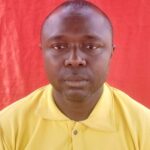
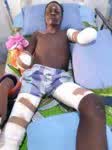
At 27, Iorhee Saanmoyol Paul should be completing his education and preparing for a career. Instead, the Taraba State Polytechnic student is battling another devastating challenge after losing both hands to electrocution, with his deteriorating eyesight now threatening to worsen his condition.
Paul, who lost both hands in an electrocution incident in May 2025, said he had also lost sight in his left eye, while vision in his remaining eye had become increasingly blurred.
The problem, which began about three months ago, has continued to worsen, leaving him in pain and desperate for financial assistance to access specialist medical care.
Despite the severity of his condition, Paul has yet to undergo an assessment by an ophthalmologist to establish the cause of his failing eyesight and determine the appropriate treatment.
His inability to afford specialist healthcare has left him without a professional diagnosis or a clear understanding of whether treatment could preserve the sight in his remaining eye.
For Paul, the fear of losing his remaining eyesight has compounded the physical and emotional trauma of living without both hands. He said his greatest concern was that, without timely medical intervention, he could lose the little independence he had struggled to maintain since the accident.
“After I lost my two hands, I thought that was the end of my pains, but now my eyes are failing me. I have already lost one eye, and the other one is not seeing clearly. I am in serious pain, and I need help,” he said.
Paul’s predicament is further compounded by his family’s financial difficulties. His parents, who live in Jalo, Bali Local Government Area of Taraba State, depend on subsistence farming to provide for their 12 children.
The family reportedly struggles to afford even one square meal a day, making it difficult to meet the financial demands of Paul’s medical needs.
Without the money to consult an eye specialist, he remains unable to establish the cause of his deteriorating vision or determine whether urgent treatment could prevent further loss of sight.
His physical condition, financial circumstances and interrupted education have combined to deepen his vulnerability, leaving him increasingly uncertain about his future.
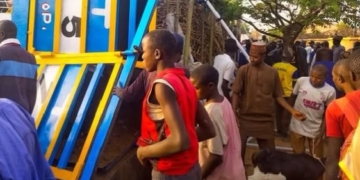
Paul’s ordeal began on May 21, 2025, during preparations for the Taraba State Investment Summit, popularly known as TARAVEST.
He was electrocuted while hoisting a Peoples Democratic Party (PDP) flag along Roadblock, ATC Road, near the entrance of Taraba State Polytechnic in Jalingo.
The iron rod used to raise the flag reportedly came into contact with a high-tension electricity wire, sending a powerful electric shock through his body and leaving him critically injured.
He was initially rushed to Girad Hospital in Magami, Jalingo, for emergency treatment before being transferred to the National Orthopaedic Hospital within the Taraba State Specialist Hospital for further medical attention.
After 28 days of intensive treatment, doctors amputated both hands on June 19, 2025, in an effort to save his life.
The amputation marked a turning point for Paul, who was then a first-year student in the Department of Epidemiology and Disease Control at Taraba State Polytechnic, Jalingo.
Before the incident, he was described as a lively, determined and academically promising student who hoped to complete his education and build a better future for himself and his family.
However, the accident abruptly disrupted those plans. The loss of both hands created enormous difficulties, while the financial implications of his condition made it increasingly challenging to continue his education.
Unable to cope with the circumstances, Paul eventually returned to his village, bringing his academic pursuit to a halt.
His deteriorating eyesight has now made the prospect of returning to school even more uncertain, as he struggles with the visual demands of reading and learning.
Despite his ordeal, Paul expressed appreciation for the assistance he received from Taraba State governor, Dr Agbu Kefas, following the electrocution incident in 2025.
He acknowledged the governor’s intervention in his medical treatment from the time of the accident until the amputation of his hands.
According to him, the governor also provided N500,000 about a week after he was discharged from the hospital. The money helped him treat some of the wounds that remained after his hospitalisation.
However, Paul said the assistance had not resolved the long-term challenges associated with his condition, particularly his current eye problem and need for rehabilitation.
He alleged that repeated attempts to reach the person responsible for following up on his case had not yielded the expected results, despite assurances that further assistance would be provided.
He appealed to Governor Kefas and the state government to revisit his situation, stressing that he urgently needed medical attention to establish the cause of his deteriorating eyesight and determine whether treatment could prevent further loss of vision.
When contacted, Dr Danga, a personal physician to Governor Kefas, said government intervention was a process but assured that Paul’s situation would be looked into.
Beyond his immediate need for eye treatment, Paul is also seeking assistance to obtain artificial hands that could help him regain some independence and participate more meaningfully in daily activities.
He said prosthetic limbs would offer him an opportunity to adapt to life after the accident, perform some tasks independently and possibly return to productive activity.
His appeal also extends to philanthropists, corporate organisations, disability support groups and well-meaning Nigerians willing to assist with his medical care, rehabilitation and other needs arising from the incident.
His deteriorating eyesight, however, remains his most pressing concern. Until he is examined by an ophthalmologist, the cause of the problem will remain medically unconfirmed, and the appropriate treatment cannot be determined.
Paul’s situation highlights the difficulties faced by people with disabilities in low-income households, particularly when they require specialised medical care, assistive devices and long-term rehabilitation beyond their financial means.
For his family, which already struggles to provide for its members through farming, the cost of specialist treatment presents a burden it cannot easily shoulder. Their circumstances have left Paul dependent on government intervention, charitable organisations and individuals who can help him access the care he needs.
Having survived an electrocution that cost him both hands, Paul now faces the possibility of further disability because he cannot afford the medical assessment needed to understand his failing eyesight.
His experience illustrates the challenges that can follow a life-threatening accident when access to continuing healthcare, rehabilitation and social support remains limited.
Paul is asking for an opportunity to rebuild his life through an eye examination, appropriate treatment, prosthetic hands and the possibility of returning to the education he was forced to abandon.
As his eyesight continues to deteriorate, timely intervention could make a significant difference to his prospects of preserving his remaining vision and regaining some measure of independence.
His plea is that his family’s poverty should not prevent him from accessing the medical attention he needs or allow the accident that changed his life to deprive him of the opportunity to build a future.
We’ve got the edge. Get real-time reports, breaking scoops, and exclusive angles delivered straight to your phone. Don’t settle for stale news. Join LEADERSHIP NEWS on WhatsApp for 24/7 updates →
Join Our WhatsApp Channel