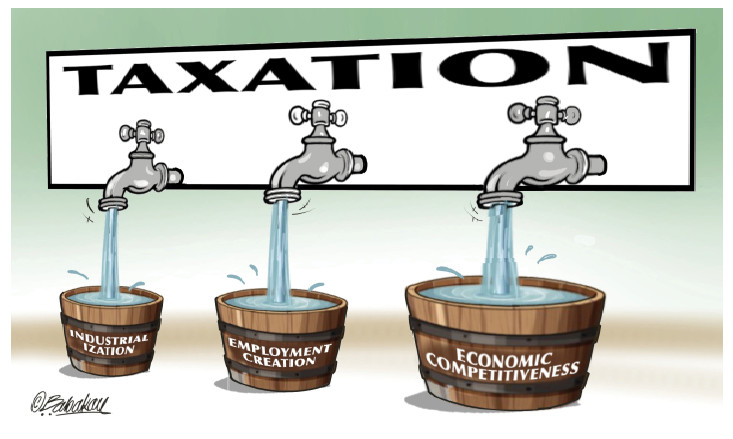
Imagine a farmer who painstakingly installs the most sophisticated irrigation system, yet never plants a single seed. The channels, pumps, and sprinklers are state-of-the-art, ensuring water reaches every corner of the field, but without planting, there will be no harvest. Most Nigerian states often face an analogous situation with taxation. Tremendous efforts are invested in digitizing collections, upgrading personnel capacity, and enforcing compliance — administrative capabilities that are necessary to ensure efficiency and reduce leakages. Yet, these measures alone cannot generate meaningful internally generated revenue if the fundamental “seeds” of economic activity — investments, industries, and formal commercial transactions — are absent. That is to say, a state may be perfectly structured to collect taxes, but if the economy is stagnant, IGR growth will remain marginal.
This column builds on that from a fortnight ago titled Rebuilding State Tax Capacity for Growth, which examined modernizing administration and improving compliance. The overwhelming responses and questions from readers, mostly tax practitioners and policymakers, indicated one clear point: many states focus heavily on enforcement metrics, compliance rates, and technology adoption, often overlooking the economic systems from which taxes can actually be derived.
Linking Taxable Capacity to Economic Dynamics
In public finance, a state’s taxable capacity is a function of the scale, diversity, and formalization of its economic activity. States with robust industrial clusters, formal employment, and high-value transactions naturally generate more revenue, even with modest administrative infrastructure. Lagos and Ogun exemplify this: their diversified economies, dense industrial networks, and concentrated commercial activity produce predictable revenue streams. In contrast, northern states, such as Kano, Kaduna, and Katsina, which are more reliant on informal markets and agrarian production, often struggle with low revenue performance despite administrative investments.
Administrative modernization — digitized filing, automated compliance, and well-trained personnel — is necessary to capture taxable transactions efficiently, but it cannot create transactions ex nihilo. Without investment, industrial activity, and formalization, even the most efficient revenue systems generate limited yields. Social cost-benefit and opportunity cost analyses underscore this point: prioritizing enforcement without simultaneously stimulating economic activity entails forgone revenue, lost employment opportunities, and underdeveloped industrial capacity. A holistic approach requires that administration, policy, and economic growth operate as mutually reinforcing systems.
Expanding the taxable base involves deliberate interventions to stimulate sectors capable of producing measurable economic activity. Industrial policy, incentives for formalization, and targeted infrastructure development can encourage investment in sectors that generate both social and fiscal returns. States must recognize that the marginal impact of administrative reforms is constrained by the underlying economy, making economic stimulation the decisive factor in revenue growth.
Differentiated Incentives for Competitive Advantage
Nigeria’s subnational economies differ in structure, potential, and resource endowments. Kano, Kaduna, and Katsina, while neighbouring each other, exemplify these differences. Kano is a commercial hub with strong trade and light manufacturing. Kaduna is diversified, combining industrial clusters, agro-processing, and services. Katsina remains predominantly agrarian but has potential for agro-industrial growth.
Uniform tax policies or blanket incentives across these states risk inefficiency and misallocation of resources. Industrial economics and fiscal federalism theory suggest that states should design tax policies aligned with their competitive advantage. Kano could incentivize light manufacturing and logistics hubs to formalize commercial trade. Kaduna could focus on industrial parks and agro-processing clusters that create jobs and add value. Katsina could target agricultural mechanization and local processing to strengthen rural supply chains and formalize production.
Differentiated incentives improve the marginal productivity of tax expenditures, ensuring that tax concessions generate both fiscal and social returns. A one-size-fits-all approach often results in wasted fiscal resources, misaligned investments, and low compliance. When tax policy is purposefully linked to economic structure, it serves as a developmental tool, stimulating investment and creating sustainable revenue.
Taxation as a Strategic Development Instrument
Beyond revenue collection, taxation is a policy lever capable of influencing economic behaviour. Conditional tax incentives, sector-specific exemptions, and performance-linked concessions can encourage firms to invest, create employment, and formalize operations. For example, a Katsina agro-processing incentive that requires local sourcing can simultaneously increase employment, enhance rural incomes, and generate taxable transactions. Kaduna’s industrial park incentives encourage clustering effects, raising productivity while widening the formal tax base. Kano’s trade-focused incentives reinforce formal registration, boosting VAT and corporate tax compliance.
From a public finance perspective, the social cost-benefit of these incentives is decisive. Tax expenditures are justified when the net social returns — jobs created, value added, skills developed — exceed the fiscal cost. Poorly designed or excessive exemptions constitute opportunity costs, diverting resources from sectors that could produce higher returns. States must therefore embed rigorous cost-benefit analysis in incentive design, continuously evaluating outcomes to ensure that fiscal tools yield both revenue and developmental benefits.
Integrating Administration, Policy, and Systems Thinking
Administration and policy cannot be siloed. Digitization, workforce training, and compliance monitoring enhance efficiency, but they only realize their potential when economic activity generates sufficient taxable transactions. Conversely, incentives without administrative capacity risk revenue leakage, inequity, and ineffective implementation.
A systems thinking approach recognizes the interdependence of policy, administration, and economic activity. Incentives, regulatory frameworks, and digital platforms must form a dynamic loop: economic activity produces taxable transactions; administration ensures compliance; revenue funds infrastructure and policy interventions that stimulate further growth. Evidence from Nigerian states shows that those aligning administration with economic policy achieve higher IGR elasticity relative to GDP growth, lower compliance costs, and broader formalization of informal sectors.
Street-level bureaucrats must be trained not only in enforcement but also in understanding the economic logic behind tax policies, bridging compliance with developmental goals. When taxation is treated as both a policy lever and an administrative exercise, it generates sustainable revenue while shaping the economy and formalizing economic activity.
Urgency in the Fiscal and Political Economy Context
The urgency of integrating economic policy into taxation cannot be overstated. Nigerian states operate under volatile federal allocations, limited fiscal space, and rising social pressures. Treating taxation solely as a compliance exercise may deliver temporary revenue gains but fails to address structural constraints on long-term fiscal sustainability.
Neglecting economic activity entails high opportunity costs. Administrative investments without parallel economic stimulation leave potential revenue uncollected and diminish social returns. Politically, overreliance on extraction without growth risks eroding citizen trust and undermining the legitimacy of the fiscal social contract. Empirical observation confirms this: northern states with low industrial density and heavy enforcement often experience high administrative costs relative to IGR gains. States that combine industrial policy, targeted incentives, and robust administration, by contrast, achieve both revenue growth and broader developmental outcomes.
Taxation, therefore, must be reframed as a strategic tool for industrialization, employment creation, and economic competitiveness, not merely a revenue generation mechanism. States that internalize this principle can catalyse structural economic transformation while enhancing fiscal resilience.
Last words
The lesson is unambiguous: administration is necessary, but it is insufficient on its own. Taxation follows economic activity, as such, states must treat tax policy as a developmental instrument, aligned with competitive advantage, industrial potential, and employment creation. Kano, Kaduna, and Katsina illustrate this principle: differentiated, evidence-based incentives, integrated with capable administration, expand taxable activity, formalize the economy, and strengthen fiscal resilience.
States that act on this insight will not only secure sustainable revenue but also drive structural economic transformation, generating jobs, formalizing industry, and enhancing fiscal legitimacy.
We’ve got the edge. Get real-time reports, breaking scoops, and exclusive angles delivered straight to your phone. Don’t settle for stale news. Join LEADERSHIP NEWS on WhatsApp for 24/7 updates →
Join Our WhatsApp Channel