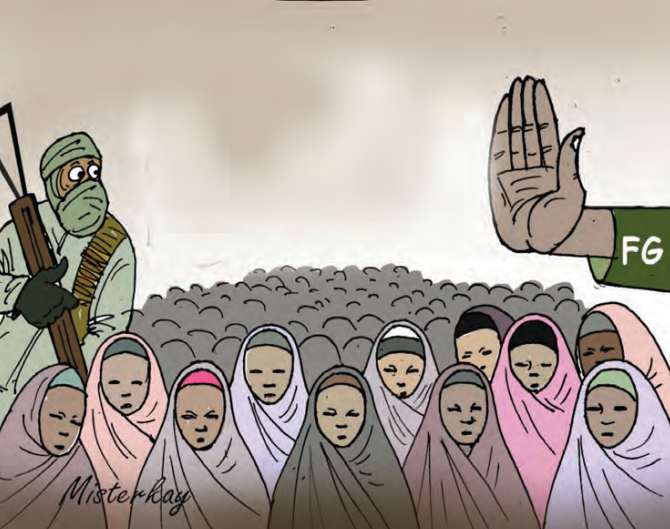
Ten years ago today, 276 girls were abducted in the night from their school in Chibok, northeastern Nigeria. The attack by Boko Haram pricked the conscience of the world. From London to Washington, protesters held placards reading #BringBackOurGirls—the hashtag the girls’ families had posted to pressure their idle government into action. It would take almost three weeks for then-Nigerian President Goodluck Jonathan even to make a public announcement. Critical time had been lost.
When this March, 137 children were tragically taken from a school in Kaduna, northwestern Nigeria, the shadow of Chibok lay ever present. Why, Nigerians and the world asked, after the passage of a decade was such an atrocity still happening?
This time, unlike Chibok, the girls and boys were brought back a fortnight later, the security and intelligence agencies deployed immediately to rescue them. Nevertheless, legitimate concerns over kidnappings persist in Africa’s most populous country. Success in Kaduna has brought families relief and praise for the military, yet the government bears no illusions: The scourge of kidnappings must be routed once and for all.
It begins with recognizing the changing nature of the threat. Boko Haram translates to “Western Education is Forbidden” and reflects an ideological impetus as jihadi insurgents opposed to the very idea of a Nigerian state. Today, Boko Haram are splintered, and mass abductions are primarily the work of criminal gangs. There is no ideology here: kidnapping has become an illegal industry rewarded with ransoms. Within days of the Kaduna attack, the abductors were demanding 1 billion naira ($600,000).
Nothing was paid. As president, I have been clear that ransoms stop. Resolution through payment only perpetuates the wider problem. This extortion racket must be squeezed out of existence. Meanwhile, the costs for perpetrators must be raised: They will receive not a dime, and instead security services’ counter action.
But compressing the kidnap for ransom market only addresses the pull factors. If we are to avoid funneling the same people into other crimes that cause normal Nigerians to feel insecure, we must address the push factors: poverty, inequality, and a paucity of opportunity. Criminal gangs can find easy recruits among those without either a job, or the prospect of one.
Some 63 percent of Nigerians are multidimensionally poor. They are bearing the economic consequences of a failure by successive governments to get to grip with the Nigerian economy. Fiscal and monetary albatrosses have grounded the country’s flight, when surging demographics demand high economic growth to just maintain current standards of living.
A decades-old fuel subsidy was exhausting paltry public finances. By 2022, the cost had ballooned to $10 billion—more than the government’s combined spending on education, health care, and infrastructure in a budget of $40 billion. Currency controls that artificially propped up the naira deterred investment and led to shortages of foreign exchange. For decades we have been financially ransoming ourselves. When my government took office last May, we faced a pile of debt obligations.
Just as with kidnappers, we had to be tough with the economy. Unsustainable market distortions had to be removed. As expected, floating the naira caused it to plunge. Given Nigeria is a net food importer, the average shopping basket has consequently risen in price. The removal of the fuel subsidy, in a country where many businesses and households rely on generators for power, has also had far reaching effects. These reforms have caused pain across Nigeria; they are still painful. Yet there is no better alternative: These and other difficult reforms are necessary to arrest the economic rot that lies at the heart of insecurity.
Green shoots are now visible. In the first quarter of this year, foreign currency inflows have almost matched those for the whole of last year. A multi-billion forex backlog at the central bank has been cleared, giving foreign investors’ confidence to invest in Africa’s largest economy, safe in the knowledge they can repatriate earnings. The naira has begun to stabilize after its initial downward trend and has made huge gains against the dollar.
Talk of macroeconomics might seem remote from the challenge of insecurity. But without the fundamentals in place, it is impossible for an enabling environment where the private sector thrives, jobs are created, and opportunity is spread across the country. It is how we ensure children can go to school without fear.
For any who may have doubted our direction, it should now be clear. There will be no more ransoms paid—not to kidnappers, nor toward those policies which have trapped our people economically. Nigerians, and their economy, will be liberated.
– Bola Tinubu is president of the Federal Republic of Nigeria.
– Culled from www. newsweek.com
We’ve got the edge. Get real-time reports, breaking scoops, and exclusive angles delivered straight to your phone. Don’t settle for stale news. Join LEADERSHIP NEWS on WhatsApp for 24/7 updates →
Join Our WhatsApp Channel