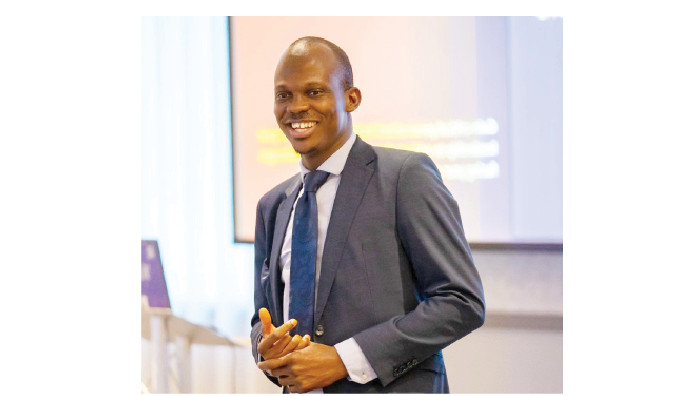
The founder of TEXEM and a British-Nigerian leadership expert and academic, Dr Alim Abubakre, has obtained the Academic Fellowship award of the Chartered Institute of Personnel and Development (CIPD), allowing him to use the designatory letters Academic FCIPD after his name.
The award is in recognition of Abubakre’s contribution to teaching, research and leadership development.
It comes at a time when organisations face increasingly complex operational landscapes driven by technological disruption, geopolitical tensions and heightened demands for transparency.
Through TEXEM, Abubakre has inspired over 4,000 global leaders through executive development programmes, focusing on transforming academic insight into operational decision-making.
The significance of that figure lies in how leadership can multiply the impact of a single improved decision at the board or executive level, which can affect employees, customers, investors, communities, and public institutions.
One stronger institution can improve confidence, opportunity and performance far beyond its walls.
Commenting on the practical impact of Abubakre’s work, MP for Beverley and Holderness, Graham Stuart, hailed his ability to bridge academic theory and executive practice.
“Converting the insights of the latest academic research into inspiring, practical and effective courses for political and corporate leaders sets Dr Abubakre apart. It’s great to see him recognised as a fellow of the CIPD,” said Stuart.
Abubakre’s academic research includes studies on stakeholder collaboration during the pandemic in Sub-Saharan Africa, as well as the systemic barriers facing small and medium-sized enterprises in public procurement.
Also, the CIPD’s Standards and Professional Development Director, Victoria Winkler, stressed the broader role of academic contributors within the sector.
She described the CIPD Academic Fellowship as a badge of expertise, credibility, and authority.
“It recognises the vital role that academics play in advancing the people profession through teaching, research, thought leadership and the development of future leaders,” Winkler stated.
Reacting to the award, Abubakre stressed that professional accolades carry an obligation to drive institutional progress and stronger governance.
“Recognition should increase responsibility, not simply status. For me, this Fellowship is a commitment to make knowledge travel further: from research into teaching, from teaching into organisations, and from organisations into decisions that improve performance and widen opportunity.
“My next step is to deepen the connection between scholarship and practice, helping leaders understand complex systems better, build stronger institutions and turn insight into action that people can actually experience.
“International business ultimately succeeds through people, trust and relationships. My next step is to deepen the connection between scholarship and practice, helping leaders understand complex systems better, build stronger institutions and turn insight into action that people can actually experience,” he said.
Beyond his academic work, Abubakre serves as a Board Director of the Business Council for Africa.
Speaking to the recognition, TEXEM stated that one of the paradoxes of the AI era is that information is easier to access precisely when judgment is becoming harder to exercise.
It explained that leaders can obtain answers faster, but still have to decide which questions matter, which interests to balance, which risks to accept, and what responsible action looks like.
“That is why lifelong learning is not remedial. It is a discipline of serious leadership. Experience is valuable, but it can harden into an assumption. Success can build confidence, but confidence without curiosity can become complacency.
“Seniority should increase the obligation to learn because the consequences of poor judgment become greater as responsibility grows.
“For TEXEM, the real measure of executive development is what changes after the programme: whether leaders make better decisions, boards govern more effectively, organisations become stronger, institutions widen opportunity and society experiences the difference,” the organisation said.
The awardee’s research examines stakeholder collaboration during the COVID-19 pandemic across Sub-Saharan Africa and the barriers facing small and medium-sized enterprises in public procurement.
While the contexts differ, the underlying question remains – how can leaders make complex systems work better for the people and organisations that depend on them?
We’ve got the edge. Get real-time reports, breaking scoops, and exclusive angles delivered straight to your phone. Don’t settle for stale news. Join LEADERSHIP NEWS on WhatsApp for 24/7 updates →
Join Our WhatsApp Channel