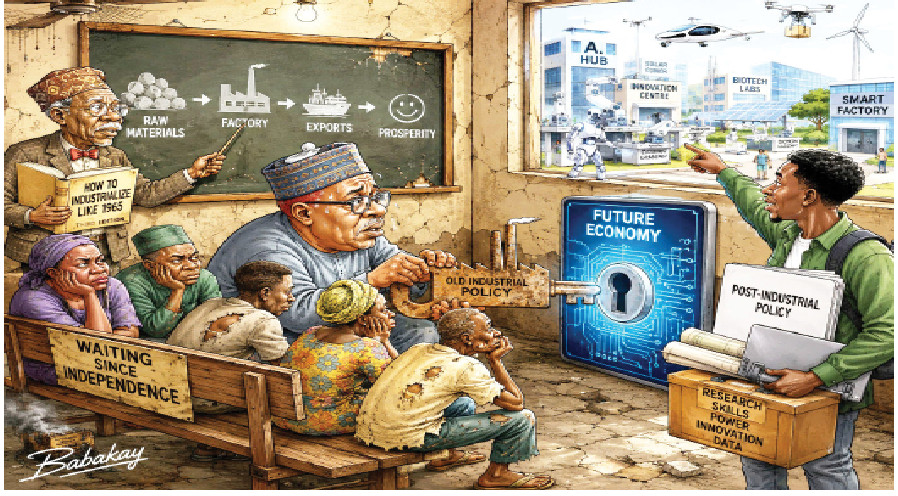
A driver who insists on using a 1960 road map to navigate a twenty-first century city is not necessarily lost because the map is inaccurate. The map may have been perfectly drawn for its time. The problem is that roads have been expanded, new routes have emerged, old pathways have disappeared, and the destination itself may have changed. This is the dilemma confronting contemporary development thinking.
I have borrowed the title of this article, “The End of Development Economics: A Manifesto for a Post-Industrial Policy,” from the forthcoming inaugural lecture of Professor Bongo Adi of Pan-Atlantic University, Lagos. The title is deliberately provocative because it challenges us to rethink whether the theories that guided economic transformation in the twentieth century remain sufficient for navigating the realities of the twenty-first century.
The argument is not that development has ended. Neither is it that manufacturing has become irrelevant. Any serious economic analysis must recognise that industrial capacity remains central to national power, employment creation and technological advancement. The argument is that the traditional belief that all nations must climb a fixed ladder, moving from agriculture to manufacturing and finally to services, is increasingly inadequate. Development is not a straight staircase; it is a complex process of building capabilities.
The Industrialisation Miracle and the Development Paradigm
Development economics emerged after the Second World War in a world defined by decolonisation, poverty reduction and economic reconstruction. Newly independent nations in Africa, Asia and Latin America faced a fundamental question: how could economies with weak industrial bases transform themselves into prosperous societies?
The dominant answer was structural transformation. Agriculture would release labour; manufacturing would absorb workers, generate productivity gains and create technological capabilities. This thinking was strongly influenced by economists such as Arthur Lewis, who in 1954 developed his famous dual-sector model explaining how economies could move labour from traditional agriculture into modern industry.
History appeared to confirm this approach. Britain’s industrial revolution transformed global economic possibilities. Japan rebuilt after 1945 through industrial strategy and technological upgrading. South Korea, which had a GDP per capita of about US$158 in 1960, became a high-income economy with GDP per capita above US$30,000 through strategic industrial policy, education and innovation.
The lesson from these countries is not simply that factories create prosperity. The deeper lesson is that factories succeed when they are supported by knowledge, institutions, infrastructure, finance and technological learning. Industrialisation was never merely about machines. It was about creating productive capabilities.
The mistake is therefore not believing in industrialisation. The mistake is assuming that the industrialisation model of the 20th century can simply be copied into the 21st century.
Nigeria and the Search for Productive Transformation
Nigeria’s economic history demonstrates the limitations of simplistic development narratives. Since independence in 1960, Nigeria has experimented with import substitution industrialisation, liberalisation, structural adjustment reforms and various industrial revival programmes. Yet the central challenge remains unresolved: how does a country rich in resources become rich in productive capabilities?
The discovery of commercial oil in 1956 transformed Nigeria’s economic structure. The oil boom of the 1970s generated unprecedented revenues, but it also created a dangerous illusion that natural resources could substitute for productive transformation. The country became a major petroleum exporter while remaining dependent on imported machinery, technology and manufactured goods.
The 2014 rebasing of Nigeria’s GDP provides an important lesson. Overnight, Nigeria became Africa’s largest economy, with its estimated GDP rising to approximately US$509 billion, partly because previously undercounted sectors such as telecommunications, entertainment and services were incorporated into national accounts.
However, the rebasing exercise also exposed a fundamental weakness in how we think about development. A larger GDP does not automatically mean a more productive economy. Economic size is not the same as economic strength.
A country can record impressive growth figures while struggling with weak industrial capacity, low research output, poor infrastructure and limited technological capability. Development must therefore be measured not only by what an economy produces today, but by what it is capable of producing tomorrow.
Beyond GDP: Measuring the Real Foundations of Development
For decades, GDP growth has dominated economic policy discussions. While GDP remains an important indicator, it provides only a partial picture of national progress. Development is not simply about expanding economic output; it is about expanding the capabilities that allow societies to continuously generate value.
A modern development framework must ask different questions. How many patents are being produced? How strong are research institutions? What percentage of firms are adopting advanced technologies? How effective is the education system in producing skilled workers? How much domestic value is created from exported commodities?
These questions matter because the global economy has changed dramatically.
Today, some of the world’s most valuable companies derive enormous value from intangible assets such as software, artificial intelligence, data, research and intellectual property. Digital platforms, biotechnology, advanced manufacturing and knowledge-intensive services are reshaping global competition.
This does not mean traditional manufacturing has disappeared. Steel, cement, machinery, pharmaceuticals, automobiles and industrial production remain critical. But manufacturing itself has changed. The factory of 2030 will not be the factory of 1970. It will combine robotics, artificial intelligence, renewable energy, digital systems and highly skilled workers.
The countries that succeed will not be those that choose between manufacturing and technology. They will be those that integrate both.
Towards a Post-Industrial Policy for Nigeria
The challenge before Nigeria is not whether to industrialise; it is how to industrialise intelligently in an era where knowledge, technology and innovation increasingly determine global competitiveness. The old model of equating industrialisation with the mere establishment of factories is no longer sufficient. Modern industrial policy must move beyond physical production and focus on building national productive capabilities.
For policymakers, the first priority must be to address the structural constraints that continue to undermine industrial competitiveness, particularly unreliable electricity, inefficient logistics and weak infrastructure. No country can sustain manufacturing growth when firms spend scarce resources generating their own power instead of investing in productivity and innovation.
Second, Nigeria must urgently transform its universities and research institutions from centres of certification into engines of knowledge creation. A country that imports technology indefinitely cannot become technologically competitive. Public policy must promote research funding, industry-academia collaboration and commercialisation of local innovations.
Third, government procurement should become a strategic instrument for industrial development. The state should deliberately support Nigerian firms that demonstrate the capacity to move from low-value production into more sophisticated activities, while ensuring that such support is tied to measurable productivity improvements.
Fourth, Nigeria must invest aggressively in digital infrastructure, artificial intelligence, advanced manufacturing skills and scientific capabilities. With Africa’s population projected to approach 2.5 billion by 2050, economic survival cannot depend on low-productivity activities alone. The country must prepare its young population for the industries of the future.
Policymakers must also abandon the belief that there is only one pathway to prosperity. Development is not a universal ladder that every country must climb in the same sequence. It is a process of building capabilities suited to changing realities.
Nigeria does not need to abandon industrialisation; it needs to reinvent it. The economies that will succeed in the future will not simply build factories. They will build the knowledge systems, institutions and technological capabilities that make those factories globally competitive.
We’ve got the edge. Get real-time reports, breaking scoops, and exclusive angles delivered straight to your phone. Don’t settle for stale news. Join LEADERSHIP NEWS on WhatsApp for 24/7 updates →
Join Our WhatsApp Channel