When the Department of State Security raided the homes of judges in October 2016—arresting Supreme Court and High Court justices over corruption allegations—the operation ignited fierce national debate about due process and judicial independence.
Nearly a decade later, the drama has faded. Still, the underlying crisis endures, now surfacing in a quieter yet equally damning form: reports that 34 of the 62 nominees for Federal High Court judgeships were dropped after failing integrity screening.
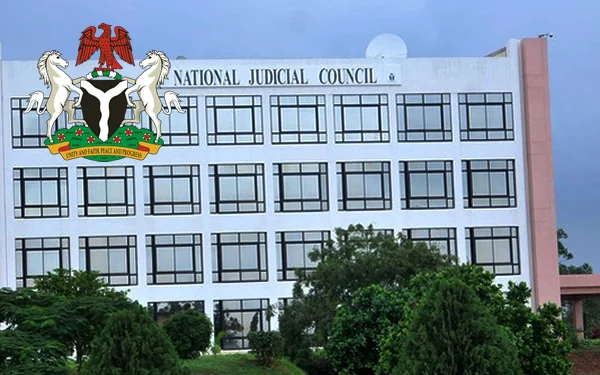
The National Judicial Council (NJC) has disputed this specific figure, clarifying that the screening took place at the level of the Federal Judicial Service Commission and that no final decisions have been made. This technical denial, however, does little to alter the fundamental reality it seeks to obscure.
In our view, whether the number is 34 or significantly lower, the fact that a substantial proportion of judicial nominees required filtering over integrity concerns points unmistakably to a profession in moral distress.
This concern is not without historical grounding. A 2010 study conducted by the Economic and Financial Crimes Commission (EFCC) and the National Bureau of Statistics (NBS), with support from the United Nations Office on Drugs and Crime (UNODC), found that the judiciary accounted for the largest share of bribes among public institutions assessed in Nigeria.
Public trus in the judiciary has steadily declined since the 2016 raids. Yet even before then, evidence of systemic problems was mounting. Following the release of the EFCC–NBS–UNODC report, the NJC has sanctioned more than 70 judges for various forms of misconduct, including corruption-related offences, leading to dismissals, compulsory retirements, and suspensions. These facts underscore that concerns about judicial integrity are neither imagined nor exaggerated.
Nigeria’s constitutional democracy rests fundamentally on the rule of law, and the judiciary occupies its moral and institutional core. When citizens trust that judges are learned, impartial, principled, and incorruptible, confidence in justice itself is preserved.When that trust erodes, the foundations of democratic legitimacy begin to crack.
For decades, Nigeria’s judiciary has struggled with perceptions—and, too often, realities—of corruption, cronyism, and compromised judgment. These failings extend far beyond individual cases. They deter investment where contracts cannot be reliably enforced, deepen public resentment against perceived injustice, and risk transforming the law from a shield for the weak into a weapon for the powerful.
Even though the NJC insists that no final decisions have been taken regarding the affected nominees, the integrity screening exercise remains both troubling and instructive. It is worrisome because it suggests that, until now, a significant number of aspiring legal practitioners seeking judicial office may have fallen short of the ethical standards required of judges. It is instructive because it demonstrates that transparency and accountability—long resisted in judicial appointment processes—can serve as effective corrective mechanisms.
Public confidence in the courts cannot remain an abstract aspiration. It must be anchored in the firm conviction that judges will uphold the law without fear or favour and without moral compromise. When a judicial appointment process excludes individuals tainted by bribery or ethical lapses, it is not an attack on the legal profession; it is an investment in its credibility and legitimacy.
To downplay the significance of this development is to misjudge the stakes. A judiciary perceived as compromised weakens democratic checks and balances, emboldens executive overreach, enables legislative impunity, and marginalises citizens seeking justice.
Conversely, a judiciary that enforces strict ethical standards fortifies the rule of law and deepens democratic resilience.
As an endemic challenge, this crisis demands structural reform. First, the judicial appointment framework must be overhauled. Nigeria’s current model vests excessive discretionary power in a narrow set of institutions, characterised by limited transparency and public accountability. Clear, publicly accessible criteria for judicial appointments—balancing competence, experience, integrity, and responsibility—must be institutionalised. Periodic external audits of the appointment process should become standard practice.
Second, professional ethics enforcement must be strengthened. The Nigerian Bar Association and relevant regulatory bodies must work closely with judicial oversight institutions to impose consistent and meaningful sanctions on lawyers and judges who violate ethical standards.
Third, the NJC must continue to safeguard the integrity of the screening process. Public input should be structured, evidence-based, and insulated from partisan or malicious abuse. Clear standards for evaluating petitions must be established, alongside due process protections that allow nominees to respond to allegations.
There must also be sustained investment in judicial education and capacity-building. Mandatory continuing professional development should place strong emphasis on ethics, human rights, and constitutional jurisprudence. Merit in judicial office must encompass not only legal knowledge and analytical skill, but also moral judgment.
Finally, a cultural shift within the judiciary is indispensable. Judges and lawyers must see themselves as custodians of the nation’s conscience, not beneficiaries of privilege. Such transformation requires principled leadership from within the judiciary, reinforced by the vigilant engagement of civil society.
For too long, Nigerians have accepted substandard judicial conduct as inevitable. This moment challenges that fatalism. It presents a rare opportunity for meaningful reform—one capable of restoring public trust, reinforcing the rule of law, and strengthening Nigeria’s democratic future.
We’ve got the edge. Get real-time reports, breaking scoops, and exclusive angles delivered straight to your phone. Don’t settle for stale news. Join LEADERSHIP NEWS on WhatsApp for 24/7 updates →
Join Our WhatsApp Channel