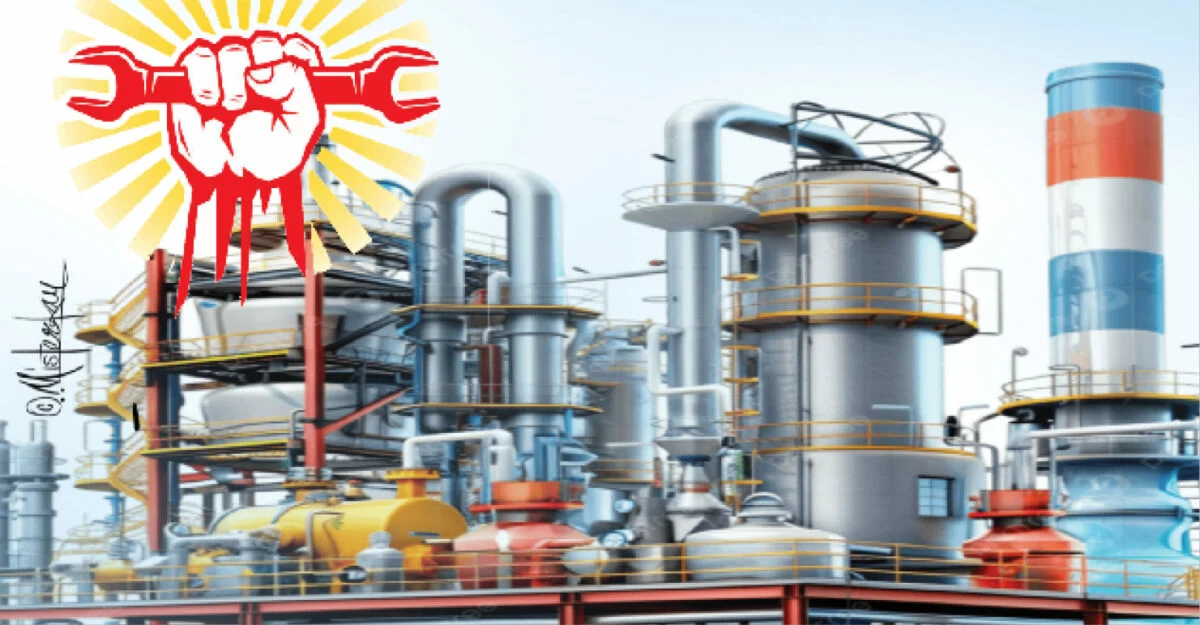
In Nigeria’s long history of industrial melodrama, few acts have drawn as much attention as the recent standoff between Dangote Refinery and the oil workers’ unions — PENGASSAN and NUPENG. It had everything that makes a good national soap: suspicion, posturing, and just enough misunderstanding to make both sides dig in. Now, after much noise and negotiation, they seem to have reached what diplomats would call a compromise — which, in Nigeria, usually means everyone is equally unhappy but pretending to be relieved.
Before the commentariat sharpen their hashtags, it’s important to remember what this dispute is really about. It’s not a morality play between good capitalists and bad unions, nor a battle between “patriotic entrepreneurs” and “lazy workers.” It is the old, eternal question of how power, production, and people must coexist when ambition meets reality.
Unions exist, ontologically and functionally, to defend the interests of their members — not to run refineries, dictate macroeconomic policy, or when government should commission turnaround maintenance. They are not politicians or managers of the NNPC. Their duty is to bargain collectively where individual workers would otherwise beg individually. To scold them for not fixing Nigeria’s refineries is to blame the fire brigade for the architect’s bad design. They didn’t pour the concrete; they only show up when smoke starts rising.
And yet, to understand this standoff, one must look beyond the daily news and into the deeper patterns of political economy. For every industrial dispute is a reflection of larger forces — the friction between capital’s drive for control and labour’s demand for dignity.
Lessons from Coal, Steel, and Common Sense
History, that old economist with the longest memory, has seen this film before. In 1984, Britain’s coal miners went to war — not with each other, but with their government. Prime Minister Margaret Thatcher sought to close unprofitable pits and crush what she saw as militant unions. The miners, led by Arthur Scargill, saw it as an existential struggle for their communities. Neither side blinked. The result? The government “won,” but entire towns in Northern England lost everything. Jobs vanished, social fabric tore, and the once-mighty British mining industry became a museum piece. It was a textbook win-lose that quickly turned into a lose-lose.
Contrast this with post-war Germany, where instead of annihilating labour, industrialists and unions struck a social pact known as Mitbestimmung — co-determination. Workers sat on company boards, shared in profits, and helped shape decisions. It wasn’t socialist idealism; it was pragmatic capitalism. The outcome was the “German miracle” — stability, productivity, and prosperity built not on conflict but on cooperation.
Economic history teaches an uncomfortable truth: when one side in the capital-labour equation “wins” absolutely, the economy loses eventually. Labour crushed leads to social unrest; capital stifled leads to stagnation. The only victories that last are those negotiated with humility and foresight.
Dangote Refinery, a project of monumental ambition, carries the same lessons. It is not just steel and pipes; it is a symbol of hope — the belief that Nigeria can finally industrialize, refine its own crude, and stop hemorrhaging foreign exchange. Yet ambition alone does not inoculate against hubris. A refinery, however modern, can grind to a halt if its people feel alienated or undervalued. Even machines respond better when the humans operating them believe they matter.
Of Capitalists, Workers, and the Dance of Survival
It’s easy to caricature labour leaders as obstinate and management as heartless, but economics is rarely so binary. Both sides operate within constraints. Management worries about efficiency, costs, and control; unions worry about job security, welfare, and respect. The dance is delicate — too much control and capital stifles trust, too much militancy and labour scares investment.
Consider Henry Ford in 1914. Faced with high turnover, he doubled wages to the then-unthinkable $5 a day. The business press called it madness. But Ford understood something timeless: a well-paid, motivated worker is not a cost; he is a customer, a collaborator, and a source of stability. Productivity soared, turnover dropped, and Ford became a legend. His logic applies equally to modern refineries: treating workers as partners, not pawns, is good economics.
Unfortunately, both capital and labour sometimes forget their own best interests. Management often believes that discipline alone drives productivity; unions occasionally mistake obstinacy for strength. When either side forgets that they are bound by shared survival, history intervenes — usually with irony. One recalls the American car industry of the 1970s, where labour excesses and managerial arrogance conspired to let Japanese competitors dominate. Detroit learned, painfully, that there are no permanent victories in the economy — only temporary truces between competing rationalities.
The Union Is Not the Villain
A peculiar chorus has emerged on social media: “Where were the unions when our refineries failed?” It’s an emotionally satisfying question — and a logically absurd one. Unions don’t allocate capital budgets, approve maintenance contracts, or dictate policy. Their core mandate is to defend labour rights, not to manage production lines or nationalize management incompetence.
When Nigeria’s refineries collapsed, it was not because workers went on strike too often, but because politicians saw them as cash cows for patronage. The problem was corruption, not collective bargaining. To expect unions to fix refineries is like expecting the traffic warden to redesign the expressway.
Of course, unions are not infallible. They too have had moments of self-inflicted decline — strikes called for opaque reasons, leaders entangled in politics, slogans detached from strategy. But to dismiss their legitimacy is to forget their role in building Nigeria’s industrial and democratic muscle. From the 1945 general strike that challenged colonial injustice to the 1993 protests that resisted military tyranny, unions have often been the only organized voice of the working citizen.
In the current case, their concerns are neither abstract nor trivial. They are about fairness, safety, and participation in decisions that affect their lives. Dangote’s management, for its part, fears bureaucratic delays and politicization. Both sides have valid points. But a modern industrial economy cannot be run by fear — fear of unions, fear of management, or fear of negotiation. What is needed is institutional maturity: clear frameworks, transparent dialogue, and a recognition that mutual dependence is not weakness but wisdom.
Towards a New Industrial Peace
If this uneasy truce between Dangote and the unions holds, it could become a model for something Nigeria desperately needs — a new industrial social contract. A refinery that refines not only crude oil but also the crude habits of our labour-capital relations.
The first rule of political economy is that production is social. Machines may run on diesel, but systems run on trust. Every great industrial revolution — from Manchester’s mills to South Korea’s shipyards — was powered not only by capital but by cooperation. Where trust collapsed, even mighty economies faltered.
A win-win is not sentimental idealism; it’s strategic realism. It recognizes that every refinery worker with a grievance is a potential delay in production, and every manager who dismisses those grievances is a risk to investment. Peace is cheaper than disruption; dialogue is cheaper than litigation.
Let both parties take a cue from Germany’s Wirtschaftswunder, not Britain’s miners’ war. Let them study Singapore’s tripartite model, where government, unions, and employers sit in continuous dialogue. Let them remember that in an interconnected world, industrial peace is not charity — it is Competitiveness.
We’ve got the edge. Get real-time reports, breaking scoops, and exclusive angles delivered straight to your phone. Don’t settle for stale news. Join LEADERSHIP NEWS on WhatsApp for 24/7 updates →
Join Our WhatsApp Channel