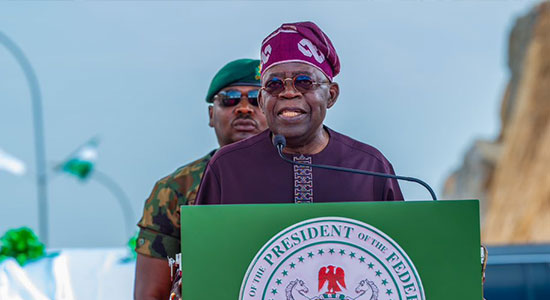
President Bola Tinubu on Thursday hosted the leadership of the Renewed Hope Ambassadors at the Presidential Villa, a gathering that brought together eleven sitting governors, several former governors, the Vice President, and the All Progressive Congress (APC) national chairman. The mood was upbeat, the speeches were enthusiastic, and the President, by all accounts, was in fine form.
But beyond the goodwill in the room, the meeting raised questions worth examining not to diminish what is being attempted, but to sharpen what must still be done.
First, some context. Governor Hope Uzodimma, the Director-General of the Renewed Hope Ambassadors, told the President that all local government structures have been inaugurated, ward-level enumeration has begun, and the organisation is actively reaching markets, schools, professional groups, and faith-based platforms. This is a significant organisational effort. Every Nigerian president has built a similar structure ahead of a re-election campaign Goodluck Jonathan had his own, so did Muhammadu Buhari and there is nothing inherently wrong with a sitting president seeking to communicate his record to the electorate. The question is simply this: does the discourse being communicated match the experience of ordinary Nigerians on the ground?
The most candid moment of the entire gathering came, unexpectedly, from the President himself. Addressing the ambassadors, President Tinubu said: “I didn’t have to look back on the economy because the truth is, I took over from myself. The late Buhari was me. He was my partner. And if I took over from him, is that not from me? So, if something is wrong, fine. Live with it, correct it, move on.”
That is a striking thing for a sitting president to say, and it deserves to be received in the spirit it was offered. Most Nigerian leaders spend their early years in office cataloguing the failures they inherited. President Tinubu has chosen a different posture one that acknowledges partnership with the previous administration and accepts responsibility for the continuum of governance. That kind of ownership, if matched with action, is exactly what Nigerians have long asked of their leaders.
What was equally notable was the President’s fighting response to those who have been throwing punches at his administration. He did not sound like a man on the defensive. “They want to scare me off? It’s a lie,” he told the ambassadors. “I’ve been through this path before. And if I have to come back over and over and over again, I’ll do the same thing.” That is not the language of a leader rattled by his critics. There is a strand of Nigerian political culture that mistakes silence for weakness and noise for strength. President Tinubu, at least on Thursday, did not oblige that expectation. His message was direct: the work is being done, the roads and bridges are visible, the economy is being rebuilt, and for those who refuse to see it, he offered with characteristic Lagos wit to lend them “Jigi-Bola,” eyeglasses. You cannot fault the man’s sense of humour, and you cannot miss the underlying point. A president who is confident in his record does not run from scrutiny. He invites comparison.
The commitment to democratic governance that ran through the President’s remarks also deserves attention. President Tinubu was unambiguous on the rule of law: “We cannot submit to disobedience of a lawful order of the court; we must embrace the judiciary, whether it favours us or not.” That is a statement of principle, and it matters particularly at a time when the relationship between the executive and the courts has been a subject of public concern. A president who says openly that his administration must obey court orders even when those orders are unfavourable is setting a standard for his own government.
The Renewed Hope Ambassadors, as they go to the grassroots, should carry that message too. Democracy is not only elections and campaigns. It is also whether the government obeys the law when it loses a court case. Nigerians will be watching.
And on some fronts, the action has been forthcoming. The fuel subsidy removal was a decision that had been deferred for fifteen years. Every administration before this one ran the numbers, understood the fiscal damage the subsidy was causing, and chose the path of least political resistance. President Tinubu did not. Former Katsina State Governor Masari put it plainly at the meeting: “Will anyone come tomorrow and say he will reverse the removal of fuel subsidy or return the nation to multiple foreign exchange rates?” The honest answer is no. The unified exchange rate was equally overdue. For years, the multiple exchange rate regime bled the country through arbitrage, rewarded those with access to official windows, and punished manufacturers and importers who had no such connections. These were politically costly decisions, and the President made them. That counts for something, and the Renewed Hope Ambassadors are right to say so loudly.
The NELFUND student loan scheme is another concrete achievement worth acknowledging. Former Delta State Governor Ifeanyi Okowa cited 1.16 million students as beneficiaries as of March 2026. That is a meaningful number in a country where the cost of tertiary education has long been a barrier for children from working-class homes c hildren wo are bright enough to gain admission but whose families simply cannot sustain the fees.
Questions remain about the long-term repayment architecture, equitable distribution across states, and whether the loan amounts keep pace with rising tuition costs. The government should publish a detailed breakdown to allow proper public assessment. But the direction is right, and the scale of early uptake is genuinely encouraging. This is a programme worth defending, worth expanding, and worth monitoring carefully.
Kaduna State Governor Uba Sani’s assertion that no President in Nigeria’s history has supported sub-national governments the way President Tinubu has reflects something real. FAAC allocations have improved on the back of exchange rate unification, and states now have more fiscal room than they have had in years. Governor Inuwa of Gombe put it simply: he governed before 2023 and governs now, and he knows the difference. That testimony carries weight.
That said, the Renewed Hope Ambassadors will serve their principal better if they carry honest feedback alongside the good news. The macroeconomic improvements have not yet fully translated into relief for ordinary households. Food prices remain elevated. Transportation costs are still a burden on working families. The naira has stabilised relative to the chaos of 2023, but the cost of living adjustment has been slow, and it is the adjustment not the exchange rate chart that ordinary Nigerians feel every morning. The transition from reform to tangible improvement in daily living standards is the unfinished chapter of this economic story, and it is the chapter that will matter most to voters in 2027.
There is a broader fiscal conversation these gatherings tend to defer. Debt servicing still consumes a substantial share of government revenue, and the space freed up by subsidy removal needs to be matched by discipline on recurrent expenditure — rationalising agencies, cutting duplications. The President’s infrastructure drive is visible and commendable. Fiscal prudence at the top deserves equal publicity.
One aspect of the April 16 gathering that was genuinely interesting was the breadth of political backgrounds in the room. Former Governor Okowa of Delta, a PDP Vice-Presidential candidate in 2023, was present and spoke warmly of the administration’s economic direction. Former Senate President Anyim Pius Anyim was also there. Politicians who opposed the President at the polls are now engaged with his agenda and if that engagement is genuine and policy-driven, it represents exactly the kind of national convergence that Nigeria needs. The country functions better when its political class competes on ideas rather than on identity and grievance. On that score, last Thursday’s meeting offered at least the appearance of a broader coalition.
What the Renewed Hope Ambassadors can do what wothatmake them genuinely useful beyond mobilisation is serve as a real feedback mechanism. Their job is not only to take the message down to the polling units; it is to bring the realities back up. What are ordinary Nigerians in Kebbi and Benue and Taraba actually experiencing? Where are the reforms still being felt as hardship rather than progress? That kind of honest upward communication is ultimately more valuable to the President than any amount of applause.
President Tinubu made a promise on the record last Thursday: “I won’t let Nigerians down.” That is a benchmark worth holding. The 2027 conversation will not be settled by the size of the organisational structure or the loudness of the applause in Abuja. It will be decided in the quieter arithmetic of ordinary lives whether wages have grown faster than prices, whether hospitals have drugs, whether a young and ung Nigerian finishing university has a realistic chance of finding work. The President has shown he is not afraid of the opposition, not afraid of the critics, and not afraid to own his record. Good. Now the country needs to see that same fearlessness applied to the harder, quieter work of ensuring the reforms reach the people who need them most.
We’ve got the edge. Get real-time reports, breaking scoops, and exclusive angles delivered straight to your phone. Don’t settle for stale news. Join LEADERSHIP NEWS on WhatsApp for 24/7 updates →
Join Our WhatsApp Channel