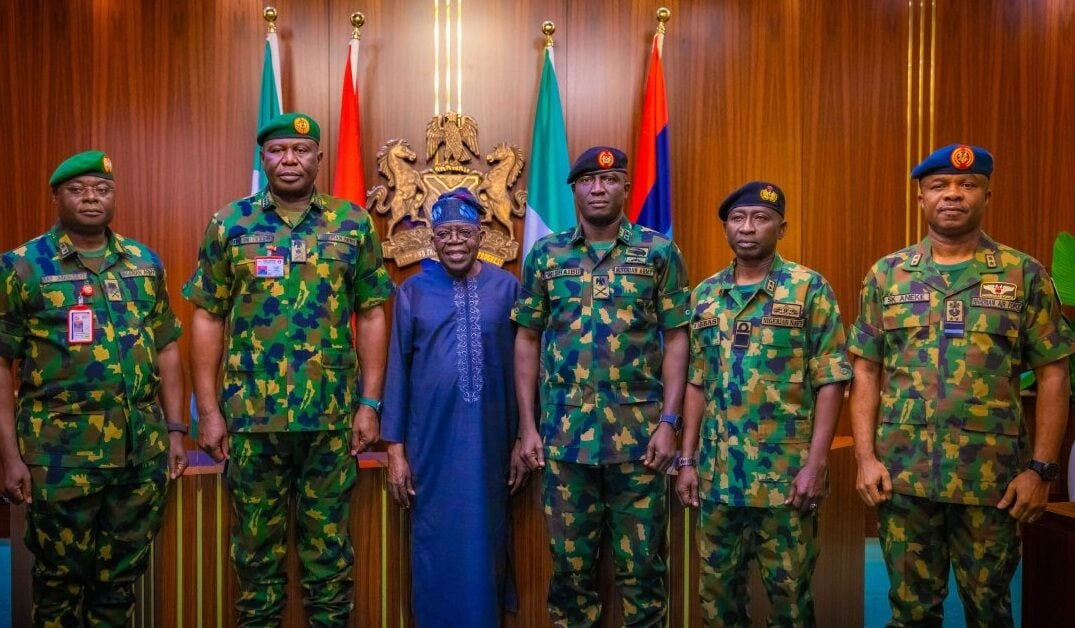
The recent appointment of Service Chiefs for the Nigerian Armed Forces signals a new drive towards addressing the country’s security challenges. While relevant stakeholders have applauded their appointments due to their rich resume, the reality on the ground paints a grim picture of the need for urgent and strategic engagement by the military in the war against banditry, kidnapping, ethnic and religious motivated killings, and other acts of criminality that have continually disrupted the nation’s socioeconomic life.
As a newspaper, we envision a daunting task before the service chiefs, and they must be ready to justify the confidence reposed in them by the president to accomplish the job. The first task is to address the concerns within the military that have resulted in several agitations from its ranks. It is well-known that a divided house cannot stand. Thus, the onus is on the service chiefs to address these concerns and boost the morale of troops deployed in the theatre of operations across the country; their problems should not be treated in a business-as-usual manner.
We recognise the enormous efforts and sacrifices of troops on the frontlines in addressing the country’s security challenges. Therefore, it is logical that their remuneration packages should be commensurate with their efforts. The service chiefs are not strangers to this challenge. They have held strategic positions before their appointments. Their experience and knowledge of the issues give them a distinct advantage.
The second task is to strengthen inter-agency collaborations among the services of the Nigerian Armed Forces. This is crucial to the success of all military operations in the country, as no single service can operate independently. The Air Force must ramp up its aerial support for ground troops, as well as for the Navy. The services should improve on intelligence gathering and sharing. The service chiefs must see teamwork as a cardinal principle. There should be no room for inter-agency rivalry, especially given a history which is replete with the effects of inter-agency rivalries among security agencies.
The third task is to devote considerable attention to the deployment of non-kinetic strategies, just as much to kinetic operations. The bulk of our security challenges is asymmetric in nature. For example, bandits, kidnappers and insurgents are ragtag groups and their methods and operations are unconventional. In this circumstance, deploying conventional strategies to address the threats they pose would be foolhardy. It is one thing to win a battle, and another thing to win the war. The military must focus more on winning the war than winning the battle. To win a war goes beyond the use of military artillery alone. They must also win the hearts and minds of the people through a deliberate effort to gaining the trust and buy in especially in the area of intelligence gathering. This can only be achieved through non-kinetic strategies.
The fourth task is for the service chiefs to hit the ground running. The severity of the security challenges in the country requires a proactive approach that would entail taking the battle to the criminal elements, locating their hideouts, identifying and cutting off their alliances with external groups, and not waiting to react whenever they strike. There is a lot of work to be done, and the need to respond to the urgency of the moment is imperative. We cannot emphasise enough the enormity of the task ahead. They must lead from the front and be ready to take responsibility for their actions and inactions.
The service chiefs must take actions that remind the military of their loyalty to the Constitution of the Federal Republic of Nigeria. The military under their watch must protect the constitution in the advancement of democracy in the country and not otherwise.
The military under their watch must not be perceived as political in the discharge of their duties and responsibilities. There must be a clear line between military duties and political duties. That is to say that loyalty to the constitution and overall interest of the people comes before any political consideration.
It is from this perspective that we stand against military involvement in politics. Countries whose military got involved in politics have not fared better, and Nigeria should not be an example.
As a newspaper, we also call on the political class in the country to stop meddling in the affairs of the military, especially state governors. We have witnessed such in recent times, and it makes a mockery of the efforts of the military in the discharge of their duties and responsibilities.
We recognise the complexity of military operations, and it is thus unarguable that for the military to succeed, the service chiefs must be intentional about what they set out to achieve.
We’ve got the edge. Get real-time reports, breaking scoops, and exclusive angles delivered straight to your phone. Don’t settle for stale news. Join LEADERSHIP NEWS on WhatsApp for 24/7 updates →
Join Our WhatsApp Channel