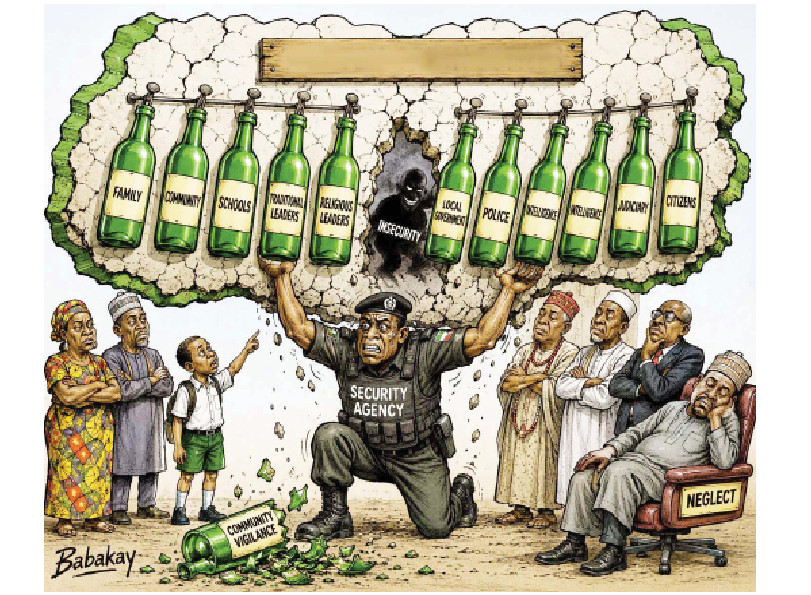
Ten green bottles hanging on the wall, ten green bottles hanging on the wall, and if one green bottle should accidentally fall, there’ll be nine green bottles hanging on the wall.”
I loved this primary school rhyme. It has several meanings other than its original intent of teaching primary school pupils. It strategically touches on the concept of unity. For example, the ten green bottles represent the various structures in society. When one bottle fell, the others became vulnerable, and it continued until all the remaining bottles fell one after the other. What if the first bottle didn’t fall? Would the others have fallen too? There is a lesson in this primary school rhyme that sounds ordinary, but reminds me of the principle of structural functionalism.
Structural Functionalism
Structural functionalism is a sociological term. It touches on the role of various structures in the survival of any society. It is also akin to the operations of a vehicle, where all parts or components are interdependent. I like to take a position from a security perspective. Who has the sole responsibility of security in the country? Is security everybody’s business? And if yes, is everybody playing their roles? And if the answer is no, the question is why? Could this be the missing link in our quest for adequate security of lives and properties? I hate to speculate. But it has been speculated that security is the sole business of the security agencies. This unwittingly negates the principle of structural functionalism as evident after the first green bottle accidentally fell down.
That accidental fall created a vacuum, and the vacuum created vulnerabilities that made the other bottles fall down too. This simple primary school rhyme is loaded with lessons that can be adopted to tackle the security challenges in the country. It is better to prevent a first fall in preventive security measures. There is a bitter truth that we have refused to accept. It is the truth that some of our actions and inactions as a people contribute to insecurity. Some might be intentional and some might be unintentional, but the consequences are the same at the end of the day.
There is also a myth that we have taken for fact: the myth that our security agencies should simply crush criminal elements with the heavy artillery at their disposal. This is wishful thinking. If it were that simple, no country in the world would experience insecurity. The use of brute force in tackling insecurity is gradually losing steam across the globe because of the realization that several factors come to play beyond the possession of arms and ammunition. A gun can kill, but it can’t address a security challenge.
That Fallen Green Bottle
In the story of the ten green bottles, there was an equilibrium shift after the first fall. This shift came with its consequences that made the wall empty at the end of the day. What is that first green bottle that fell in the security architecture in the country? We have to think about this carefully. It is worth a moment of deep reflection. It might be that we have been accidentally living in denial and shifting blame? That fallen green bottle might be that farmer, okada rider, miner, politician, or market woman who refused to act when they were supposed to and acted when they were not supposed to.
The theory of causation in conflict helps to explain the ability of one variable to impact another, explaining why and how conflicts start, escalate, and are sustained. It is argued that the “first” variable can either cause the second variable to exist or cause the incidence of the second variable to fluctuate.
I can argue this using several examples, but one that comes to mind easily is the Jili market rendezvous in Yobe State. According to sources, the market is a notorious transaction point for terrorists within and outside Nigeria. As a farmer, if you want to make brisk business, all you need to do is take your farm produce to the market, and you are assured of ready buyers offering outrageous amounts for basic commodities. What is the culpability of those selling to criminal elements in the market? Are the identities of the buyers unknown to the sellers? This is the tragedy of denial that we are grappling with, and it is a bayonet for insecurity.
The Tragedy of Denial
Let me use another analogy. Chinua Achebe in his novel Things Fall Apart told an incredible story on the tragedy of denial. The 1987 adaptation as a mini-series on the NTA network brought out the incredible details of Okonkwo’s insecurities that ultimately made him vulnerable. He lived a life of denial. He had his inner fears and acted otherwise in public, and his end was tragic. He hung himself to death. This is the danger ahead of us if we continue to live in denial about the fact that security is not the business of the government and security agencies alone, but everybody.
In the ten green bottles rhyme, after the first fall, other bottles could not stand. They fell one after the other until there were no more bottles standing on the wall. When interpreted along our present security challenges, the overarching objective is not to let any fall occur in the first place; if it does, everything else will fall. It goes further to highlight again the principle of structural functionalism.
Two things must be done urgently for the “ten green bottles” to serve as our wall of security. The government must launch a sustained national campaign on the theme “Security is Everybody’s Business.” This is necessary to create that reawakening on the concept of security and insecurity. The tragedy would be when a green bottle falls and we assume there would be no consequences. This is the equilibrium of deficit. It states that “security is treated as the exclusive burden of the uniform, but it is permanently shattered the moment we realize that closing this gap is a shared, collective responsibility of every single citizen.”
This is also the position of Prof. Thomas Imobighe, a renowned expert in defence and security. In one of his seminal works, he argued that “national security is concerned with the individuals and groups, not just states alone. When individuals are not secured, then the state is not safe. The public is the most vital stakeholder in any security architecture.” He advocated for a “structured, public-security synergy, to systematically deconstruct the ‘state-only’ security paradigm.” He concluded that “without a structured synergy between the public and the security forces, a state will perpetually chase a deficit it can never fully fund or fight its way out of.”
This position is common sense. It emphasizes that we must be clear about where we are, what we want, and where we want to be. We must come to this understanding quickly, and if we have been living in denial about it, the time to rethink is now.
– Ocheja, PhD, is an alumnus of the Nigerian Defence Academy, a military historian, and author of War and Mosquito Nets.
We’ve got the edge. Get real-time reports, breaking scoops, and exclusive angles delivered straight to your phone. Don’t settle for stale news. Join LEADERSHIP NEWS on WhatsApp for 24/7 updates →
Join Our WhatsApp Channel