Today is Workers’ Day. Across the country, state governors will mount podiums, labour leaders will deliver speeches, and the ritual of solidarity will be performed with the usual fanfare. But when the bunting comes down and the microphones go quiet, the average Nigerian worker will return to the same grind, earning wages that cannot pay rent, feed a family, or fill a tank of petrol. That is the uncomfortable truth that no Workers’ Day address will speak of plainly enough.
When President Bola Tinubu signed the N70,000 minimum wage into law in July 2024, it was widely greeted as a significant concession to organised labour. A 133 percent increase from the previous N30,000 floor. A recognition, at last, that workers had been crushed by the twin blows of fuel subsidy removal and naira devaluation. The Nigeria Labour Congress accepted it, however grudgingly, and the government took its bow. That was the end of the good news.
Nearly two years later, at least 20 states have not fully implemented the new wage. Some have made token adjustment stacking a few thousand naira onto the old figure and calling it compliance. Others have drawn a distinction between state civil servants and local government staff, teachers, and health workers, the latter groups left stranded on the old N30,000 or marginally above it. A handful of governors have simply pleaded poverty while their security votes and foreign trips remain untouched. And the federal government, which set the wage in law, has watched this spectacle with what can only be described as studied indifference.
This is not a minor administrative delay. It is a systematic failure of political will, dressed up in the language of fiscal constraint. The governors who claim they cannot afford N70,000 per worker are, in most cases, the same governors presiding over bloated political offices and security expenditures that dwarf their education and health budgets combined. Their financial distress is selective it appears only when workers come asking.
And here is the deeper problem: even where the wage has been paid, it has already been defeated by inflation. Nigeria Labour Congress(NLC) President Joe Ajaero made the point bluntly and correctly when he said that a monthly salary of N1 million is worthless without a stable naira and improved economic conditions. This is not rhetorical excess. It is arithmetic. The effective purchasing power of N70,000 today is a fraction of what N30,000 could buy before the subsidy removal. Food prices have more than doubled in many markets. Transportation costs have spiralled after fuel prices climbed from N800 to over N1,300 per litre, a surge worsened further by the conflict in Iran’s oil region. Housing in any Nigerian city of consequence is beyond the reach of workers earning the minimum wage. Electricity tariffs, since the Band A hike, now exceed what many workers take home in a month.
The government’s economic reforms may have a defensible rationale. This newspaper has not argued that subsidy removal was wrong in principle. But every orthodox economic argument for painful reform carries with it an obligation,the obligation to protect those least able to absorb the shock. That obligation has not been met. There are no functional social safety nets. The Conditional Cash Transfer programme has reached a fraction of those who need it, and even its disbursements are sporadic and plagued by leakage. Workers have been told to bear the pain of reform while the rewards of reform remain, as always, something that is perpetually around the corner.
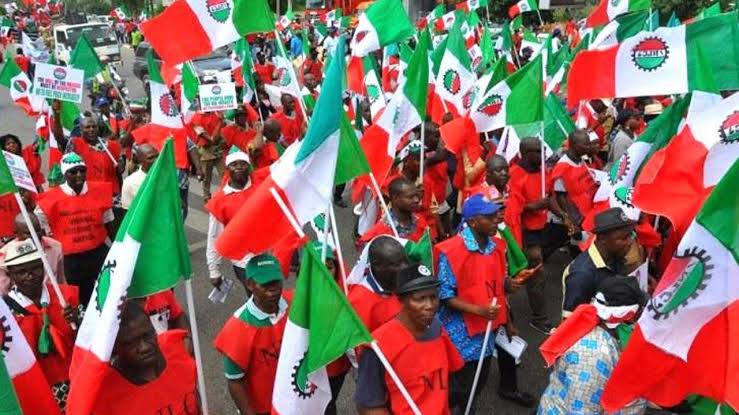
The NLC is right to have put the defaulting states on notice ahead of this Workers’ Day. The threatened protests are not agitation for privilege,they are a demand for what has already been promised and enshrined in law. A minimum wage is not a gift from the political class to the working class. It is a legal floor below which no employer, public or private, is permitted to descend.
Governors who have not complied are not merely slow implementers. They are lawbreakers. The federal government should say so, and it should act on it.
What concrete action looks like is not complicated. The Revenue Mobilisation Allocation and Fiscal Commission exists, in part, to ensure equitable distribution of federal allocations. There is no legal or constitutional reason why compliance with the Minimum Wage Act cannot be made a condition for unfettered access to those allocations. If the threat of withheld funds concentrated minds when the Supreme Court ordered local government financial autonomy last year, the same lever can work here. Political will is the only missing ingredient.
Beyond the wage itself, this Workers’ Day must occasion a harder conversation about the conditions in which Nigerian workers operate. Reliable public transport does not exist in most cities. Workers in Lagos, Abuja, Anambra and Kano spend a disproportionate share of their income and their lives commuting in dangerous, expensive conditions. Public hospitals are understaffed and underequipped. The National Housing Fund, which workers contribute to monthly, delivers almost nothing. These are not incidental inconveniences. They are structural taxes on labour that reduce the real value of every naira earned.
Nigeria cannot build a productive economy on the backs of a workforce that is too hungry, too exhausted, and too financially precarious to perform at its best. The connection between worker welfare and economic output is not a matter of sentiment
it is established economics. Countries that invest in their workers’ living standards do not do so out of charity. They do so because it works.
On this Workers’ Day, Nigerian workers deserve more than speeches. They deserve a government that treats the minimum wage as a floor and not a ceiling, that enforces its own laws, and builds the infrastructure of health, transport, and housing that makes a living wage actually livable. The states that have defied the law should be named, shamed, and sanctioned. The federal government cannot sign legislation with one hand and ignore its violation with the other. The workers who keep this country running, who teach its children, nurse its sick, and collect its refuse, have waited long enough. Their patience is not infinite, and it should not have to be.
We’ve got the edge. Get real-time reports, breaking scoops, and exclusive angles delivered straight to your phone. Don’t settle for stale news. Join LEADERSHIP NEWS on WhatsApp for 24/7 updates →
Join Our WhatsApp Channel