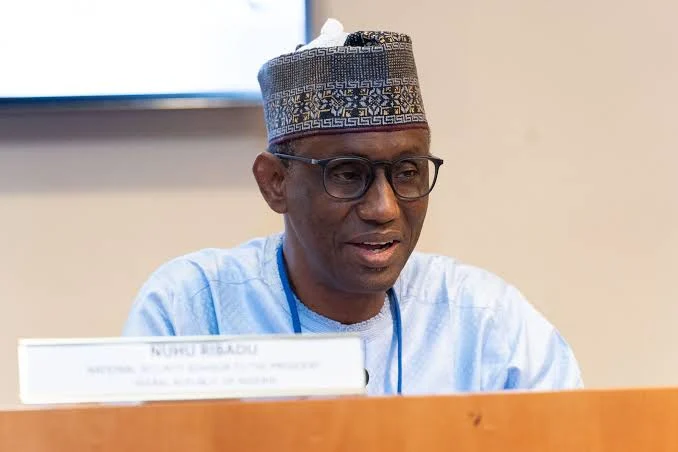
National Security Adviser (NSA) Nuhu Ribadu has said there is still work to be done in the task of building the nation.
Ribadu spoke at a symposium/dinner in honour of a veteran journalist and social activist, Dr Chido Onumah, to mark his 60th birthday in Abuja yesterday.
The NSA who was the special guest of honour at the event with the theme; “Formation or Nation Building: Nigeria’s Troubled Quest for a Modern Federal Republic,” said the enormity of the task ahead demanded the contributions of conscientious Nigerians like Onumah who had already given their all for the advancement of the country.
Ribadu, a former chairman of the Economic and Financial Crimes Commission(EFCC), recalled that the celebrant, who was a pioneer team member at the anti-graft agency, contributed greatly to its success.
“He(Onumah) is a very good person, very good Nigerian and I’ve really had the best with him. We worked together at the time during our early days, in our 30s and 40s, he participated fully in everything we did in the establishment of the EFCC, FIU and so many others.
“He remained faithful, honest all through and he continued to be a very good Nigerian, exceptionally brilliant and continued to put it into good use. He has a lot to offer, he’s a good man, brilliant, like I said.
“There’s still work to be done, and people like him will continue to be very much in demand and use for our country, very much in demand, and he will continue to be the good Dr Chido Onumah I know,” Ribadu added.
Also speaking, chairman of the occasion and a former governor of Ekiti State, Dr Kayode Fayemi, said Nigeria belongs to all her citizens and not just politicians.
According to him, those who are not necessarily involved in partisan politics should not cede their right to change society to politicians alone because they do not always know better.
“Professor Ochefu is right, when it suits politicians, they will do what is required. But citizens must make that possible. Citizens must put the feet of politicians to the fight so that they do the right things, not just what suits them, but what suits their interests.
“I believe that is the journey you have been consistently involved in, Chido, and it’s one that you cannot get tired of. Nigeria is unfinished greatness. It cannot just be arrested by political machinations.
“That commitment, that passion that drove you into working against dictatorship is required even now more than ever in ensuring that the Nigeria Project is one that achieves that vision you had when you were involved in the democracy movement.
“The work has to continue with greater vigour with more passion, with more commitment so that we can turn this electoralism to genuine democracy because we’re still on that journey.
“We need patriots like you to continue to work in the greater interest of the greater public good. The struggle is still one that must continue. As my old friend whom you know very well would say, we can’t continue it if we continue to agonise. We have to organise and you’ve been part of that organising,” Fayemi stated.
A former minister of education and a panelist at the event, Dr Obiageli Ezekwisili, said until citizens take ownership of Nigeria, all of what is constructed as models for nation building would not happen.
She called on Nigerians to stop agonising but wake up and demand accountability and good governance from their leaders and contribute actively to nation-building.
“We need to stop agonising. We need conversations. We’ve had so far. I think that anyone who has s followed my way of thinking about the failures of the Nigerian state would come to the conclusion that I absolutely believe that until the citizens of Nigeria take ownership of Nigeria, all of what we construct as models for nation building will not happen.
“Perhaps that is what is going to show you my own trust of thought compared to the socialist trust of thought. From a demand and supply side analysis of what it means to have a society and to function in a democracy.
“One thing that is clear is that the supply side of the Nigerian society has been more in existence, more mature and therefore more powerful. The supply side being what you call the state and its organisations. I call them departments and agencies.
“That demand side is essentially the citizen side. It is about the people of a society who demand on the basis of the ideals of the values that they share. It’s on the basis of the vision that they have rallied behind. And it is often on the basis of an agreed identity.
“Now these three state formation things are lacking in the Nigerian context. So where is the shared values that we would say we all have agreed to? As a society, when someone can just jump in and say perhaps the idea that it is entirely okay to subordinate a common good, a collective good, to narrow and personal interest is a shared vice, not value. No, that’s certainly not value.
“The supply side seeing how weak and totally without form the demand side is, has become a really entrenched formation of a captured scenario. So that capture has happened because a few, as a subtract from the Nigerian people, have been able to enter into politics and through politics define the standard of the supply that is available in governance,” Ezekwisili stated.
She also dismissed the idea of elite consensus concerning Nigeria as the country does not have elite but ruling class.
The former minister said, “Nigeria does not have that thing defined as elite. What we have is a political class towards the common good. These people who are migratory elements, migrating from one platform to another platform, does that make for an elite class?”
Another panelist, the executive director of Yiaga Africa, Samosn Itodo, said it was unbelievable that Nigeria had come to a point where it normalised impunity and made it a part of her culture.
He said healthy societies have red lines that the powerful must not cross but in “our own time, they do not just cross the lines, but they want to make us believe that the lines no longer exist.
“There are no lines because the question is, how did we get to a point where, in some instances, judges are compromised to deliver warped and jaundiced judgments? And the ruling class wants us to accept this as the normal. There are no red lines, and we’ve crossed the red lines and erased them.
“The second on the issue about the demand side is the rigging of the minds that have taken place. So today, building up to the next elections, the politicians want us to believe and some section of the political class want us to believe that the results of the 2027 elections have been written because every attempt is being made to decimate the opposition.
“This system needs pressure. And the pressure has to come from citizens. And it’s not just protesting. It’s about getting active and preparing, not just for the next elections. But before we get to the next election, there has to be a country. Because without a country, we would not have elections in 2027.And I think we just really need to push back,” Itodo added.
In a keynote address, the National Chairman of Association of Nigerian Universities Alumni, Professor Yakubu Ochefu, said after the independence struggle and
having inherited the Nigerian state, there was disagreement on what to do with that particular state.
The former Vice Chancellor of Kwararafa University, Wukari in Taraba state said, that scenario laid the foundation of a crisis that the country is witnessing even more today.
“By the time we get into independence, you begin to see where the different interests of the various nationalist groups began to align and misalign and triggered a crisis that ended up with the first system crash that we saw in 1966.
“Now, at some point in the paper, I said let us imagine Nigeria as a computer, where we have the constitution as our operating system, the people as our hardware, and then of course the software and the hardware elements that drive it. And so we have a situation where we have an operating system that is 60 years old on a hardware that is very modern.
“What that tells us is that if we check where we have been through all the national development plans, through all the projections, all of those things that we have done, all our efforts on this thing, we still come back to the same issue. Why have we not developed? Formation of a nation is different from nation building,” the historian noted.
Ochefu noted that the younger generation see the country very differently from the way the older one does and if “we don’t have a brutally frank conversation with them on how we want this country to be run, we are going to force onto an agenda a topic that we don’t like. We saw signs of it at the level of the EndSARS.”
Citing the revolution in telecommunication which did not take longer time, the professor of history said; “this simply means that once the politicians put their willpower behind anything they want to do, it gets done.
“But when it is not in their strategic interest, or when they’ve looked at it and see that it’s not going to favour them in one way or another, they begin to divide.
“It’s how to resolve the issue of the will of the politicians to align that will with the interest of people that we need to focus on and see how we can make that happen.”
We’ve got the edge. Get real-time reports, breaking scoops, and exclusive angles delivered straight to your phone. Don’t settle for stale news. Join LEADERSHIP NEWS on WhatsApp for 24/7 updates →
Join Our WhatsApp Channel