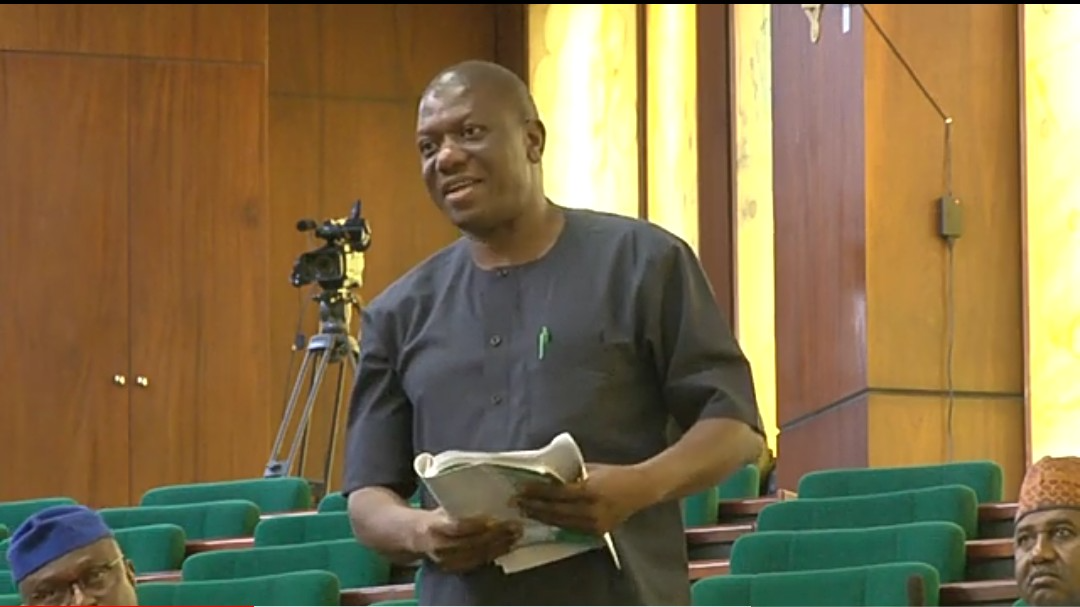
Senator representing Kaduna South, Sunday Marshal Katung, has declared that his loyalty to President Bola Tinubu transcends party affiliation, saying he would have openly worked for the President’s re-election even if he had remained in the PDP.
Katung said Tinubu’s establishment of a federal university, a college of medicine and a federal medical centre in his zone made his support for the president a moral responsibility.
Katung, who recently defected to the ruling All Progressive Congress (APC), said gratitude, not political calculation drove his decision, noting that Tinubu’s interventions in Southern Kaduna within 18 months surpassed anything previous administrations had done.
According to the Senator “Even if I stayed in PDP, I would have still worked 100 per cent for President Tinubu. No President, living or dead, has done for my people what he has done.”
Speaking in an interview with select journalists, the senator who has funded sickle cell treatment for dozens of constituents without publicity, said the level of neglect in Kauru and Sanga Local Government Areas demands urgent national attention.
According to him, while many commend his discreet support for sickle cell patients, his broader vision for the district is centred on “a comprehensive infrastructural revival” and community-driven development.
The senator recalled that during the political negotiations that preceded his recent defection, party stakeholders highlighted various achievements to him. But he told them his priorities were not personal.
He further disclosed that, after consulting widely with stakeholders back home, the consensus was that supporting Tinubu fully was the right and honourable thing to do.
“Remaining in PDP while working for him would have amounted to antipathy. My people said when someone does this much for you, you don’t stand aside,” he said.
“I told them I had nine major issues affecting my constituents. These people have been neglected for years. From what I know, they are among the most neglected communities in this country,” he said.
He narrated how entire communities in Kauru are now inaccessible, with residents unable to reach neighbouring villages or transport farm produce to markets.
“It pains me that in a country where we claim to spend so much on infrastructure, there are still places totally cut off from civilisation,” he lamented.
He gave a striking example of his preferred route—Jere, Kuru Minjibu, Kwoi, Kafanchan up to Kanahuli—describing it as a stretch that urgently requires federal intervention.
The road is his nominated “one critical project” in the 2024 federal budget.
In Sanga, he said, the situation is not any better. “A 15-minute journey takes three to four hours. Some communities cannot even access others within the same local government.”
He recounted the tragic incident of students who drowned in Kauru last year. Visiting the community, he said he personally crossed the river to see the terrain.
“I became emotional. These are Nigerian citizens—and this is what they go through daily,” he said.
Beyond roads, he said many communities remain in complete darkness. In one particular village, his Special Assistant on Projects had to paddle a canoe to carry out an assessment. Villagers told the aide he was the first government representative they had ever seen—even
Beyond politics, Katung said one of his strongest motivations in the Senate is his revived sickle cell bill, which he described as a deeply personal mission dating back more than three decades.
He recounted a 1991 encounter with a child battling sickle cell crisis who pleaded with his parents to “allow him to die so they could rest,” a moment he said has haunted and driven him ever since.
Katung first attempted to sponsor the bill in 2016 while in the House of Representatives, but it stalled. Now, he insists, the legislation must be completed because “too many people have died needlessly.”
He also recalled the case of the late Kaduna Military Administrator, General Mukhtar, whose children died one after the other from sickle cell crises—an experience he described as painfully unforgettable.
The senator disclosed that a public hearing on the bill is scheduled for Monday, after which the National Assembly will conclude work and forward it to the President for assent.
The bill proposes treatment centres in every local government area, centres of excellence across the six geopolitical zones and policies to boost local production of critical sickle cell medication currently sourced from London.
Katung praised religious institutions for insisting on premarital genotype screening but said mandatory testing should emerge from stakeholder submissions to avoid unnecessary sensitivities.
He revealed that his NGO currently supports about 55 sickle cell patients under the care of a public-health physician, adding that he does it as a personal sacrifice, not for publicity.
The senator emphasised that his priorities include roads, healthcare facilities and electrification, stressing that bottom-up planning and genuine community engagement are key to curbing insecurity and youth restiveness in the region.
We’ve got the edge. Get real-time reports, breaking scoops, and exclusive angles delivered straight to your phone. Don’t settle for stale news. Join LEADERSHIP NEWS on WhatsApp for 24/7 updates →
Join Our WhatsApp Channel