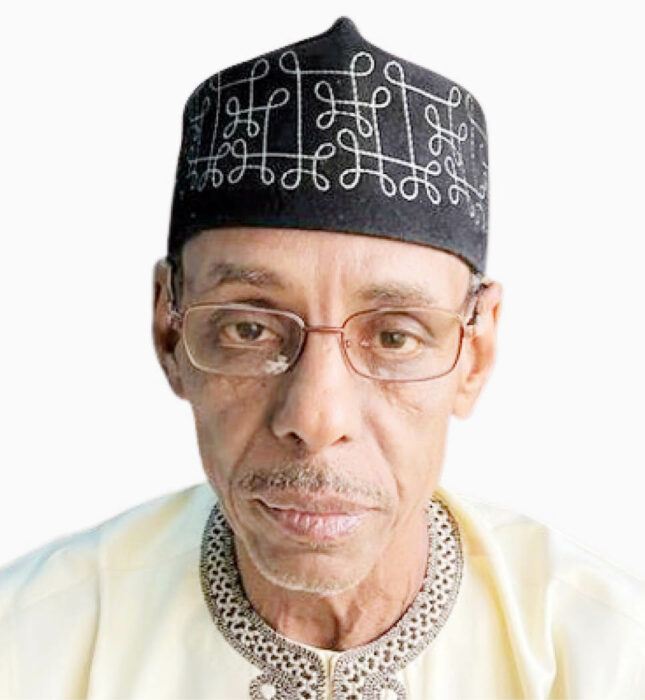
Hakeem Baba-Ahmed is a former special adviser to President Bola Tinubu on Political Affairs and a former spokesperson of the Northern Elders Forum (NEF). In this interview with ADEMU IDAKWO, he raises grave concerns over Nigeria’s leadership crisis and the state of democratic governance, situating his views within the broader national debate on insecurity, economic hardship, and the fragile question of national unity.
You have argued that the President should not pursue a second-term bid. What experiences or concerns led you to that conclusion, and on what grounds do you believe stepping aside would better serve the nation’s interests?
I have been active politically and have been in public service for close to 40 years. I have seen all types of leaders at national and sub-national levels at very close quarters.
I have worked with presidents and heads of state. I am familiar with the challenges of running Nigeria. I know it is one of the most difficult tasks any human being can undertake.
Nigeria today, and the Nigeria we want to see in the next two to three years, secured and beginning to regain economic prosperity, is not suited to someone like President Bola Tinubu, who has a very laid-back approach to leadership and governance.
And of course, his personal challenges, age and perhaps health, may be a hindrance to outperforming someone younger.
I worked with them briefly. I know what good governance looks like when I see it, and I know nothing will make him a better president in another four years in office. That is why I advised against it.
Many critics argue that you were less vocal during the Buhari years, despite claims that his administration entrenched poor governance. How do you explain that relative silence?
I was not quiet then. Anyone saying so may not be conversant with me or my struggle for a better Nigeria. I criticised Buhari more than any person in the country. I was among the loudest critics; I criticised him more than any other president.
I criticised him for not governing at all. In 2019, the organisation of which I was a member summoned the courage to invite all the socio-cultural groups in Northern Nigeria, and we spearheaded a conference in Abuja where we warned Nigerians that Buhari should not be voted for again because he had not done well.
I was his worst critic, and a very responsible one at that. For anyone to say I did not criticise him or that I was quiet about his administration is most unfair and complete nonsense.
On a scale of performance, what ratings would you give former President Muhammadu Buhari and his successor, President Bola Ahmed Tinubu, and why?
I have not seen much difference between the two. I have said before that Buhari did great damage to the country, and Tinubu inherited a badly damaged nation from him.
Instead of fixing it, as we expected from an experienced politician, Tinubu has continued from where his predecessor stopped. We have seen even worse outcomes this time. A president who sits for two years without appointing ambassadors?
We voted for Tinubu because we believed he had the zeal and determination to return the country to the right direction, but what we are experiencing is worse than what he met.
He has not made any significant effort to improve the security situation. Poverty levels remain high, communal crises persist, and the economy is bleeding. How do you rate him above President Buhari?
Buhari abdicated his responsibilities for eight years, while Tinubu’s two years in office have, in effect, made Buhari the second worst.
If President Tinubu does not contest in 2027, who, in your view, should succeed him, and on what qualities should that choice be based?
I do not particularly want anybody. What I am looking for is a Nigerian who believes in the continuity of this country and who has the potential to make Nigeria one of the best countries in the world.
That person must be honest, energetic, educated, and competent. He or she must be a leader who can reunite the nation and give our children hope for a brighter future.
We have many such people in this country, across different political parties, not those who merely have money and are desperate to remain in power without using it to improve the lives of Nigerians who are dying daily from hunger, insecurity, and health challenges without any meaningful government intervention.
Do you believe any political party besides the All Progressives Congress (APC) has a real chance of breaking the ruling party’s hold on power and winning the presidency in 2027
Why not? If they field credible candidates and mobilise the people effectively against the All Progressives Congress (APC), they can win. We did it in 2015, and it is still possible.
Nobody thought Buhari’s APC would defeat Jonathan.
I was part of that campaign, and despite the strength of the PDP, we defeated them.
However, the opposition must think outside the box. They must do things differently to convince Nigerians that they can provide a genuine alternative to the present style of governance and leadership.
In your view, what do you think accounts for the appeal of the All Progressives Congress among those who are defecting to it?
The APC offers political comfort, the belief that defectors will receive automatic tickets and protection from prosecution for corruption and wrongdoing after leaving office.
They are in the party that controls the centre and, by extension, much of the economy.
By February or March next year, the APC is likely to have more governors.
These politicians simply want to be where they can win elections, not necessarily to serve or govern the people well.
They are interested in power, not outcomes. The APC has increasingly become a refuge for selfish politicians.
You’ve observed challenges within the opposition, what do you see as the main reasons they have struggled to present a united front against the ruling party?
The problem lies within the opposition. They have been unable to agree on leadership, and time is not on their side.
They are overly focused on who becomes the presidential candidate.
To win the 2027 election, they must unite and agree on a common identity that convinces Nigerians they can tackle insecurity and revive the economy.
They must show they can introduce policies to salvage the battered economy, reunite the country by addressing Muslim–Christian tensions, the North–South divide, and properly integrate the South-East into the national political equation.
However, in my view, the opposition is not yet radical enough to effect such change.
They must also change familiar faces Nigerians are tired of seeing if they want to regain public confidence.
You’ve mentioned that your role as Special Adviser was limited. What structural challenges prevented you from fully executing your responsibilities?
I worked as a special adviser to the President in the Office of the Vice President. Under the presidential system we practise, the Vice President is expected to have defined responsibilities, but in this case, there were none.
Many people were redundant and under-utilised.
The President operated largely on his own. I became tired of staying idle and decided to quit.
Resigning from a political appointment is rare in Nigeria, especially given the perks and allowances involved. What principles or convictions gave you the courage to step down despite these incentives?
Everyone has principles. I could not continue idling away. I accepted the appointment because I was eager to contribute to solving pressing problems, but there was no platform to present ideas that could improve governance.
I am a member of the Peoples Redemption Party (PRP). Ideologically, we see things differently. I cannot watch things go wrong and remain unable to correct them.
Looking back, once declined a meeting with President Tinubu for fear of saying uncomfortable truths. If that meeting were possible now, what would be the first issue you would raise?
I would tell him he has done his best and given what he can. History granted him the opportunity and the power he sought. He said “Omilekan,” and circumstances favoured him.
He has served, and I do not believe he has much more to give this country. He should not consider recontesting in 2027.
That would be the greatest advice I would offer if we met again.
Some Northern leaders have publicly endorsed President Tinubu for 2027. Would you say that there’s a gap between elite political support and popular opinion?
Those leaders are governors, senators, and defectors from other parties to the APC. The APC appears to lack a strong organic connection with the grassroots.
They engage mainly with politicians and small circles of supporters who make the noise of endorsement.
Visit villages and towns and speak directly to the people. They will tell you they have suffered enough.
We have paid a heavy price for insecurity. We hear of huge funds being generated and shared among states and local governments, yet the people see no benefit.
This is not the government we voted for. Those praising it have largely lost their conscience.
When citizens chase and stone their representatives, chanting “Ba mai, ba mai,” it shows a deep disconnect.
Anyone who cannot return home without police protection cannot truly claim to represent the people.
Some allege that your criticism of President Tinubu is driven by bias because he is not from the North. How do you respond to this claim, and what truly informs your stance on leadership and governance?
I do not dislike anyone. My concern is with leaders who acquire power and fail to use it for national good.
Ethnicity is irrelevant to me. I criticised Buhari throughout his tenure and even campaigned for him.
I criticise Tinubu because he failed to correct the damage Buhari caused, not because he is from Lagos State.
Would you be willing to support a competent presidential candidate from another region, and what factors would guide that decision?
Yes. I have always said leadership is about competence and national unity, not geographical origin. I will support those who meet the criteria I have told you that Nigerians deserve as of now.
As chairman of the Northern Reconciliation Group (NRG), how can mutual understanding and coexistence be rebuilt among communities in the North despite religious tensions and cultural differences?
In our hearts, we know we have wronged one another, but we must recognise that we need each other as people of the same region.
We practise different religions and speak different languages, yet we live together.
The group has reached out to Christian Association of Nigeria (CAN) chapters in 19 Northern states, as well as the Muslim body, Jama’atu Nasril Islam (JNI).
We remind them that those killing us do not distinguish between Muslims and Christians.
We must unite to end the violence.
The response has been encouraging, and we hope communities will domesticate this movement across the North.
We’ve got the edge. Get real-time reports, breaking scoops, and exclusive angles delivered straight to your phone. Don’t settle for stale news. Join LEADERSHIP NEWS on WhatsApp for 24/7 updates →
Join Our WhatsApp Channel