
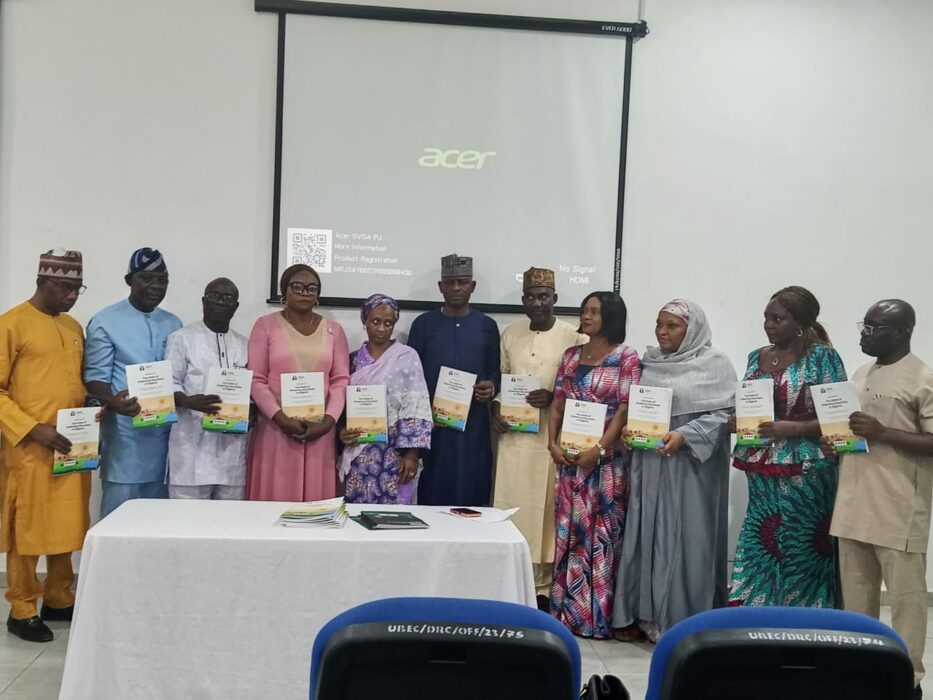
The Universal Basic Education Commission (UBEC) and the Institute for Greening Education in Nigeria (IGEN) have called for the integration of climate change education, environmental sustainability and green skills development into Nigeria’s school curriculum to prepare young people for emerging environmental challenges.
The call was made in Abuja at a Technical Working Group Meeting on the Greening Schools and Climate Change Education Intervention (GSCCEI), where the organisations unveiled the State of Greening Education in Nigeria Report and its accompanying policy brief.
The publications are designed to provide an evidence-based framework for strengthening environmental sustainability in the education sector through improved policies, institutional collaboration, teacher training and practical climate action in schools.
Speaking at the event, UBEC Executive Secretary, Mrs Aisha Garba, represented by Dr Lydia Gbagi, reaffirmed the commission’s commitment to transforming Nigerian schools into environmentally responsible, climate-resilient and sustainable learning environments.
She said the initiative was aimed at equipping learners with not only academic knowledge but also the values, competencies and practical skills needed to respond effectively to emerging environmental challenges.
Providing an update on the intervention, Gbagi disclosed that 33 states, including the Federal Capital Territory (FCT), had benefited from state-level capacity development training.
She explained that the training, delivered through the State Universal Basic Education Boards (SUBEBs), focused on climate change education, integrating environmental sustainability into teaching and learning, establishing Climate Change and Green Champions Clubs, promoting practical greening activities and strengthening monitoring and reporting mechanisms.
According to her, UBEC had also developed implementation guidelines and training materials to facilitate the nationwide rollout of the programme.
These include the GSCCEI Implementation Guidelines, Handbook for Climate Change and Green Champions Clubs, and guidelines for Green Schools and Climate Change Interventions.
She further disclosed that the National Greening Schools Programme (NGSP) had been developed as a comprehensive framework for promoting environmental sustainability across Nigerian schools, with seven strategic pillars guiding its implementation.
Garba added that the capacity development initiative had produced state-level master trainers who would extend the training to local government areas and individual schools.
She noted that the intervention aligned with the Federal Government’s education reform agenda, the Nigeria Education Sector Renewal Initiative, the Climate Change Act 2021, Nigeria’s Nationally Determined Contributions and UNESCO’s Greening Education Partnership.
Earlier, the Executive Secretary of IGEN, Unyime Robinson, described the unveiling of the report and policy brief as a major milestone in efforts to position education as a critical instrument for tackling climate change, environmental degradation and other sustainability challenges.
He observed that climate change, biodiversity loss and unsustainable consumption were increasingly threatening communities, livelihoods and education systems, underscoring the need for coordinated and sustained interventions.
Robinson stressed that greening education should go beyond teaching students about climate change to embedding sustainability principles in education policies, curricula, school infrastructure, institutional management, teacher development and practical skills acquisition.
He explained that IGEN was established to promote environmental sustainability, climate change education and green skills development across Nigeria’s education system.
According to him, the newly launched report assesses the state of greening education in Nigeria, highlights existing progress and implementation gaps, and provides recommendations for strengthening policies, institutional coordination, implementation and accountability.
He, however, emphasised that the value of the report would depend largely on stakeholders’ commitment to translating its recommendations into practical interventions.
The IGEN chief therefore called for stronger collaboration among federal and state governments, education agencies, development partners, civil society organisations, the private sector and other stakeholders to ensure effective implementation.
He also advocated increased investment in teacher capacity development, climate-smart school infrastructure and green skills training to equip young Nigerians with the competencies required to take advantage of emerging opportunities in the green economy.
Robinson commended the African Centre for Environment, Agriculture and Rural Development, Green Schools International Foundation, researchers and other partners for their contributions to the development of the report and policy brief.
Both UBEC and IGEN expressed optimism that the publications would provide strategic guidance for ongoing education reforms and strengthen efforts to make environmental sustainability an integral component of Nigeria’s education system.
They urged relevant stakeholders to move beyond policy commitments and translate the recommendations into concrete actions that would make schools centres of environmental learning, innovation and practical climate action.
The initiative is expected to foster a generation of environmentally conscious Nigerians equipped with the knowledge, values and skills to contribute to a greener, climate-resilient and sustainable society.
We’ve got the edge. Get real-time reports, breaking scoops, and exclusive angles delivered straight to your phone. Don’t settle for stale news. Join LEADERSHIP NEWS on WhatsApp for 24/7 updates →
Join Our WhatsApp Channel