
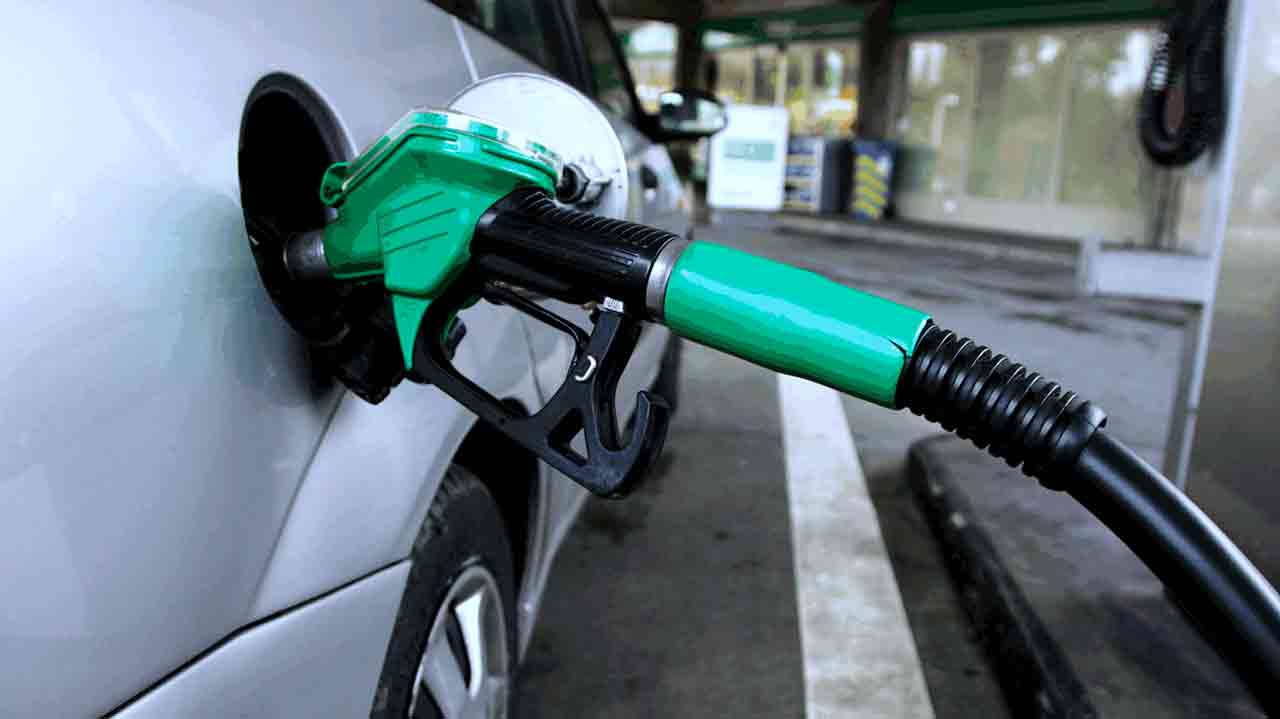
The escalating conflict between the United States, Israel and Iran has triggered a sharp surge in global oil prices, pushing domestic petrol costs higher across Nigeria amid fears of disrupted supplies from the Middle East.
Brent crude oil prices jumped over 8% to above $95 per barrel on Monday, marking the highest level since late 2024, as traders reacted to reports of Israeli airstrikes on Iranian oil facilities and retaliatory missile exchanges in the Strait of Hormuz.
In Nigeria, the Dangote Petroleum Refinery raised its petrol gantry price from N774 to N875 per litre on Monday, a development that will prompt pump price adjustments across retail stations in the country amid surging global crude costs tied to the Middle East conflict.
Currently, NNPC retail outlets in Abuja dispense petrol at N875 per litre.
Following Dangote’s gantry hike to N875 per litre—up from N774—retail pump prices at partner stations like MRS are likely to now align toward N890–N900 per litre to cover distribution margins and taxes.
US President Donald Trump projected the conflict to last four to five weeks but warned of a bigger phase ahead.
Defense Secretary Pete Hegseth dismissed “endless war” talk, while Iran’s security chief rejected US-Israel talks.
Iran produces 3.3 million barrels daily (3% of global output) and controls the Hormuz access for 20 per cent of the world’s oil and LNG flows to markets like China and India.
“The longer the war and blockade persist, the greater the fear in markets,” said Arne Lohmann Rasmussen of A/S Global Risk Management.
JPMorgan estimates that a 25-day Hormuz halt would overflow storage, slashing output.
A Dangote Refinery official confirmed the N875 gantry price to a national newspaper on Monday, citing crude volatility and replacement costs.
US President Donald Trump said the conflict is projected to last four to five weeks but added that the US is prepared to fight longer, saying a “big wave” has yet to come.
US Defence Secretary Pete Hegseth, for his part, rejected the idea of an “endless” war.
The Islamic Republic of Iran’s security chief, meanwhile, ruled out negotiations with the US and Israel.
The war marks a dangerous new phase for the Middle East and the global oil market. Iran pumps about 3.3 million barrels a day, or 3 per cent of global output, but it wields greater influence over energy supplies given its location alongside the Strait of Hormuz.
Oil from the Persian Gulf must pass through the waterway to reach major markets such as China, India and Japan. The chokepoint handles a fifth of the world’s oil and a similar portion of liquefied natural gas.
“The longer the war and the blockade persist, the greater the risk that more and more fear will creep into the market,” said Arne Lohmann Rasmussen, chief analyst at A/S Global Risk Management. “We see further upside today.”
JPMorgan Chase & Co. estimates that a halt in Hormuz lasting 25 days would fill producer nations’ storage tanks, forcing them to cut production. Insurance markets are already scrambling to work out how to price the risk.
A US-flagged oil tanker that operates as part of a military fuel supply programme was hit in the region, while at least four vessels were targeted on Sunday. Naval forces described the threat as “critical,” and swathes of shipowners aren’t transiting.
A senior official at the Dangote refinery was quoted as confirming the increase on Monday, noting that the adjustment followed recent volatility in global crude oil prices.
“The new gantry price is now N875 per litre from N774, and the review became necessary due to changes in global crude fundamentals and replacement costs,” the official was quoted as saying.
Efforts by LEADERSHIP to get a clearer picture of the situation at the refinery were unsuccessful at the time of filing the report, as the spokesperson for the Dangote Group, Anthony Chiejina, did not respond to our emails or pick up his calls for comment.
According to petroleumprice.ng, the revised price had already been reflected, indicating a shift in downstream pricing benchmarks.
The price increase came shortly after the refinery suspended petrol loading operations effective midnight on March 2, 2026, following a sharp surge in international crude oil prices, which crossed the $80 per barrel threshold overnight.
Meanwhile, the Centre for the Promotion of Private Enterprise (CPPE) has highlighted the possible consequences of the ongoing Middle East crisis on Nigeria’s economy.
The chief executive officer of the Centre, Dr. Muda Yusuf, said that the Iran–U.S.–Israel conflict represented a classic double-edged shock for Nigeria.
The CPPE, however, urged the government to strengthen oil production capacity, intensify anti-theft operations and incentivise upstream investment to maximise output within OPEC limits.
Yusuf also called for the firming up of fiscal buffers and channeling excess revenues into stabilisation and sovereign savings frameworks.
Other recommendations include deepening domestic refining to reduce vulnerability to imported refined products; enhancing transparency and liquidity in the foreign exchange market to mitigate volatility; cushioning vulnerable households against energy-driven inflation shocks; and expanding non-oil exports in manufacturing, agro-processing, ICT and services to reduce external vulnerability.
Higher oil prices may strengthen fiscal and external balances in the short term; however, inflationary pressures, welfare deterioration, capital flow volatility and global growth risks pose significant countervailing threats, he said.
The ultimate impact will depend less on external events and more on domestic policy discipline, he said in a policy brief.
“Strategic savings, production efficiency, macroeconomic prudence and structural diversification will determine whether Nigeria converts geopolitical turbulence into macroeconomic resilience,” he said.
Yusuf warned that the escalating conflict involving Iran, the United States and Israel had injected a new wave of geopolitical risk into the global economy, and energy markets are the first transmission channel.
“Of particular strategic importance is the Strait of Hormuz, through which roughly 20 percent of global crude oil supply is transported daily.
“Any disruption to this corridor has immediate implications for global oil prices, shipping costs, insurance premiums and supply chains. There is also the output disruption effect, as Middle East countries are major oil producers,” he said.
For Nigeria, an oil-dependent economy where crude accounts for over 85 per cent of export earnings and about half of government revenue, the implications are significant.
“The effects will be both positive and adverse, depending on the duration of the conflict and the quality of domestic policy responses,” he said.
Energy analysts have also warned that business entities and families will pay the price through fossil fuel-driven inflation: higher fuel costs, rising energy bills and more expensive groceries as a consequence of the escalating conflict between the US, Israel and Iran.
They said this is all because of a system tied to a volatile, conflict-driven industry.
In response to the escalating violent conflict involving Iran and the reported closure of the Strait of Hormuz, climate justice organisation 350.org warned that the crisis exposes the costs of continued reliance on fossil fuels.
A strait between the Persian Gulf and the Gulf of Oman, the Strait of Hormuz provides the only sea passage from the Persian Gulf to the open ocean and is one of the world’s most strategically important choke points.
Iran holds the world’s third-biggest oil reserves, while the Strait of Hormuz carries one-fifth of the world’s oil and gas supply—making it critical for the global economy and impacting people around the world and their household budgets.
Climate justice organisation 350.org also argued that the crisis highlights the risks of continued dependence on fossil fuels.
Olivia Langhoff, managing director at 350.org, said: “The new war on Iran and the closure of the Strait of Hormuz lay bare the horrendous costs of a world chained to fossil fuels. When global energy security can be upended by a single flashpoint, it shows how unstable and risky our dependence on oil and gas is.
“Renewable energy provides home-grown power that remains secure and affordable regardless of geopolitical shocks.”
The price of crude oil has already risen 20 per cent this year and is expected to spike even more now.
In 2022, energy and food price shocks triggered by the war in Ukraine pushed over 70 million people into poverty in the space of only three months, according to the United Nations Development Programme.
350.org called on governments to accelerate the transition away from fossil fuels and towards renewable energy that strengthens communities, protects the Earth and reduces exposure to global instability.
“Once again, families will pay the price through fossil fuel-driven inflation: higher fuel costs, rising energy bills and more expensive groceries as a consequence. All because of a system tied to a volatile, conflict-driven industry.
“Renewable energy offers a worldwide path to real and long-term energy security, one rooted in cooperation, resilience and justice rather than instability and violence,” Langhoff added.
We’ve got the edge. Get real-time reports, breaking scoops, and exclusive angles delivered straight to your phone. Don’t settle for stale news. Join LEADERSHIP NEWS on WhatsApp for 24/7 updates →
Join Our WhatsApp Channel