
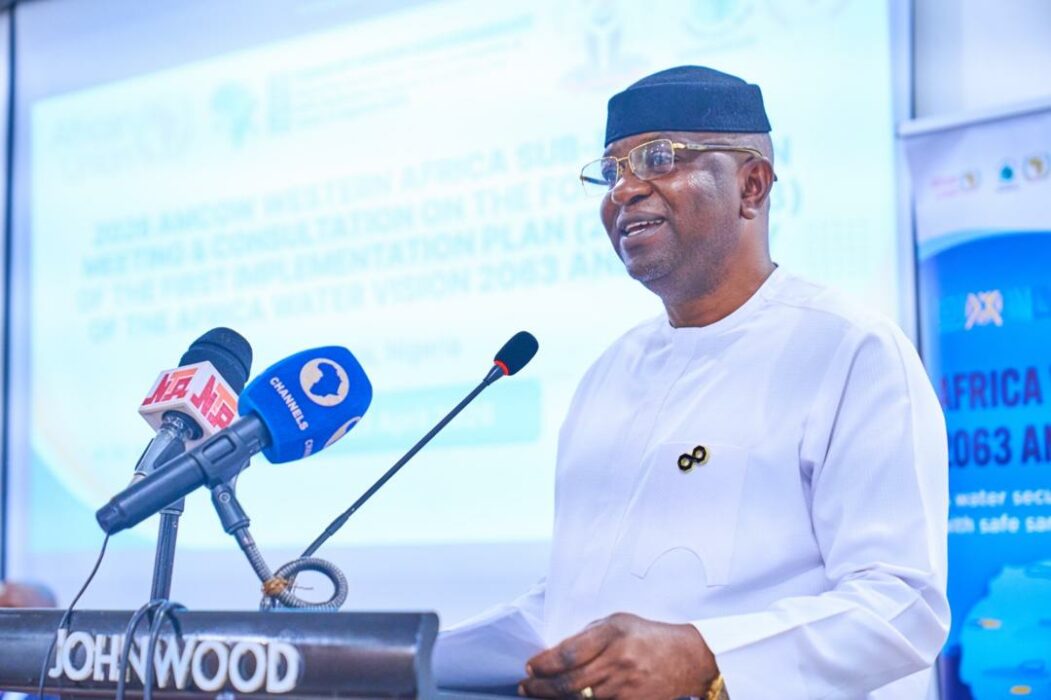
Stakeholders in West Africa have begun deliberations on a new plan to strengthen water security and sanitation in the region, in line with the Africa Water Vision 2063.
The meeting, convened under the African Ministers’ Council on Water in collaboration with the Federal Government of Nigeria, seeks to align regional priorities with Agenda 2063.
In his opening remarks, the minister of Water Resources and Sanitation, Prof. Joseph Utsev, said the consultation offers West Africa an opportunity to speak with “one clear and united voice” on water security ahead of the Africa Water Vision 2063 agenda-setting processes.
He stressed that the region must transition from policy discussions to implementable, scalable actions backed by bankable projects.
Utsev said West Africa’s diverse water realities, from rapid population growth and coastal flooding to drought, pollution, and inadequate sanitation, demand coordinated solutions.
He noted that governments must prioritise cross-border water management, data-driven planning, climate adaptation, and domestic resource mobilisation.
“This consultation is therefore both timely and strategic. It provides the West African sub-region with a unique opportunity to articulate its priorities and contribute meaningfully to shaping the First Implementation Plan (2026–2033) of the Africa Water Vision 2063 and Policy.
“As we reflect on the Africa Water Vision 2025, it is evident that while progress has been made, it has not been uniform or sufficient. Significant gaps remain in achieving universal access to safely managed water and sanitation services, as well as in ensuring sustainable and climate-resilient water resource management across the continent,” the minister said.
Earlier, Chairman of the Technical Advisory Committee (TAC), Mukaila Babarinde, described the consultation as a crucial step toward translating policy commitments into concrete action.
He said the meeting represents a key milestone in efforts to strengthen water security and promote climate-resilient water resource management across the region.
Babarinde urged participants to ensure the emerging implementation plan is practical, inclusive, and grounded in evidence, stressing that technical expertise must guide a roadmap that reflects both national and regional realities.
Also speaking, Nelson Gomonda of the African Ministers’ Council on Water described the adoption of the Africa Water Vision 2063 as a landmark achievement, noting that it marks the first time since 2008 that water and sanitation have received such prominence on the continental agenda.
He said the framework would enable Africa to present a unified position at global platforms, including the 2026 UN Water Conference, and called for accelerated implementation efforts.
Gomonda also urged countries to develop national plans to strengthen ownership and accountability.
In his remarks, the Director of the Water Resources Management Centre at the Economic Community of West African States, Kouassi Alexis, reaffirmed the region’s commitment to the initiative.
He disclosed that ECOWAS was reviewing its 2008 water policy to better respond to emerging challenges, with a revised framework expected by 2027.
Alexis further disclosed plans to host a regional water forum in Abidjan ahead of the next global water conference.
Participants identified several priority areas for the regional agenda, including improved governance of shared water basins, expansion of safely managed sanitation, financing of water infrastructure, strengthened disaster preparedness, and increased youth and women’s participation in water-sector decision-making.
They called for stronger financing models, improved governance, increased private-sector involvement, and enhanced transboundary cooperation to manage shared water resources.
We’ve got the edge. Get real-time reports, breaking scoops, and exclusive angles delivered straight to your phone. Don’t settle for stale news. Join LEADERSHIP NEWS on WhatsApp for 24/7 updates →
Join Our WhatsApp Channel