From repackaged expired products in open markets to chemically preserved meats and poorly stored imported foods, what ends up on Nigerian plates is increasingly raising questions about safety. Despite regulatory agencies, enforcement remains weak, inspections are sporadic, and consumers are left to navigate a market flooded with unlabelled, adulterated and counterfeit products. As food-borne illnesses rise and public trust in the food chain weakens, Inside Nigeria’s Consumer Safety Crisis examines what Nigerians are really eating, who is supposed to keep them safe, and where the system is failing. BUKOLA OGUNSINA reports.
There is a growing crisis eating into the fabric of food safety in Nigeria, and adulterated food is at its heart. From open markets to other informal trading channels, the practice of tampering with food products for profit remains a persistent concern, exposing consumers to substances they may not even know they are consuming.
The concern has been heightened by renewed attention on adulterated palm oil. Social media has been awash with claims about a simple “water test” that supposedly reveals whether palm oil contains dye or artificial colouring. But a research study published in September has cast doubt on the test’s reliability, finding that the water-and-oil method cannot be relied upon to determine whether palm oil has been adulterated.
Then came another warning that brought the issue closer to home. In a video that circulated widely online, former Vice-President Yemi Osinbajo spoke about food safety in Nigeria, recounting how laboratory testing reportedly found his wife’s freshly squeezed orange juice “not fit for human consumption”.
In another video shared more recently on social media, Nollywood actress Ngozi Ezeonu raised concerns about the circulation of counterfeit medicines, baby food and other consumer products in Nigeria, warning that unsuspecting families could be putting their health at risk. She urged Nigerians to be more vigilant about the products they buy and bring into their homes.
In a recent operation, the National Agency for Food and Drug Administration and Control (NAFDAC) uncovered a counterfeit alcoholic beverage operation at the Lagos International Trade Fair Complex. It seized products valued at over N2 billion. The agency also discovered more than 20 unauthorised stores allegedly used for counterfeiting and other illicit activities.
Together, these concerns raise a troubling question: how safe is the food Nigerians consume every day?
Speaking on the issue, economic expert and CEO of Payfair Corporate Services Limited, Bob Ugochukwu Ani, who operates in the food retail space, says it has become increasingly difficult to distinguish genuine products from counterfeit ones, particularly in the informal sector.
“We see concerns around diluted or substituted food products, counterfeit branded goods, expired products that are relabelled, and products whose packaging or labelling has been tampered with,” he also added that there are also quality and safety issues arising from poor storage, transportation and handling.
“In some cases, what consumers consider ‘adulteration’ may actually be contamination caused by poor handling or inappropriate storage conditions. This is particularly concerning because the consumer ultimately bears the health risk.”
The project director of N-MEP and founder of Kaduna Business School, Prof. Dahiru Sani, confirms that food adulteration in Nigeria today spans a wide range of everyday staples.
“The scale of the problem is reflected in the numbers regulators themselves have released. Between May and July 2026, NAFDAC inspected 6,233 facilities across all 36 states and the Federal Capital Territory, and removed 7,210 fake, falsified, substandard or otherwise non-compliant products from circulation, with about 80 per cent of that surveillance activity specifically targeting fake, falsified and substandard products,” he said.
“It is driven largely by the pursuit of quick profit in an economy where many traders, transporters and small processors are under intense cost pressure and operate on thin margins,” he says, noting that what used to be isolated cases now show up across almost every category of food Nigerians buy daily, from cooking oil to fruit to prepared staples.
He further added that the most frequently reported forms include the addition of industrial or synthetic dyes, including azo dyes, to palm oil to deepen its colour and disguise poor quality or age. In more extreme cases, palm oil is mixed with cheaper industrial oils, transformer oil, or lard to increase volume without proportionately raising the price.
Other practices include ripening fruits with calcium carbide and using industrial detergents or bleach during the fermentation and processing of garri and cassava products to speed up production, lighten colour, or improve appearance and shelf life.
Bleach and other harmful chemicals are also used to whiten or preserve fufu and similar staples, particularly products sold loose and without labels. Unapproved preservatives are used to extend shelf life beyond safe limits, while substances such as paracetamol are used to tenderise or “soften” meat before sale.
The Resident Media & Communication Consultant to NAFDAC, Sayo Akintola, also pointed out that fake products cut across many categories, with the most critical being substandard medications that include antibiotics and anti-malarial drugs, which can cause treatment failure, organ damage, and even death.
He also mentioned adulterated food and beverages, including packaged foods, wines, spirits, and basic items such as cooking oil and water.
“Substandard or fake alcoholic drinks have been known to contain harmful substances such as methanol, which can cause blindness or death.
Fake cosmetics, including creams, soaps, and body sprays, are also common. These may contain toxic chemicals like mercury and lead, causing short- and long-term health issues such as skin rashes, kidney damage, and even skin cancer,” he noted.
When identifying adulterated foods, Mr Ani says, the first line of protection is where you buy from and who you trust. “In our business, we pay attention to the source of products and the reliability of our suppliers because the retailer also carries reputational responsibility when something goes wrong.”
He advises consumers to examine packaging, seals, product information, expiry dates, batch numbers and NAFDAC registration details where applicable. They should be cautious about products whose packaging looks suspicious, whose prices are significantly below the normal market price, or whose colour, smell, texture, or taste appears unusual. Not all adulterated food can be physically identified, as some require laboratory tests. “This is why buying from reputable retailers and established distribution channels is extremely important,” he recommended.
Similarly, Prof. Sani says that while laboratory testing remains the only way to confirm adulteration with scientific certainty, consumers can still protect themselves by paying close attention to unnatural colour or shine.
He said, “Palm oil that looks unusually bright red, overly clear, or has an artificial sheen rather than the natural, slightly cloudy deep orange-red of genuine oil should raise suspicion. The same applies to fruit or vegetables with an even, unnaturally glossy or uniform appearance.”
Other warning signs include uneven or premature ripening, strong chemical odours from staple foods, and unusual changes in texture. Garri or flour that appears unnaturally white, excessively smooth or unusually fine and powdery may also warrant caution. Meat that feels unusually soft or “mushy” for its particular cut may have been treated with an unapproved tenderiser. Consumers should also be wary of prices that seem unusually low or simply too good to be true, as well as other warning signs.
NAFDAC’s resident consultant also points out that, as a consumer, knowing how to identify and avoid fake drugs is an essential health skill in Nigeria. Despite raids and seizures by the NAFDAC, there are still pockets of fake products in the market linked to high consumer demand for affordable goods and their easy accessibility through open markets.
“In February this year, NAFDAC intercepted over 10 million doses of fake malaria medications worth approximately N3bn during a raid at the Lagos Trade Fair Market. The eight truckloads of contraband, including anti-malarial drugs, cerebral malaria injections, antibiotics, Postinor contraceptives, and Analgin products, were seized.
“In August last year, the agency also reported the seizure of over 10,000 cartons of unregistered tomato paste and cosmetic products at the same market during a five-day enforcement operation,” he highlighted.
He therefore advises that for regulated products such as medicines, foods, cosmetics and other applicable products, while it is vital to check the NAFDAC registration information, it is not enough.
“A number printed on a package is no automatic proof that the product is genuine, as counterfeiters can copy legitimate registration numbers. Enter the number into NAFDAC’s official online verification portal and compare the result with the product you’re buying,” he explained.
He also advises entering the product name or NAFDAC registration number on NAFDAC’s Greenbook. If the registration details do not match the product name, manufacturer or other information on the package, it becomes a major red flag. Adding that most importantly, “when the product is too cheap, run for your life. If a drug is sold for N2,000 in other chemist shops and you find it being sold for N1,200 or N800, you know that something is not right and it’s a red flag.”
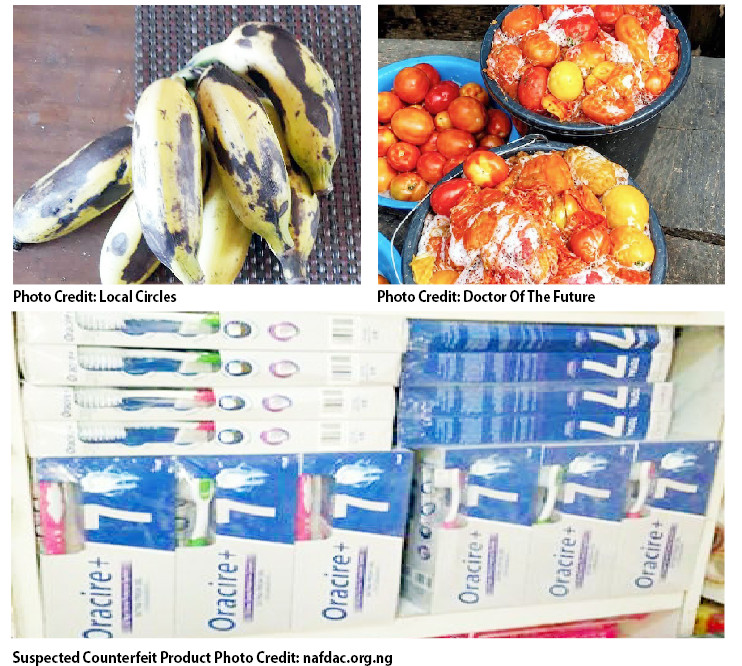
Akintola says other things to look out for include spelling or grammatical errors, poor-quality printing, crooked labels, missing manufacturer information, blurry logos or images, broken or suspicious seals, strange or inconsistent fonts, and altered expiry dates.
Regarding stronger measures to curb this menace, Mr Ani says the solution must start with the supply chain and that it is a shared responsibility.
“Manufacturers must produce responsibly, distributors and retailers must maintain proper controls, regulators must enforce the rules effectively, and consumers must make informed purchasing decisions. As food businesses, protecting the consumer is also fundamental to protecting the trust and reputation upon which our businesses depend,” he said.
Prof. Sani notes that tackling the problem requires more than periodic enforcement raids and public briefings, important as they are. He points to the need for a more structural and sustained response, including closing the regulatory gap in the informal sector, which often falls outside the direct reach of agencies such as NAFDAC, whose oversight is strongest over branded and registered products.
He also called for tighter coordination among regulatory agencies and expanded, decentralised testing capacity, including more accessible, faster laboratory services, mobile testing units, and state-level laboratories.
Other measures he recommends include tougher, more consistent and visible penalties, as well as greater support for legitimate small-scale processors and traders to discourage them from cutting corners. He also emphasises consumer education, a trusted system for reporting food-safety concerns, traceability requirements for bulk staples and regular independent surveys of food markets.
Meanwhile, Akintola notes that NAFDAC has made fighting fake drugs a central part of its mandate, with significant progress made since 2017 when the director general, Prof. Mojisola Adeyeye, assumed office.
“The agency’s efforts, including market raids, port inspections, the Mobile Authentication Service (MAS), and public awareness campaigns, have reduced the prevalence of counterfeit drugs in formal distribution channels. However, challenges remain, particularly in open drug markets and in areas with limited access to licensed pharmacies,” he observed.
In terms of stronger measures by NAFDAC, he emphasised repeated enforcement raids, continuous surveillance, intelligence gathering, laboratory verification and public engagement. He identifies post-market surveillance as a major regulatory control, alongside routine nationwide surveillance, investigation and enforcement, as well as large-scale destruction exercises, all of which are carried out by NAFDAC.
We’ve got the edge. Get real-time reports, breaking scoops, and exclusive angles delivered straight to your phone. Don’t settle for stale news. Join LEADERSHIP NEWS on WhatsApp for 24/7 updates →
Join Our WhatsApp Channel