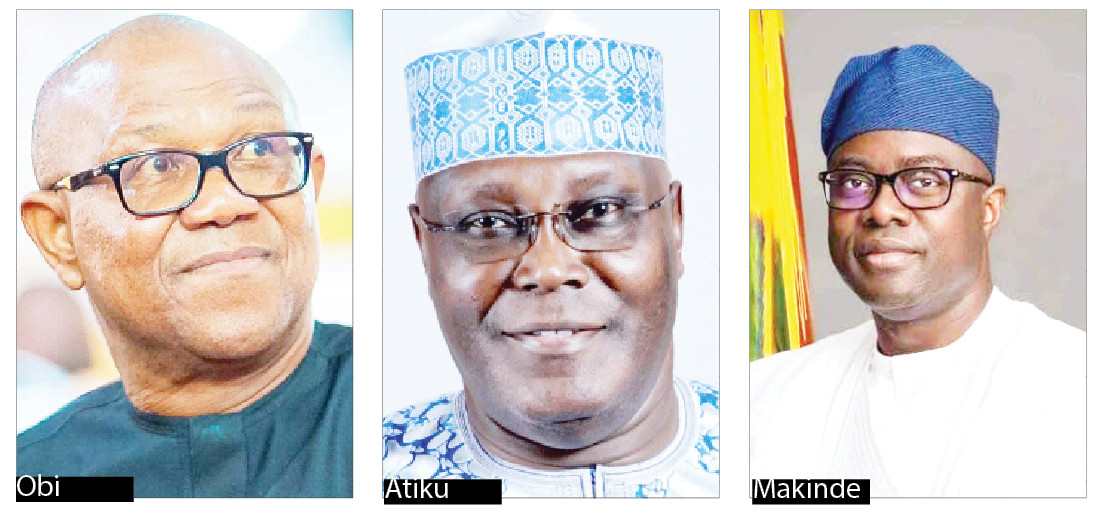
Three opposition presidential candidates have unveiled competing visions for Nigeria ahead of the 2027 general election, outlining plans to tackle insecurity, revive the economy, improve healthcare and education, strengthen democratic institutions and restore public confidence in governance.
The presidential candidates are a former Vice President, Atiku Abubakar of the African Democratic Congress (ADC), former Anambra State governor, Peter Obi of the Nigerian Democratic Coalition (NDC), and Oyo State governor, Seyi Makinde of the Allied Peoples Movement (APM), Atiku Abubakar of the African Democratic Congress (ADC), former Anambra State governor, Peter Obi of the Nigerian Democratic Coalition (NDC), and Oyo State governor, Seyi Makinde of the Allied Peoples Movement (APM.
They revealed their missions in their blueprints, a copy of which was sighted by our correspondent in Abuja on Thursday.
While Atiku is to focus on rescuing democracy, strengthening security institutions, and rebuilding the economy, Obi emphasised national unity, human capital development, agricultural productivity, and the rule of law. Makinde, on his part, vows to pursue the “Reset Nigeria” agenda, centred on security decentralisation, petroleum sector reforms, food security, and people-centred governance.
ADC Administration Will Rescue Democracy, Economy, Security – Atiku
According to Atiku, an ADC administration would focus on restoring democratic values, strengthening institutions and ending what he called the abuse of state power against political opponents.
He said that the coalition behind the ADC was formed to protect Nigeria’s democracy and to offer an alternative to the ruling party.
On security, Atiku described the situation across the country as the worst in Nigeria’s history, noting that citizens and even members of the armed forces had become victims of violent attacks.
He pledged to strengthen the military, police and other security agencies through massive recruitment, improved welfare, modern equipment, enhanced training and better coordination among security institutions.
“An ADC government under my leadership will take decisive action to address insecurity and protect lives and property in the country,” he said.
Atiku also identified education as a key pillar of national development, lamenting that more than 20 million school-age children remained out of school.
He promised free and compulsory primary and secondary education, alongside investments in entrepreneurial, technological and innovation-based learning.
On the economy, the ADC candidate accused the current administration of failing to improve the living conditions of ordinary Nigerians despite official claims of economic growth.
He promised to remove obstacles to investment, attract local and foreign investors, create jobs, and tackle Nigeria’s persistent electricity crisis.
According to him, the savings from removing the fuel subsidy had not translated into improved welfare for citizens, while excessive borrowing was placing an unfair burden on future generations.
Atiku also criticised government spending priorities, noting that healthcare had received inadequate attention.
He pledged substantial investments in primary healthcare, the expansion of specialist medical centres and incentives for private-sector participation in healthcare delivery.
He said an ADC government would be guided by measurable targets and timelines aimed at improving welfare, accountability and service delivery.
We’ll Build Trust In Governance, Restore Hope – Obi
Peter Obi said his campaign would focus on rebuilding trust in governance and restoring hope among Nigerians.
The former Anambra State governor said Nigeria was at a critical moment, with many citizens facing insecurity, unemployment, poverty and uncertainty about the future.
According to him, national unity must be strengthened if the country is to overcome its challenges.
“Nigeria cannot advance while fragmented by ethnic, religious, regional or narrow political divides,” Obi said.
He argued that the country’s diversity should be a source of strength rather than division, and called for greater understanding and cooperation among Nigerians.
On security, Obi expressed concern over Nigeria’s worsening position in global terrorism rankings and pledged to adopt an intelligence-driven, technology-based and community-focused approach to combating insecurity.
He promised to strengthen security institutions, improve operational coordination and address root causes such as poverty, unemployment and marginalisation.
In the healthcare sector, Obi painted a grim picture of Nigeria’s health system, saying only a fraction of the country’s primary healthcare centres were functioning effectively.
He pledged to more than double health insurance coverage within four years and increase healthcare spending to at least 10 per cent of Gross Domestic Product.
The NDC candidate also promised to establish fully functional primary healthcare centres across Nigeria’s 8,809 wards and ensure that at least half of the country’s approximately 30,000 primary healthcare facilities become fully operational by the end of his first term.
On education, Obi described human capital development as central to national transformation.
He promised major investments in schools, teachers, technology and vocational training, saying education should equip young Nigerians not only to seek jobs but also to create them.
He argued that large-scale investments in agriculture would shift Nigeria from a consumption-driven to a production-oriented economy.
According to him, improving agricultural productivity would be a direct pathway to reducing hunger and poverty.
He pledged to increase power generation and distribution by at least 10,000 megawatts within four years.
Obi further promised support for micro, small and medium enterprises through tax incentives, affordable financing and targeted interventions aimed at reducing unemployment and underemployment.
He also vowed to reduce corruption, lower the cost of governance, uphold the rule of law and deepen democratic practices.
“Our democracy will be pursued with integrity, fairness and transparency,” he said.
I’ll Give Greater Power To States – Makinde
Governor Seyi Makinde also said Nigeria needed a comprehensive reset, arguing that existing governance approaches had failed to address the country’s growing challenges.
Makinde said his nomination came at a difficult period marked by insecurity, economic hardship and widespread public frustration.
“Our nation is hurting. Millions of Nigerians are weighed down by hunger, insecurity, rising transportation costs and uncertainty about tomorrow,” he said.
According to him, Nigeria could no longer continue with the same leadership methods while expecting different outcomes.
He identified insecurity as one of the country’s most pressing problems. He argued that governors had been placed in a difficult position by being designated chief security officers without direct constitutional control over security agencies.
Makinde promised that, if elected president, he would pursue reforms to decentralise security management and give states greater capacity to respond to security threats.
“As President of Nigeria, I will work to reform our national security architecture so that states are no longer left helpless in moments of crisis,” he said.
On the economy, Makinde said Nigerians deserved greater benefits from the country’s status as an oil-producing nation.
He pledged to introduce what he called fair and transparent pricing templates for petroleum products and ensure that citizens were protected from arbitrary fuel price increases.
The APM candidate also promised major reforms at the Nigerian National Petroleum Company Limited (NNPCL), saying the organisation must become leaner, more efficient, and more commercially driven.
He further advocated restructuring the ownership framework of Nigeria’s refineries to stop what he described as the waste of public resources on facilities that were not delivering value.
Makinde also highlighted transportation costs as a major challenge facing citizens and pledged to introduce practical support measures for commuters, students, workers and traders.
According to him, transportation costs have become a major burden on households and businesses, requiring practical interventions rather than rhetoric.
On food security, he said his administration would prioritise accurate agricultural data and address weaknesses in production, processing, logistics and storage.
“We will address the issue of food security to ensure that in the midst of abundant resources, Nigerians do not keep going to bed hungry,” he said
Describing his presidential bid as a national project rather than a personal ambition, Makinde said the campaign would focus on rebuilding confidence in Nigeria.
“This journey is not about one man’s dream. It is about rebuilding belief in Nigeria again. It is about the Nigerian Dream,” he said.
The three candidates are expected to intensify their campaigns in the coming months as political activities gather momentum ahead of the 2027 presidential election.
We’ve got the edge. Get real-time reports, breaking scoops, and exclusive angles delivered straight to your phone. Don’t settle for stale news. Join LEADERSHIP NEWS on WhatsApp for 24/7 updates →
Join Our WhatsApp Channel