
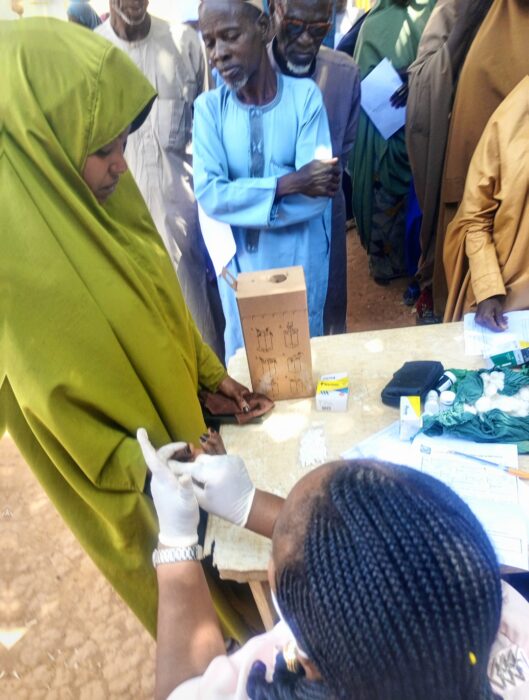
The National Eye Centre, Kaduna, has commenced activities to mark the 2026 World Diabetes Day with a sensitisation outreach to its host community, warning of rising diabetes cases globally and a looming prediabetes crisis in North-West Nigeria.
A family physician with the Centre, Dr. Patricia Ella Idoko, said the outreach, organised in partnership with Ultimate Health HMO, was part of the Centre’s Corporate Social Responsibility (CSR) and a follow-up to an earlier advocacy visit to the palace of the neighbouring community.
Dr. Idoko said the theme for this year’s commemoration is “Early Action on Diabetes,” which focuses on early screening, diagnosis and prevention.
She said activities lined up include health education, blood sugar screening, eye and visual acuity tests, provision of reading glasses for persons with refractive errors, deworming of children, and Body Mass Index (BMI) checks, adding that cases requiring further attention would be referred to the centre.
She noted that about one-third of people living with diabetes in sub-Saharan Africa are undiagnosed, while another one-third of those diagnosed are not on proper medication or control.
Idoko explained that high BMI remains a major risk factor for chronic diseases such as hypertension, diabetes, metabolic syndrome and cancers, adding that diabetes has a direct link with eye health and could lead to diabetic retinopathy and blindness.
“Some people come to the National Eye Centre and that is the first time they discover they are diabetic. By then, there are already changes in the eye called diabetic retinopathy, which can lead to blindness if not treated,” she said.
Also speaking, Dr. Nguyele Nathaniel of the Centre said Nigeria is poor in data keeping and still relies on global statistics.
According to him, global estimates show that one in every nine adults is living with diabetes, with projections that the figure could hit 870 million by 2050.
He urged government at all levels to sponsor sustained grassroots outreaches, radio jingles and television programmes to drive awareness and early testing.
Checks by LEADERSHIP on published peer-reviewed data show a paradox in North-West Nigeria.
While the national pooled prevalence of Type 2 diabetes is 7.0 per cent, according to a 2023 systematic review and meta-analysis published in PMC, the North-West prevalence ranges between 2.0 per cent and 8.49 per cent depending on whether rural or urban populations are considered.
Available state-by-state data for the zone comprising Sokoto, Zamfara, Katsina, Kano, Kaduna, Kebbi and Jigawa show Dakace Village, Zaria, Kaduna State (Rural): 2.0 percent, Sokoto State (Urban): 4.6 percent, Sokoto State (Rural Fulani): 0.8 percent diabetes, but 6.9 percent impaired fasting glycemia and 8.0 per cent impaired glucose tolerance, Katsina State (Urban): 5.3 per cent, Kano State (Hospital-based): Up to 10 per cent
The major concern, however, is prediabetes. Studies show Sokoto rural dwellers have 14.9 per cent prediabetes burden, while 5.5 per cent to 8.9 per cent of adolescents in Kano are already prediabetic, indicating a future explosion.
Experts attribute the looming surge to urbanisation, family history, obesity, high socio-economic status, physical inactivity and low intake of fruits and vegetables.
We’ve got the edge. Get real-time reports, breaking scoops, and exclusive angles delivered straight to your phone. Don’t settle for stale news. Join LEADERSHIP NEWS on WhatsApp for 24/7 updates →
Join Our WhatsApp Channel