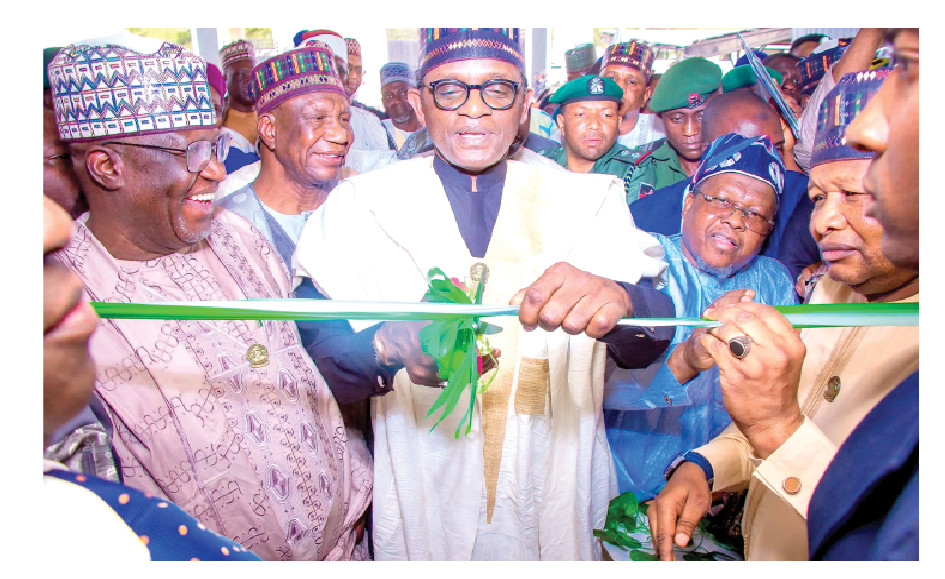
Governor Mai Mala Buni of Yobe State has described the establishment of the Biomedical Research and Training Centre (BioRTC) as a major relief and a beacon of hope in the fight against challenging and emerging diseases affecting communities in the state and beyond.
The governor stated this while commissioning the permanent site of the BioRTC in the Yobe State University, Damaturu, expressing deep gratitude to God and a strong sense of fulfilment over the realization of a project driven by his administration’s vision of placing education, science, research, and innovation at the heart of Yobe’s development agenda.
Buni stated that the state government deliberately adopted strategic measures to facilitate the recovery of the education sector, enhance research, and promote innovation to ensure Yobe becomes part of the global knowledge production space while addressing its peculiar health and developmental challenges.
“As a matter of policy, we increased budgetary allocation to the education sector to support its recovery. In this spirit, the government invested over N800 million to construct this edifice as the permanent site of the BioRTC,” he said.
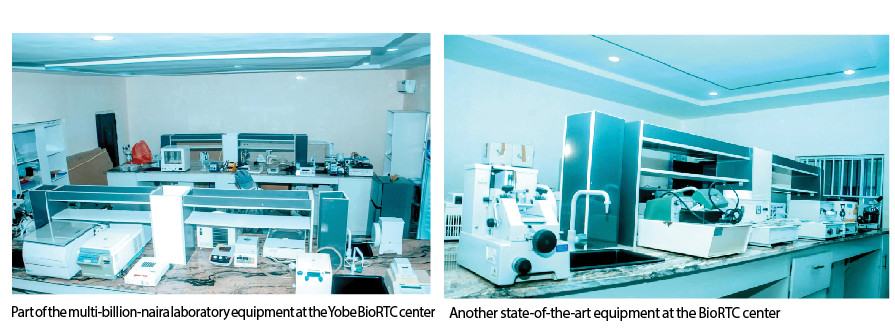
The governor commended Director of the center, Prof. Mahmoud Bukar Maina for his uncommon commitment and generous contributions to the centre, including the donation of equipment valued at over N10 billion, describing the gesture as the launching pad for the take-off of advanced research activities at the facility.
He noted that BioRTC represents a scientific asset that will enable more inclusive, accurate, and people-centred research, stressing that Africa has for too long relied on medical research conducted in environments that do not reflect its genetic diversity, culture, and lifestyle.
Buni expressed pride that BioRTC has established Africa’s first major induced pluripotent stem cell (iPSC) biobank with an African-centred focus, as well as leading the development of one of Nigeria’s most ambitious and deeply characterised dementia research cohorts.
“This work will place Nigeria on the global map in Alzheimer’s disease and brain health research and ensure African populations are not excluded from the future of neuroscience,” he said.
The governor further revealed that the prevalence of chronic kidney disease in communities along the banks of River Yobe, which has claimed many lives and devastated families, was a major motivation behind the establishment of the centre.
He disclosed that preliminary findings from BioRTC’s kidney disease research are already pointing toward possible remote causes of the disease in the state, describing it as an encouraging sign that the investment is beginning to yield results.
Buni recalled that in 2023, he led a state delegation to the United Kingdom to seek partnerships with international research institutions to support the smooth take-off of the BioRTC, adding that encouragement from renowned global scientists helped shape the centre’s progress.
He noted with pride that BioRTC has attracted international recognition, with external observers, including scientists from the Janelia Research Campus in the United States, describing the centre as an exemplary model for building research capacity in underdeveloped regions.
The governor reaffirmed his administration’s commitment to the state-funded kidney disease initiative, stating that dialysis support has been made available to patients and that an additional dialysis centre will be established in Gashua to reduce the burden of long-distance travel for treatment.
He also appealed to the Federal Government to establish a Federal Kidney Disease Centre in Yobe State to further address the growing health challenge.
Buni applauded BioRTC’s innovative open-science initiatives, including the development of low-cost microscopes to support field diagnosis and strengthen community-level health services, especially in rural areas.
He called on the Federal Ministry of Health to partner with BioRTC on open, low-cost diagnostics for malaria microscopy and other community-level diagnostic programmes to ensure that evidence-based innovations from Yobe inform national health practice.
The governor disclosed that over 1,000 people from Yobe, Nigeria, and other African countries have so far benefited from capacity-building programmes at the centre through summer schools, workshops, and international training initiatives fully supported by the state government.
Speaking at the occasion, the Director of the center, Prof. Mahmoud Bukar Maina, described the commissioning as the opening of a possibility, signalling Nigeria’s deliberate shift from being a consumer of global knowledge to becoming a producer of world-class science.
Prof. Maina praised Governor Mai Mala Buni for what he described as visionary and historically significant leadership, noting that the establishment of BioRTC reflected a bold long-term investment in knowledge, innovation and institutional development.
“Advanced science belongs in Yobe State,” he said, stressing that the government’s commitment had demonstrated that transformative leadership is measured not by immediate applause but by generational impact.
We’ve got the edge. Get real-time reports, breaking scoops, and exclusive angles delivered straight to your phone. Don’t settle for stale news. Join LEADERSHIP NEWS on WhatsApp for 24/7 updates →
Join Our WhatsApp Channel