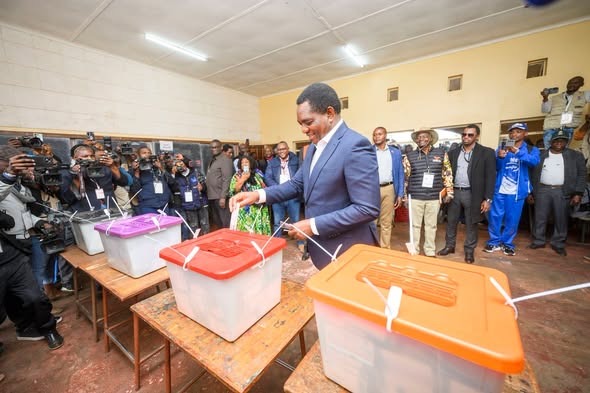
Zambian President Hakainde Hichilema, has been re-elected for a second five-year term after securing about 61 per cent of the votes in the country’s August 13 presidential election.
The Electoral Commission of Zambia (ECZ) announced Hichilema’s victory in the early hours of Tuesday, August 18, declaring him the winner ahead of his closest challenger, Brian Mundubile, who polled about 38 per cent.
ECZ chairperson, Mwangala Zaloumis, declared Hichilema president-elect after the commission completed the bulk of the collation process following four days of vote counting.
Although results from five of Zambia’s 226 constituencies were yet to be tallied at the time of the declaration, Zaloumis said the outstanding results were not expected to materially alter the overall outcome.
Hichilema, 64, contested under the ruling United Party for National Development (UPND) and was widely expected to retain the presidency, having campaigned on his administration’s economic record since taking office in 2021.
His victory marks the seventh time he has contested the Zambian presidency. He lost five previous attempts before defeating then-President Edgar Lungu in 2021.
Mundubile, a former provincial minister and first-time presidential candidate, based his campaign largely on concerns over the cost of living and economic hardship, arguing that improvements in Zambia’s macroeconomic indicators had not translated into better living conditions for many citizens.
The election outcome followed a tense counting process, with the opposition alleging irregularities and possible manipulation of results.
Mundubile alleged discrepancies between results recorded at polling stations and figures subsequently announced during the collation process.
He also called for an independent investigation into reports of possible alterations to result forms.
Hichilema’s camp rejected the allegations, accusing the opposition candidate of making false claims.
Tensions intensified after the electoral commission temporarily suspended the counting and announcement of results following reports of violence against election officials and the theft of marked ballot papers.
The Commission later resumed the collation process.
The opposition also accused authorities of using security agencies to intimidate political opponents.
On election night, authorities arrested 11 people, including prominent opposition figures, during a raid at a location where Mundubile was present.
Government officials said the operation targeted alleged militia activity and claimed those arrested were in possession of military-grade weapons intended for an armed insurrection.
Mundubile rejected the government’s account, saying armed personnel raided his home, using an armoured vehicle to break through the gate and opening fire during the operation.
The government and opposition have continued to give conflicting accounts of the incident.
Hichilema’s re-election was largely anchored on his administration’s handling of Zambia’s economic crisis.
He assumed office in 2021 after Zambia defaulted on its debt amid one of the country’s worst economic crises in decades.
His government subsequently secured major debt restructuring agreements with international creditors and sought to restore relations with global financial institutions.
The administration also intensified efforts to attract investment into the copper sector, which remains central to Zambia’s economy.
The government has highlighted improvements in economic management, free secondary education, expanded social protection programmes and increased investment in community projects as key achievements of Hichilema’s first term.
France 24 reported that the free secondary education policy brought an estimated 2.3 million children back into classrooms, while funding for social cash transfers and community projects was also increased.
However, the economic recovery has not eliminated widespread hardship.
Rising living costs and food prices remained major concerns for voters during the election campaign, providing the opposition with a major line of attack against Hichilema.
Zambia, with a population of about 22 million, is Africa’s second-largest copper producer and has become increasingly important in the growing competition between China and the United States over critical minerals.
Following the declaration of the results, Hichilema thanked Zambians for giving him another mandate and appealed for national unity.
He also acknowledged voters who supported the opposition, saying his government would continue to work for them.
Mundubile had yet to announce whether he would formally challenge the election result.
We’ve got the edge. Get real-time reports, breaking scoops, and exclusive angles delivered straight to your phone. Don’t settle for stale news. Join LEADERSHIP NEWS on WhatsApp for 24/7 updates →
Join Our WhatsApp Channel