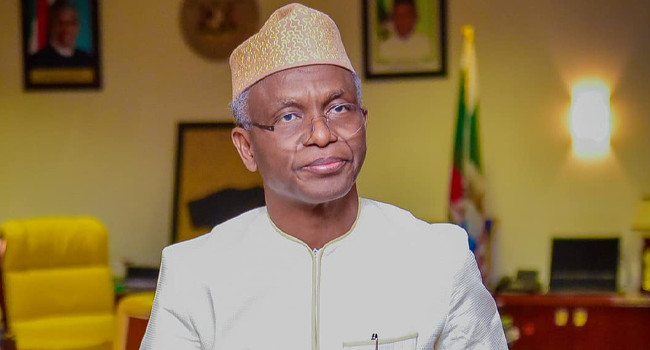
A former governor of Kaduna State, Malam Nasir El-Rufai, has said that as Nigeria prepares for the 2027 general elections, there are disturbing signs that the tradition of competitive democracy is under threat.
Taking to his verified Facebook page yesterday, El-Rufai, who is a chieftain of the opposition African Democratic Congress (ADC), accused President Bola Ahmed Tinubu of attempting to re-engineer the country into a democracy without competition, “featuring elections without real choice and power without legitimacy.”
El-Rufai’s opinion titled, ‘Democracy Without Competition? – Nigeria and the Road to 2027”, he stressed that free, fair elections require not only credible electoral administration, but an open political climate in which citizens can organise, speak and choose without fear.
El-Rufai, who alleged the present administration appeared increasingly uncomfortable with political pluralism, said the ruling All Progressives Congress (APC) had embarked on an aggressive campaign to portray Nigeria as a virtual one-party state.
“Governors elected on opposition platforms have been cajoled, pressured or coerced into defecting. Alongside this poaching runs a more insidious programme: the deliberate weakening, factionalisation, or destruction of opposition parties capable of mounting a credible challenge in 2027,” he said.
The former governor recalled that, before he became president, President Tinubu preached about democracy and the rule of law, but now operates contrary to those views.
He maintained that Nigeria stands at a crossroads ahead of the 2027 elections, “One defining feature of Nigeria’s Fourth Republic since 1999 has been the persistence of political competition. Imperfect and often turbulent, our political system has nonetheless allowed alternation, contestation and meaningful choice.
“Dominance at the centre has repeatedly been countervailed by opposition victories in states. The myth of incumbent invincibility was decisively broken in 2015, and the tightly fought elections of 2023 reaffirmed the enduring pluralism of Nigerian political life. As I noted recently at the Daily Trust Dialogue, this democratic endurance ‘constitutes a credit not only to politicians and parties but to the ordinary Nigerian and is indeed a cause for national celebration.’
“Yet as the country moves toward the 2027 general elections, there are disturbing signs that this tradition of competitive democracy is under systematic threat”
“Beyond party-level manipulation lies a more dangerous trend: the systematic persecution of individuals perceived as potential anchors of a democratic alternative. Opposition figures are subjected to sustained media vilification, reputational attacks, and selective law enforcement. Even Nigeria’s grave security challenges are being cynically exploited, with allegations of terrorism financing or national security threats casually deployed against political opponents”
The former governor continued, “At the centre of this strategy is the growing politicisation of national security architecture. Agencies endowed with extraordinary coercive powers—intended to protect the state and its citizens—are being pressured to target opposition politicians and to cripple businesses allegedly linked to them. These actions, many of them of dubious legality, corrode the rule of law and convert state institutions into partisan instruments”
“Africa’s Cautionary Tales—and Nigeria’s Choice. This trajectory recalls the practices of certain African regimes that pride themselves on ‘stability’, countries whose ruling parties perpetually win elections by implausible margins. In such systems, democratic contests are rendered meaningless long before ballots are cast.
“Nigeria must resist the temptation to emulate these models. Our Constitution does not require unanimity or political monopoly. The threshold it prescribes for victory is a simple majority of votes cast, combined with the required geographical spread.
“Even if the Constitution had specified much tougher conditions for electoral victory, it would still behoove all political actors to respect the law and the spirit of democratic contestation. Therefore, there is no constitutional justification for destroying the political space in the name of electoral convenience,” he said.
El-Rufai added, “Democracy without competition is not stability—it is stagnation. Elections without choice do not confer legitimacy; they merely postpone reckoning. Nigeria is better than this, and Nigerians know it.
“The erosion of political freedom carries direct economic costs. Investor confidence depends not only on macroeconomic indicators, but on institutional predictability, judicial independence, and respect for due process. A climate in which businesses can be targeted by association, where prosecutions appear selective, raises risk premiums and depresses long-term investment. Democratic backsliding thus compounds existing challenges in foreign exchange stability, power sector reform, and fiscal federalism”
“Equally damaging is the impact on the judiciary and law enforcement institutions themselves. When courts are perceived as instruments of political intimidation rather than neutral arbiters, public trust erodes. Appellate trends that suggest deference to executive pressure, rather than rigorous protection of rights, deepen the crisis of confidence.
“A patriotic contribution to Nigeria’s political future lies not in suppressing opposition, but in strengthening democratic practice. The central task before Nigeria is not how to eliminate rivals, but how to mobilise political energy, policy talent, and managerial competence to meet citizens’ real needs: human security, quality public education, accessible healthcare, reliable infrastructure, and inclusive economic opportunity. These are the true tests on which governments should seek re-election,” he said.
We’ve got the edge. Get real-time reports, breaking scoops, and exclusive angles delivered straight to your phone. Don’t settle for stale news. Join LEADERSHIP NEWS on WhatsApp for 24/7 updates →
Join Our WhatsApp Channel