LONGTONG YAKUBU writes on the defection of a former governor of Kano State, Mallam Ibrahim Shekarau, to the All Progressives Congress(APC) ahead of the 2027 general election, asking if such a defection would make the ruling party return to power.
The return of former Kano State governor, Ibrahim Shekarau, to the All Progressives Congress (APC) has once again stirred political conversations in the state, raising questions about its implications for Governor Abba Yusuf and the unfolding permutations ahead of the 2027 general elections. In this report, Longtong Yakubu writes whether his return to the ruling party is a boost to it or a realignment ahead of 2027.
In a state where politics is defined by shifting alliances and entrenched rivalries, Shekarau’s latest move is seen by many not as an isolated development but as part of a familiar cycle of political realignment. For a man whose career has spanned multiple platforms, the defection underscores both his enduring relevance and the fluid nature of Kano’s political landscape.
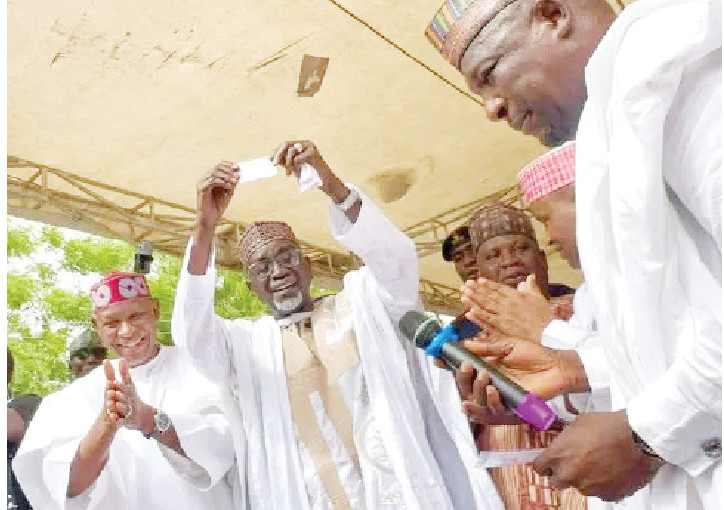
Shekarau recently resigned from the Peoples Democratic Party (PDP), citing “wide and extensive consultations” with his associates. Days later, he formalised his return to the APC, receiving his membership card in Giginyu, Nassarawa Local Government Area, amid a large turnout of supporters.
The ceremony itself told a story: despite years of political migration and the loss of some high-profile allies, Shekarau still commands a notable following at the grassroots—an asset that could prove valuable in a state where electoral victories are often determined by voter mobilisation at the ward level.
A seasoned political actor, Shekarau first rose to prominence in 2003 when he defeated Rabiu Musa Kwankwaso to become governor under the All Nigeria Peoples Party (ANPP). He went on to secure a second term in 2007, building a reputation around governance anchored on human development and the implementation of Shari’ah law.
His political journey since then has been marked by strategic recalibrations. After flying the ANPP’s presidential flag in 2011, he joined the PDP in 2014 and served as Minister of Education under former President Goodluck Jonathan. In 2018, he joined the APC and won the 2019 election as senator representing Kano Central.
However, disagreements within the APC saw him defect to the New Nigeria Peoples Party (NNPP) in 2022 in a bid to retain his senatorial seat—an effort that ultimately proved unsuccessful. His subsequent return to the PDP and, now, to the APC highlights a pattern that has come to define his political trajectory.
Observers say this history of movement reflects not just personal strategy but the broader volatility of Nigeria’s party system, where ideology often takes a backseat to political survival and relevance.
Political analyst, Dr Kabiru Sufi, noted that while Shekarau may no longer wield the same level of influence among political elites, his relevance among the electorate remains significant.
According to him, “Any political camp that secures his support stands to gain a boost,” adding that the large turnout at his declaration underscores his enduring popularity.
Yet, while his return may strengthen the APC’s base, analysts caution against overstating its immediate impact. Kano’s political terrain remains highly competitive, shaped by dominant blocs and longstanding rivalries that no single figure can easily override.
For the APC, integrating Shekarau’s structure presents both opportunities and challenges. While his network could enhance the party’s reach, it may also trigger internal competition as existing power centres negotiate space and influence within the fold.
For Governor Yusuf, the development adds another layer to an already complex political equation. The governor’s camp must now contend with a potentially reinvigorated opposition, even as it consolidates its own support base.
Beyond Kano, Shekarau’s defection mirrors a wider trend of political repositioning across the country ahead of 2027. With parties jostling for influence and high-profile figures seeking platforms with the best prospects, the coming months are likely to see more shifts in allegiance.
In that context, Shekarau’s return to the APC may not be a game-changer on its own, but it is certainly a significant piece in a larger puzzle. It reinforces his status as a political survivor—one who continues to adapt to changing realities while remaining a factor in the state’s power dynamics.
Ultimately, whether this latest move translates into tangible electoral advantage for the APC or remains another chapter in Kano’s long history of political realignment will depend on how well the party manages its internal dynamics and builds broader alliances.
We’ve got the edge. Get real-time reports, breaking scoops, and exclusive angles delivered straight to your phone. Don’t settle for stale news. Join LEADERSHIP NEWS on WhatsApp for 24/7 updates →
Join Our WhatsApp Channel