
Nigeria’s aviation industry is expanding, but behind the ambition to produce more homegrown pilots lies a critical question: how many aviation schools have the aircraft needed to turn aspiring pilots into qualified professionals?
Nigeria has at least four identified aviation institutions with dedicated aircraft or helicopter fleets for practical flight training, following the recent acquisition of two training aircraft by Baze University, Abuja.
However, owning training aircraft is one thing; keeping them operational and using them to produce the next generation of Nigerian pilots is another.
Here Are The Four Institutions That Own Training Aircraft In Nigeria
1. Nigerian College of Aviation Technology (NCAT), Zaria
Established in 1964, NCAT is a federal aviation training institution offering programmes in pilot training, aircraft maintenance, air traffic control and other aviation-related disciplines.
The college has operated aircraft including Socata Tampico TB9, Socata Trinidad TB20, Beechcraft Baron 58, TBM 850 and Diamond DA40 and DA42 models.
However, the institution has faced challenges in maintaining and expanding its training fleet.
In July 2026, NCAT Rector, Dr Danjuma Ismaila, disclosed that one of its TBM training aircraft was grounded due to inadequate funds for maintenance and reactivation.
He also lamented the institution’s limited admission capacity, saying it could only admit about 25 pilot trainees every six months.
“We can only admit about 25 pilot trainees every six months, which is inadequate for a country of over 200 million people. The demand is overwhelming,” he said.
The rector further disclosed that NCAT had received only nine of the 20 Diamond training aircraft ordered for the institution.
2. International Aviation College (IAC), Ilorin
The International Aviation College was established in 2011 by the Kwara State Government to provide professional aviation training.
The institution operates Diamond DA40 and DA42 aircraft for pilot training.
However, its aircraft availability has been a concern following incidents involving its training fleet.
In July 2025, reports emerged that the college’s flying school had been grounded due to a shortage of operational training aircraft.
The college’s Head of Training, Abdullahi Ajape, disputed the claim, maintaining that it had two operational DA40 aircraft.
He, however, acknowledged that the institution did not have a functioning DA42 multi-engine trainer at the time.
Ajape also disclosed that three students who completed their Commercial Pilot Licence training in June 2025 had used NCAT’s Diamond DA42 aircraft to complete their practical training under an existing agreement between both institutions.
3. International Helicopter Flying School (IHFS), Enugu
The International Helicopter Flying School is a specialised institution focused on helicopter pilot training.
Located at Akanu Ibiam International Airport, Enugu, the school is associated with a joint venture involving the Nigerian Air Force through its Aeronautical Engineering and Technical Services Limited (AETSL) and Triax Airlines.
Its training operations include Robinson R66 helicopters.
Aviation database Helis.com identifies four Robinson R66 helicopters associated with the school.
However, the current operational status and ownership of all four helicopters could not be independently established from available public records.
4. Baze University Aviation School, Abuja
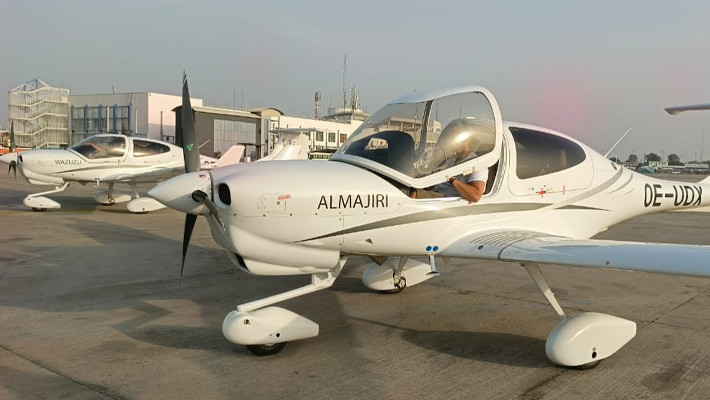
Baze University has joined the institutions investing in practical aviation training with the acquisition of two Diamond DA40 aircraft from Austria.
The aircraft arrived at the Hajj Terminal of the Nnamdi Azikiwe International Airport, Abuja, on Friday, November 6, 2026, where they received a water-cannon salute.
Speaking after their arrival, the university’s founding Pro-Chancellor, Senator Datti Baba-Ahmed, said the aviation school would strengthen Nigeria’s aviation capacity and international standing.
“Baze Aviation School is going to uplift the integrity of Nigeria across the world. The institution will enable us to command and control geography in Nigeria,” he said.
Baba-Ahmed also disclosed plans to train at least 600 aviation professionals in areas including air traffic control, air rescue and firefighting, subject to approval by relevant regulatory authorities.
The university is developing a dedicated aviation facility on a 90-hectare site in Bwari, Abuja, featuring a runway, hangar, terminal building, laboratories and simulation centres.
Coordinator of the aviation school project, retired Air Vice Marshal Aliyu Bello, said the newly acquired aircraft would be used for practical flight training.
“You need multi-engine for multi-engine training, instrument rating and so on. I’m very positive that in the near future, the Chancellor will also procure a twin engine aircraft for the aviation school. And at the same time, a simulator,” Bello said.
The university’s Vice-Chancellor, Professor Abiodun Adeniyi, described the development as an opportunity to expand aviation training beyond Nigeria.
Questions Over Operational Capacity
Despite the identified aircraft fleets, concerns remain over the number of training aircraft available for practical instruction across the country.
While NCAT has disclosed funding and maintenance challenges, IAC has also experienced fluctuations in its operational fleet.
For Baze University, the completion of its aviation facilities and the necessary regulatory approvals will determine when its full flight-training operations can commence.
The Nigerian Civil Aviation Authority (NCAA) regulates aviation training organisations in the country under Part 3 of the Nigeria Civil Aviation Regulations.
Consequently, aircraft ownership alone does not establish that an institution is authorised to conduct pilot training or that its entire fleet is operational.
The NCAA’s latest publicly listed register of approved training organisations is dated April 1, 2024, making an updated regulatory record necessary to establish the current number of approved flying schools.
The NCAA is yet to provide a publicly verified nationwide breakdown of training aircraft owned, leased and currently operational across the four institutions.
We’ve got the edge. Get real-time reports, breaking scoops, and exclusive angles delivered straight to your phone. Don’t settle for stale news. Join LEADERSHIP NEWS on WhatsApp for 24/7 updates →
Join Our WhatsApp Channel