There’s a kind of silence that hangs in Nigeria today, a silence not born of peace, but of pause. A collective holding of breath. Across city streets and village squares, in government offices and roadside kiosks, the air is thick with a quiet kind of reckoning. We are a country long familiar with the weight of disappointment, yet still tethered to the fragile thread of hope.
Ours is a nation that dreams deeply, yet wakes up each morning to potholes, power cuts, and policies that seem allergic to progress. It is a place where parents pray not just for the future of their children, but for the present to let them survive it. A country of scholars forced to hustle. Of doctors who heal abroad. Of youth who build tech apps while dodging police bullets. Nigeria, for all its vibrance, exists in a state of suspended potential, bright but dimmed, growing but groaning.
And still, the real tragedy is not that we have failed. It’s that we have grown accustomed to failure. That we have normalized mediocrity. That we now whisper dreams we once shouted. Yet history shows us this: nations do not collapse from chaos alone. They collapse when those who should build become content to watch. When those who should speak begin to sigh instead.
The Lost Art of Leadership
In his seminal work On Grand Strategy, historian John Lewis Gaddis writes that leadership is not the pursuit of motion, but the alignment of vision and means. To lead, truly lead, is to map ambition onto terrain. In Nigeria, our terrain is complicated – ethnic fault lines, historical betrayals, and institutional decay. But what we suffer most from is not geography. It is governance.
Too many of our leaders speak in metaphors and manifestos, yet tremble before implementation. They talk of unity but act in silos. They promise reforms, then appoint loyalists who dismantle them. We mistake noise for change, charisma for competence. We are governed by men fluent in the language of electioneering but illiterate in the grammar of nation-building.
In Forged in Crisis, Nancy Koehn details how Lincoln, Shackleton, and others did not lead by convenience, they led by clarity. When the Union was crumbling, Lincoln chose the hard path of principle over the easy path of compromise. Shackleton, trapped on Antarctic ice, kept his men alive not through force but through trust. Their lessons are urgent: leadership in crisis is not about control; it is about character.
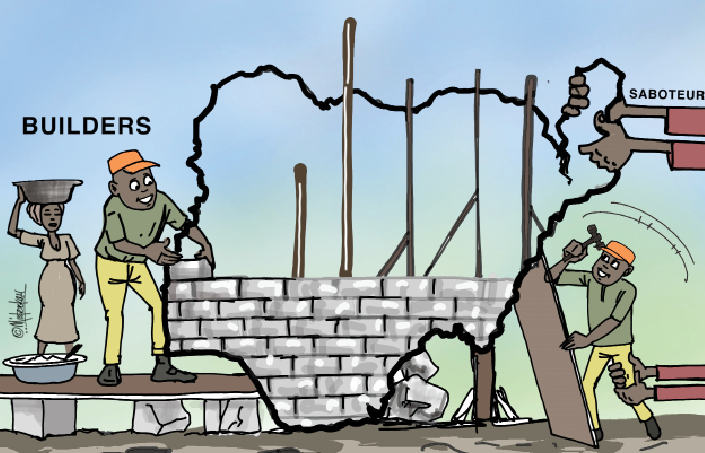
Nigeria needs not rulers, but reformers. Not strongmen, but steady minds. The time for theatrical governance is over. The times now call for architects, those who will not simply inherit the country, but reconstruct it.
What Lee Kuan Yew Knew
There is a legend in Singapore’s rise, but behind the myth stands a man, Lee Kuan Yew. In From Third World to First, Lee describes how he governed with brutal honesty and unshakeable pragmatism. He understood something Nigerian leaders have yet to grasp: that true leadership requires one to be more committed to outcomes than to optics.
Lee built institutions where Nigeria has built bottlenecks. He replaced sentiment with systems, loyalty with law, and guesswork with governance. Under his watch, Singapore grew not just in GDP, but in dignity. He insisted that competence was non-negotiable – that ministers must perform, or be replaced. The contrast with Nigeria is painful.
Here, we reward underperformance with reappointment. We allow governors to owe salaries while building vanity projects. We build roads that wash away after the first rains, and commissions that commission nothing. Our public service is bloated, not with talent, but with the weight of political favours.
Yet Lee’s greatest insight was this: transformation is a matter of will, not wealth. Nigeria has the natural and human resources. What we lack is resolve.
In the Midst of Chaos, Opportunity
But not all is lost. There is, in every Nigerian street, a quiet resilience that defies logic. It is the teacher in Bauchi who refuses to sell exam questions. The midwife in Akwa Ibom who works nights without light. The young tech founder in Yaba who writes code between fuel shortages. These are the silent custodians of the future. They do not make headlines, but they make history.
As Sheikh Mohammed bin Rashid Al Maktoum writes in My Vision, “Leaders are those who see opportunities in every difficulty.” The UAE did not become a global hub because of oil alone, it became one because its leaders believed in the future more than they feared the present. They merged tradition with technology, loyalty with logic.
Nigeria can learn from this. We must invest not just in infrastructure, but in imagination. We must see governance not as control, but as care. Every policy must ask: how does this serve the people; not how does it serve the party?
In Leadership: Six Studies in World Strategy, Henry Kissinger profiles leaders like Adenauer and de Gaulle – men who led with humility, and rebuilt fractured nations with discipline. They were not perfect. But they were purposeful. They understood that power without purpose is simply noise. Nigerian leaders must learn to lead with the long view, to speak less of 2027 and more of 2050.
When We Rise, What Shall We Remember?
There is an old Igbo proverb: “Until the lion learns to write, the story will always glorify the hunter.” For too long, Nigeria’s story has been told by those who break it, not those who bear it. The future must change that.
We must begin to demand not just representation, but reform. We must elevate the teacher, the technocrat, the thinker, not just the political strongman. The age of personality cults must give way to the age of institutions. We must train leaders who are allergic to corruption and addicted to service.
Sun Tzu, in The Art of War, warned that wars are won not on the battlefield, but in the mind. Nigeria’s war is not just against poverty or terror, it is a war for meaning. Will we continue to be a country that remembers its heroes only in death? Or one that honours courage in life? Will we be a country of survivors, or one of builders?
Isaiah Berlin once described the tragedy of the “hedgehog”, a thinker of one grand idea who fails to adapt to nuance. Too many of our leaders are hedgehogs, clinging to nationalism or neoliberalism without understanding how to translate theory into results. But Nigeria needs foxes now, leaders who can think across sectors, timeframes, and tribes.
This is our call. Not just to resist the collapse, but to reverse it. Not just to speak of change, but to become it. Let us not wait for a messiah. Let us manufacture one, through mentoring, through merit, through the relentless pursuit of meaning.
When Nigeria rises, and rise it will, we will not only remember the years the locusts ate. We will remember the ones who planted anyway. The ones who kept teaching. Kept coding. Kept resisting. And when that day comes, we will not need to crown a king.
We will recognize a leader.
We’ve got the edge. Get real-time reports, breaking scoops, and exclusive angles delivered straight to your phone. Don’t settle for stale news. Join LEADERSHIP NEWS on WhatsApp for 24/7 updates →
Join Our WhatsApp Channel