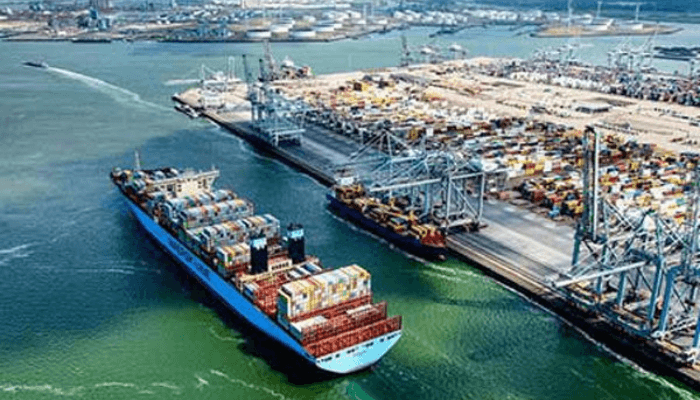
Nigeria loses N7.2 trillion out of N9 trillion ($6billion) annual freight rate to foreign shipping companies over a lack of indigenous capacity.
In the National Policy of Marine and Blue Economy launched by the Federal Ministry of Marine and Blue Economy in Lagos, over the weekend, it was gathered that 80 per cent of the $6 billion (N9 trillion) freight rate paid in Nigeria annually goes to foreign firms.
The policy document was launched to create a sustainable pathway for economic growth in fisheries, aquaculture, renewable energy, tourism, and seabed mining, while also ensuring environmental sustainability.
The document also lamented that a large portion of the nation’s freight fees leaving the country annually has limited the nation’s economic capacity and opportunities for job creation.
“The sector employs more than 150,000 workers (serving as seafarers, crewmen, etc) and over 180 million tons of seaborne freight are transported in Nigeria each year.
While freight paid in Nigeria exceeds $6 billion per year, 80 per cent of the revenue goes to foreign firms in maritime transport,” the document stated.
“Nigeria’s cabotage policy, governed by the Cabotage Act, was launched in 2003 and aims at enhancing indigenous maritime capacity by limiting coastal shipping between Nigerian ports to Nigerian-owned, built, manned and registered vessels.”
“Nigeria lacks a substantial indigenous fleet to take advantage of the opportunities offered by its huge market. A large portion of its freight fees consequently leaves the country, limiting its economic capacity and opportunities for job creation.
“The Nigerian Ship Registry is suboptimal leading to loss of revenue to foreign ship registries. There is an urgent need to review and revamp the Nigerian Ship Registry and ensure it meets global standards to make it professional, effective, and globally competitive,” the document reads.
The document further stated that the nation’s Marine and Blue Economy is important to the nation’s economy as it is highly dependent on the exports of crude oil, agricultural products and the import of raw materials, machinery and Equipment for industries.
“The Marine and Blue Economy is significantly important to the Nigerian economy.
This is seen in its strategic contributions to the country. The Nigerian economy is highly dependent on the exports of crude oil and agricultural products, and the import of raw materials, machinery and equipment for industries.
“The country’s transport of cargo is a key driver of the economy in this regard through its access to the Gulf of Guinea (Atlantic Ocean) and its navigable inland waterways. The marine and blue economy contributes significantly to government revenues through customs duties, taxes, levies and fees collected by agencies of government such as the Nigeria Customs Service (NCS), Nigerian Maritime Administration and Safety Agency (NIMASA), the Nigerian Ports Authority (NPA), etc.
“Nigeria’s maritime transport sector is essential for the country’s economic growth, contributing significantly to international trade. The sector plays a critical role in the transport of crude oil, petroleum products, agricultural goods, and other commodities.
“Key activities in the maritime transport sector include international trade and shipping, cabotage shipping, and inland waterways transport of cargo and passengers.”
The document also revealed that the nation’s maritime trade accounts for a substantial portion of the nation’s GDP, enabling the export of key resources such as crude oil, natural gas, and agricultural products, while also supporting the import of refined petroleum products, machinery, vehicles, and consumer goods.
“The significance of maritime trade to Nigeria’s economy cannot be overstated. It accounts for a substantial portion of the nation’s GDP, enabling the export of key resources such as crude oil, natural gas, and agricultural products, while also supporting the import of refined petroleum products, machinery, vehicles, and consumer goods.
“As one of Africa’s largest oil producers, Nigeria relies heavily on its maritime sector to export crude oil and liquefied natural gas (LNG), which are critical to its revenue generation. The value of exports transported via maritime routes experienced significant growth, rising from N19,050 billion in 2019 to N36,241 billion in 2023, reflecting a substantial increase in Nigeria’s export activities over the five years.
“Similarly, the value of imports conveyed through maritime channels also saw a notable rise, climbing from N14,682
billion in 2019 to N32,203 billion in 2023. This upward trend in both export and import values underscores the critical role of maritime trade in Nigeria’s economy, highlighting the sector’s contribution to facilitating international trade and economic growth.
“The consistent growth in these figures also points to the increasing reliance on maritime transport as a key mode of moving goods in and out of the country, driven by factors such as globalisation, trade agreements, and the expansion of key industries.”
Meanwhile, the chairman, Nigerian Ports Consultative Council (NPCC) Bolaji Sunmola, said Nigeria loses over $9 billion yearly to under-enforcement of the Cabotage Act.
He said the ports must now prioritise indigenous participation in shipping, terminal operations, and maritime services, while national/indigenous companies must not just be present, but must be protected and empowered to lead.
Bolaji also recommended boosting digital reforms, port community systems, and continuous customs modernisation, to cut down the high cargo dwell time in Nigeria, hindering trade and a direct cost to the economy, to acceptable international standards.
He also highlighted upgraded/modernised infrastructures that are smart, green, and accessible as well as ensuring that the inland connectivity by rail, water and road is seamless, to avoid the congestion trap of the past.
The NPCC boss further stated that the policy must translate into skills development, scholarships, apprenticeships, and new career paths in logistics, digital operations, and port security, noting that human capital will define the future of the nation’s ports.
He said the federal government must fix governance frameworks such as duplication of agencies, overlapping mandates, and manual clearance processes that must give way to a unified, efficient, and accountable system.
We’ve got the edge. Get real-time reports, breaking scoops, and exclusive angles delivered straight to your phone. Don’t settle for stale news. Join LEADERSHIP NEWS on WhatsApp for 24/7 updates →
Join Our WhatsApp Channel