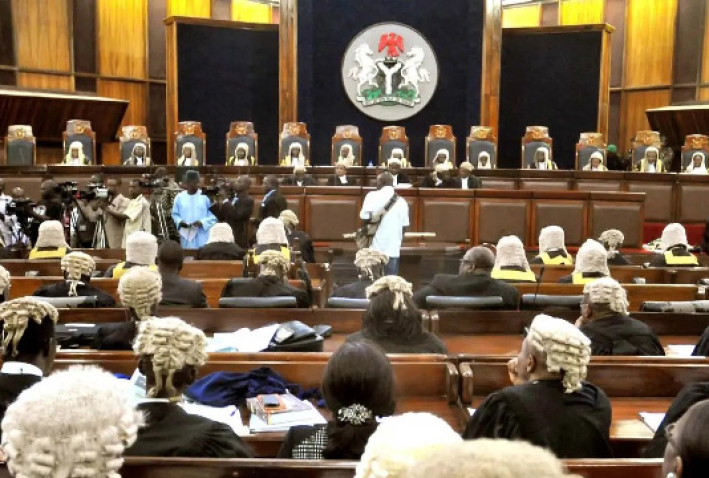
Recently, a member of the House of Representatives, Hon. Clement Jimbo, called for greater clarity and consistency in judicial pronouncements across Nigeria, warning of an increasing trend of court judgments riddled with ambiguities—judgments open to multiple interpretations.
Citing the legal standoff between the Senate leadership and suspended Senator Natasha Akpoti-Uduaghan, Jimbo argued that judgments must be simple, precise, and unambiguous, as anything less breeds confusion and undermines the rule of law.
He has given voice to the thoughts of every right-thinking Nigerian. This newspaper has watched, with dismay, the unfolding drama of Nigeria’s convoluted court rulings—judgments so ambiguous they inflame situations rather than calm them, and sow chaos instead of clarity.
Across the world, courts—whether constituted by a single judge or a panel—exist to resolve disputes, interpret the law, and enforce justice. As Aare Afe Babalola (SAN) once stated, the role of the judiciary in any society is to interpret laws, adjudicate disputes, and ensure the supremacy of the rule of law.
The judiciary is rightly called “the last hope of the common man,” a sacred pillar upon which the trust of the people rests. Its influence is far-reaching, shaping the political, social, economic, and even religious life of a nation.
But when judgments emerge from these courts twisted, unclear, or susceptible to misrepresentation—causing confusion, even mayhem—then there is a serious problem.
What is baffling is that these judgments are delivered by Nigerian judges who live in Nigeria, understand the political climate, and yet seem unmoved by the misinterpretations and havoc their rulings trigger in the public space.
Do they issue these pronouncements and then drift into some judicial “space,” oblivious to the storm their words unleash on litigants, lawyers, and the society at large?
Consider the case of Senator Natasha Akpoti-Uduaghan. In March, the Senate suspended her for six months for allegedly breaching its standing rules. She challenged her suspension in court, and after a July 4 ruling, she announced plans to resume her seat. Yet, the Senate reaffirmed—three separate times—that there was no subsisting court order requiring her recall.Confusion reigns.
The same pattern of ambiguity trails judgments regarding the leadership crises in the Peoples Democratic Party (PDP) and Labour Party (LP). Rival factions, from Julius Abure to Senator Nenadi Usman, have each claimed victory after conflicting court orders, plunging the parties into chaos.
This is not new. Forum shopping—a practice where litigants hunt for courts willing to grant them ex parte motions—once compounded the confusion, until former Chief Justice Mohammed Tanko wielded the hammer, sanctioning judges who entertained frivolous orders. His decisive stance allowed conventions like those of the PDP and APC in 2022 to proceed smoothly, without judicial interference.
But those gains are eroding.
As Jimbo warned, the judiciary’s credibility is now at stake. When judgments lack the clarity required for enforcement—especially in politically sensitive cases—they fuel uncertainty, invite mischief, and risk heating up the polity.
This newspaper believes there is an urgent need to recalibrate how judgments are written and delivered in Nigeria. Judgments must not read like riddles; they must not leave room for endless interpretations.
When judges leave their rulings open-ended, they share the blame for the resulting confusion. When judgments are clear but misinterpreted, then lawyers must share that blame.
Chief Justice of Nigeria, Justice Kudirat Kekere-Ekun, must rise to this challenge. Under her watch, there must be renewed emphasis on judicial clarity.
We strongly suggest that courts should avoid excessive legal jargon that alienates the public and instead communicate in words everyone understands. Facts, issues, reasoning, and conclusions should be laid out in sequence. A reader should not struggle to find the “what,” “why,” and “how” of a ruling.Every question brought before the court should be explicitly resolved. This prevents partial interpretations of judgments.
Judgments should clearly cite statutes and cases that underpin decisions, grounding them in visible legal authority.Judgments must be easily obtainable by the public and professionals alike—preferably through well-organised court websites.Draft judgments could benefit from scrutiny by judicial peers to weed out ambiguities before they are finalised.
Needless to say ,Nigeria’s judiciary is the third arm of government—a vital guardian of democracy and economic stability. But that role is weakened when its judgments are treated like cryptic puzzles.
The courts must remember this: not every Nigerian is a lawyer. Their rulings must be written and delivered so that the average citizen, as well as the litigant and the lawyer, understands them without the need for elaborate decoding.
The stakes could not be higher. A judiciary that speaks clearly reinforces the rule of law. A judiciary that speaks in riddles erodes it.
We’ve got the edge. Get real-time reports, breaking scoops, and exclusive angles delivered straight to your phone. Don’t settle for stale news. Join LEADERSHIP NEWS on WhatsApp for 24/7 updates →
Join Our WhatsApp Channel