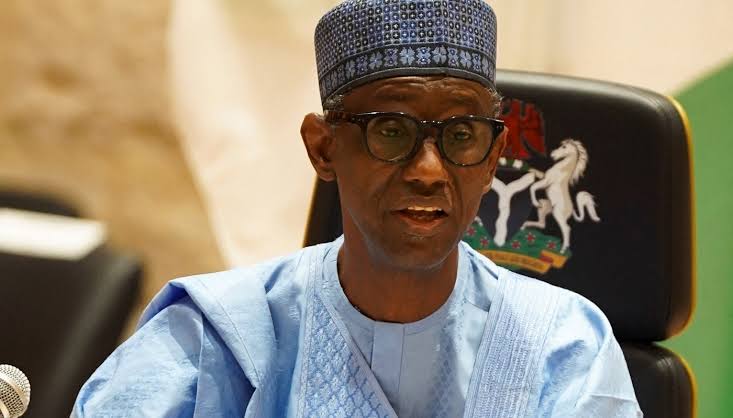
On Saturday, 18 October 2026, a brainstorming session on coping with banditry convened in Sokoto under the joint auspices of the Sokoto Advancement Forum and the Centre for Peace Studies at Usmanu Danfodiyo University. The occasion was significant on its own terms: a civil society forum and a university putting together a serious, non-partisan platform to interrogate a crisis that has consumed the North-West for years. What gave the session its particular weight was the presence, in representation, of the National Security Adviser, Malam Nuhu Ribadu. His representative, Director of Legal Services in the Office of the NSA, delivered an address that merits close attention. Not only because of its content, but because of what it acknowledges, and what acknowledging it, at this hour, means.
The NSA’s remarks went further than the usual recitation of operations. He stated explicitly that banditry in Sokoto had grown beyond cattle rustling, highway robbery and kidnapping into a more systemic threat, with criminal groups now exercising territorial control, imposing illegal levies on rural residents and disrupting economic life across wide areas of the state. He named Sokoto’s proximity to the Republic of Niger and the wider Sahel as a major structural challenge, noting that armed groups exploit porous borders and gaps in security arrangements to sustain their operations. He outlined five priorities: denying armed groups safe havens through intelligence-led operations and sustained deployments; strengthening intelligence-sharing across agencies and borders; building community trust and early-warning systems; protecting farms, rural markets, schools and health facilities; and preventing young people from being recruited into criminal networks. He further stated that the government’s security goal was to restore conditions under which Nigerians could return to their farms, markets could operate freely and children could attend school without fear. He referenced the National Crisis Management Doctrine as a coordinating framework.
These are the right things to say. This newspaper records them without irony and with a degree of qualified relief. The Sokoto Advancement Forum’s chairman, Professor Ahmad Wali, had reported that security incidents had been recorded in 21 of Sokoto’s 23 local government areas between January 2024 and August 2025, and that more than 1,100 people were kidnapped in the state in the twelve months to June 2026. An August 2026 attack in Tsamaye, Sabon Birni Local Government Area, killed at least 21 people and abducted 37. The same period saw SBM Intelligence, an Africa-focused market intelligence and security analysis firm that tracks violence incidents, deaths and kidnapping data across Nigeria using open-source information and verified field reports, record 7,825 Nigerians kidnapped in the year to June 2026, an increase of 66 per cent on the previous cycle. The NSA’s representative was therefore speaking into the face of a documented catastrophe.
But the editorial task is not to repeat what was said in Sokoto. It is to ask what the saying of it means and what must now follow.
The NSA’s acknowledgement that military operations alone cannot resolve this crisis is, at one level, a statement of the obvious. Security analysts have been making the same argument for years. The logic is elementary: armed groups that recruit from populations of impoverished and displaced youth, that finance themselves from illicit levies and ransom payments, and that exploit ungoverned border forests as operational bases cannot be removed by aerial bombardment and ground sweeps alone. Clearing a forest without occupying it creates a vacuum. Raiding a camp without disrupting the networks that supply and finance it produces a tactical success and a strategic stalemate. When the NSA says that security operations must be combined with good governance and community participation, he is correct. The question is whether this represents a genuine doctrinal shift or an eloquent restatement of a position that successive administrations have articulated and then set aside when operational pressure returned.
There is also the matter of scale. Sokoto is one state. The crisis spans at least the entire North-West: Zamfara, Kebbi, Katsina, Kano. It runs into the North-Central: Niger, Kaduna, Benue, Kogi. It has established footholds in the North-East alongside the insurgency. The bandits and their financial networks do not recognise state boundaries. The five priorities outlined by the NSA apply not just to Sokoto but to every community that has buried its dead, emptied its schools and abandoned its farmland across Northern Nigeria. A doctrine of national scope is needed, not a state-by-state improvisation, and it must be funded, staffed and supervised at a level commensurate with the scale of the emergency.
The Sokoto Advancement Forum and the Centre for Peace Studies deserve commendation for convening this session. The forum comprises intellectuals, business leaders, academics, retired civil servants, politicians, youth groups and farmers. Its co-chairman, Professor Riskuwa Arabu Shehu, former Vice-Chancellor of Usmanu Danfodiyo University, has been explicit that the forum does not work for any political interest but for everyone. That civic spirit is precisely what good governance requires as a partner. It is also, incidentally, the spirit that this crisis demands from every citizen: the refusal to allow banditry to be framed as a political matter, a Northern matter, or a government matter alone.
The NSA’s five-point framework should now become a publicly monitored commitment. The Federal Government should publish, a measurable implementation plan with timelines, responsible agencies, budget lines and accountability mechanisms. The communities of Sokoto, Zamfara, Kebbi and their counterparts across the North have heard enough frameworks. They are entitled to watch them become facts.
We’ve got the edge. Get real-time reports, breaking scoops, and exclusive angles delivered straight to your phone. Don’t settle for stale news. Join LEADERSHIP NEWS on WhatsApp for 24/7 updates →
Join Our WhatsApp Channel