An economist, Dr Sand Mba-Kalu, has emphasised the importance of creating an independent oversight board to monitor the disbursement of savings from the petroleum subsidy removal.
Mba-Kalu, who is the executive director, Africa International Trade and Commerce Research (AITCR), made this known on Friday in Abuja, in an interview with the News Agency of Nigeria
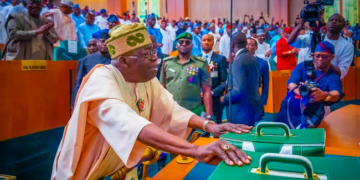
He was reacting to President Bola Tinubu’s Oct. 1 national broadcast on the 65th Independence Anniversary of Nigeria.
“I suggest that the board should include representatives from Civil Society Organisations (CSOs) and the audit office to ensure transparency and accountability in the use of the funds,” he said.
Tinubu had on Oct. 1 said that the removal of the corrupt petroleum subsidy had freed up trillions of Naira for targeted investments in the real economy and social programmes for the most vulnerable, and all tiers of government.
The president also said that oil production rebounded to 1.68 million barrels per day from barely one million in May 2023, an increase which occurred due to improved security, new investments and better stakeholder management in the Niger Delta.
Reacting to the assertion, Mba-Kalu said “trillions freed” from subsidy removal could be at risk of mismanagement or leakages, undermining public trust and development outcomes.
“Multiple studies caution that subsidy removal often leads to inflation, poverty, and social unrest unless accompanied by strong transparency and accountability.
“The rationale for subsidy removal is to reallocate resources effectively.
“To maintain public trust, the government should publish an expenditure ledger detailing the “savings from subsidy removal” and should be linked to specific line items—such as health, social support, infrastructure, state funding, and education,” he said.
He said that a quarterly result dashboard should also be published, reflecting metrics such as kilometers of roads constructed, hospital beds added, households served and expanded energy access.
According to him, the removal of subsidies has initiated sharp increases in transport costs, food prices, and general inflation, putting pressure on already vulnerable households.
He said that the costs of educational materials, utilities and other essential goods also increased, following the subsidy removal, worsening inequality and hardship, particularly in rural and low-income areas.
“According to a March 2025 Afrobarometer and NOIPolls survey, approximately 93 per cent of Nigerians believe the country is heading in the “wrong direction” and strongly oppose subsidy removal due to the economic difficulties it has caused.
“Multiple studies show that subsidy removal often leads to inflation, poverty and social unrest unless accompanied by strong transparency and accountability,” he said.
He further said that while the oil and industrial sectors had demonstrated some strength, the non-oil sectors must grow in tandem, to support broad-based development.
Mba-Kalu also said that in the second quarter (Q2) of 2025, the non-oil sector grew by 3.64 per cent, contributing about 95.95 per cent of national Gross Domestic Product (GDP).
He, however, said that the manufacturing sector remained precarious, with nominal growth in Q2 record at 4.51 per cent year-on-year, which was down from 7.65 per cent the previous year.
This, he said, resulted in a decline in its share of GDP.
“Sectors such as agriculture, trade, ICT and services need to be accelerated to create jobs, drive exports and diversify risk,’’ he said.
To cushion the shock to households, he said the government should scale up conditional cash transfers, transport vouchers and targeted subsidies for critical goods like fertilisers, power and broadband, rather than blanket fuel subsidies.
“Efforts should particularly focus on women, rural households, informal workers, and low-income communities.
“Transitional measures for food, medicine and electricity tariffs are necessary to prevent a regression into extreme poverty,” he added. (NAN)
We’ve got the edge. Get real-time reports, breaking scoops, and exclusive angles delivered straight to your phone. Don’t settle for stale news. Join LEADERSHIP NEWS on WhatsApp for 24/7 updates →
Join Our WhatsApp Channel