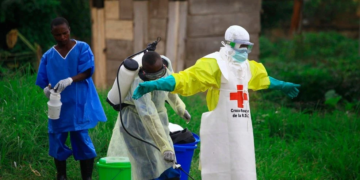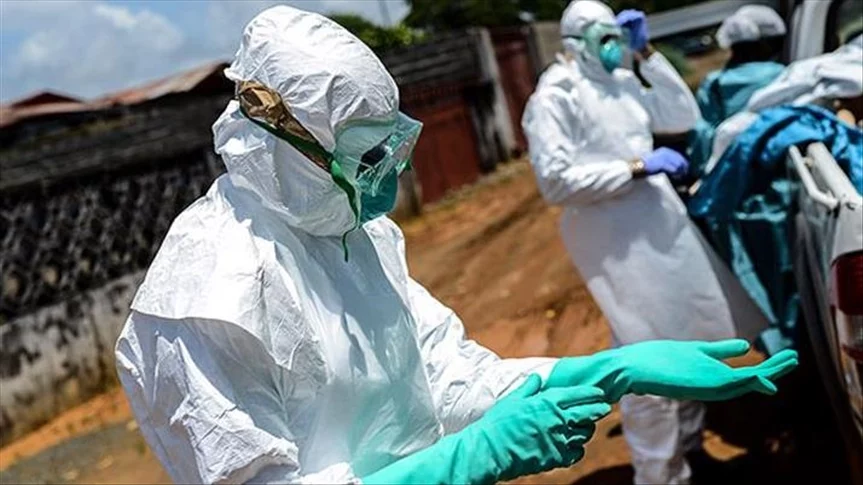
An upsurge in Ebola cases in some African countries, specifically Uganda, has raised some concerns about the disease re-entering Nigeria. A media report actually talked about the country importing the dreaded virus. According to reports, as of October 29, 2022, the Ugandan Ministry of Health had reported 128 confirmed cases and 34 deaths.
No doubt, Nigeria cannot afford to battle Ebola at the moment as the country is facing a myriad of other health challenges. We recall that the Nigeria Centre for Disease Control and Prevention, NCDC, disclosed, recently, that 2,187 confirmed cases of cholera had been reported in 31 states. It also stated that at least 233 deaths had been recorded from January 1 to September 25, 2022.
Similarly, NCDC reported that a total of 164 people has so far died of Lassa fever in Nigeria in 2022. The NCDC also confirmed a total of 5,890 suspected cases in 2022. In the considered opinion of this Newspaper, adding Ebola to the mix is not cheery news for the country.
It is pertinent to point out that the dreaded Ebola virus was introduced into Nigeria on 20 July 2014 when an infected Liberian man arrived by airplane in Lagos. The man, who died in a hospital five days later, set off a chain of transmission that infected a total of 19 people, of whom seven died.
Instructively, according to World Health Organisation (WHO) recommendations, the end of an Ebola virus disease outbreak in a country can be declared once 42 days have passed and no new cases have been detected. The 42 days represents twice the maximum incubation period for Ebola (21 days). This 42-day period starts from the last day that any person in the country had contact with a confirmed or probable Ebola case.
Consequently, on 20 October 2014, Nigeria reached the 42-day mark and was considered free of Ebola transmission. To be sure, Ebola, officially called Zaïre Ebola Virus (EBOV), is an infectious disease caused by the Ebola virus. The virus can affect both humans and animals. The disease is rare but very severe and potentially lethal. In Africa, more than half of the infected do not survive. After being infected with the virus, the first symptoms occur within two to 21 days. Usually, the first signs occur within a week. Ebola often starts with symptoms of severe flu or malaria: diarrhea, fatigue, vomiting, muscle pain, and headache.
Also, the Ebola virus attacks the immune system, once infected, the virus spreads and multiplies at a lightning speed. It causes bleeding in various places in the body, resulting in multiple organ failures. It can be transmitted through body fluids.
The Ebola virus is transferable through direct contact with (any kind of) body fluids, such as blood, saliva, or feces. To prevent further spreading of the virus, it is important to avoid any kind of direct body contact with patients. Rapid patient isolation is, therefore, necessary.
The virus does not spread through the air or mosquitos. Ebola is still very difficult to battle: no specific cure or medical treatment is available yet. New treatment methods and the use of vaccinations are currently still in the experimental phase and, therefore, not yet available to everyone.
It is gratifying to note that the NCDC recently said it has stepped up preparation against possible Ebola Virus Disease (EVD) outbreak in the country following incidences in Uganda.
In a Public Health Advisory, signed by its Director General, Dr Ifedayo Adetifa, NCDC said it has been aware of the ongoing outbreak of the Sudan strain of EVD in Uganda, since an official declaration on September 20, 2022.
According to the advisory, the NCDC, through the National Emerging Viral Haemorrhagic Disease Technical Working Group, met on September 26, 2022, to assess the risk of importation of EVD to Nigeria and the potential impact to inform in-country preparedness activities.
The advisory stated that based on available data and risk assessment conducted, Nigeria is at high risk of importation of the virus. This risk is due to the large volume of air travel between Nigeria and Uganda and the mixing of passengers, especially at the regional travel hubs of Nairobi, Addis Ababa, and Kigali airports, and the additional risk from other neighboring countries that share a direct border with Uganda, should cases arise in other countries in the region.
The NCDC said output from this risk assessment is being used to initiate preparedness activities. It said several measures have been put in place to prevent and mitigate the impact of a potential EVD outbreak in Nigeria.
The agency, on its part, has advised Nigerians to adhere to the following precautions: wash your hands frequently using soap and water or use hand sanitizers when soap and water are not readily available, and your hand is not visibly soiled.
Avoid physical contact with anyone who has symptoms of an infection with an unknown diagnosis. Healthcare workers are advised to always adhere to standard precautions. This includes the use of personal protective equipment always when handling patients and always maintaining a high index of suspicion.
In view of the foregoing, we call on the federal government to increase surveillance at our international airports and land borders with heavy traffic. We call on the NCDC to follow religiously their plans to forestall an outbreak of the deadly virus.
We’ve got the edge. Get real-time reports, breaking scoops, and exclusive angles delivered straight to your phone. Don’t settle for stale news. Join LEADERSHIP NEWS on WhatsApp for 24/7 updates →
Join Our WhatsApp Channel