

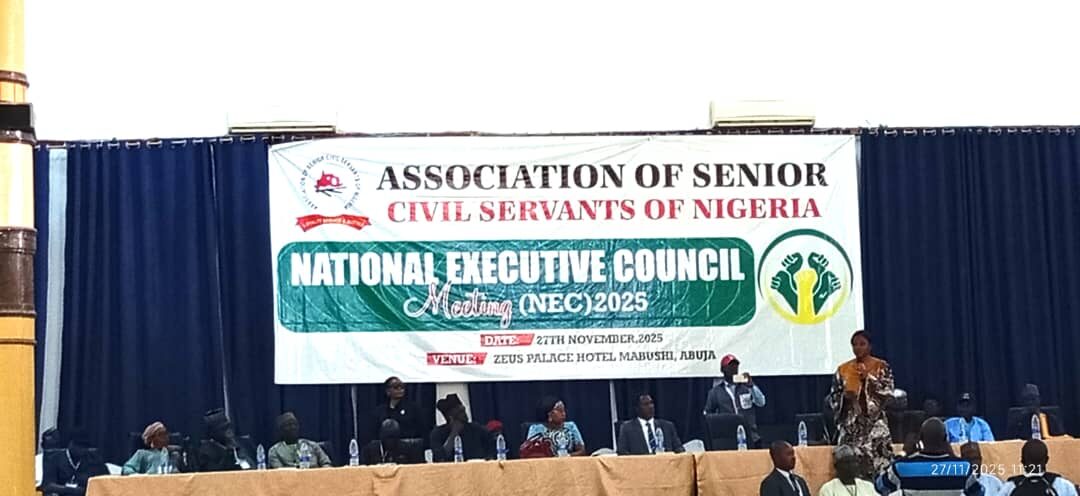
The federal government has restated its commitment to deepening social dialogue with organised labour as a central tool for resolving disputes and maintaining stability in the workplace.
The minister of labour and employment, Muhammad Maigari Dingyadi gave the assurance in Abuja at the National Executive Council meeting of the Association of Senior Civil Servants of Nigeria (ASCSN), where he commended the union for its sustained defence of worker welfare and its role in stabilising public sector industrial relations.
He said the ministry remained focused on promoting decent work, improving labour standards and supporting both workers and employers as they confront economic pressures and technological disruptions transforming the world of work.
According to the minister, the labour environment can only thrive when unions, employers and government act collaboratively and respond to change with fairness and foresight.
He added that social dialogue would continue to guide the administration’s approach to dispute resolution, job security and efforts to strengthen productivity.
The minister described the ASCSN as a dependable partner in tripartite engagements, noting that its input had been vital to sustaining workplace peace and improving national productivity. He assured delegates of the government’s ongoing cooperation, saying the shared objective of a fair and responsive labour system required continuous engagement and mutual trust.
ASCSN national president, Comrade Shehu Mohammed, used the session to highlight rising security threats across the country, warning that civil servants and their families were increasingly at risk.
He said the wave of killings, abductions and forced displacement had created widespread fear and undermined worker morale. Mohammed urged the federal government to overhaul the security architecture and advised governors to take greater responsibility for safeguarding their states.
He backed the creation of state police but argued for a model that limits political interference. His proposal centres on a State Police Commission composed of representatives of political parties, labour leaders, religious bodies, traditional rulers, students, civil society groups and prominent citizens to provide oversight and prevent abuse.
He said recent kidnappings of union members underscored the need for a policing system capable of swift, community-level response.
Mohammed welcomed the government’s decision to restore gratuity payments to public servants beginning January 2026, describing it as a long-awaited relief following years of advocacy.
He also cautioned against renewed attempts to privatise unity schools, insisting that institutions such as King’s College, Lagos, must remain public assets accessible to all Nigerians.
“Every day, we all read in mainstream and social media and watch on television, gory tales of citizens being kidnapped, killed, or displaced from their homes by all manner of criminals. This almost daily incidences of violence has created a specter of fear among the citizens in all parts of the country.
Members of the association and their families have been largely affected by the activities of these criminals. I wish, therefore, to appeal to the Federal Government to rejig the security architecture in the country and reposition it to meet the aspiration of the citizens”, he said.
We’ve got the edge. Get real-time reports, breaking scoops, and exclusive angles delivered straight to your phone. Don’t settle for stale news. Join LEADERSHIP NEWS on WhatsApp for 24/7 updates →
Join Our WhatsApp Channel

