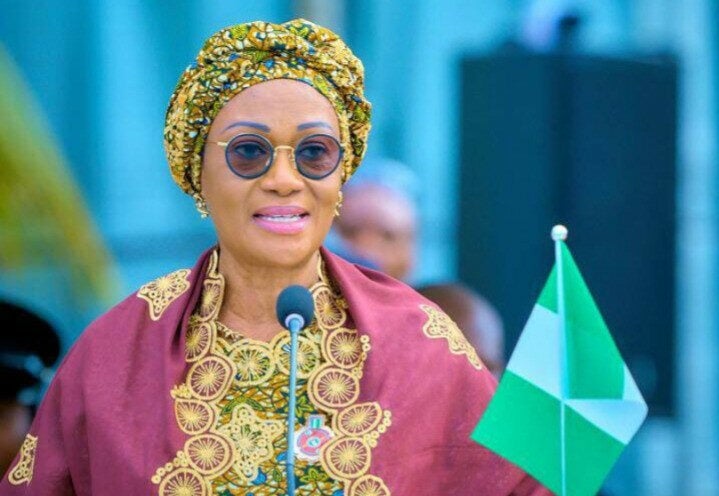
Something is shifting in Abuja, and anyone who has covered this country long enough can feel it even before they can fully explain it. It isn’t loud. It isn’t chaotic. It isn’t wrapped in the usual theatrics that follow political families around like flies on overripe fruit. It’s quiet, steady, and intentional. And the centre of that shift is Nigeria’s First Lady Senator Remi Tinubu.
If you think this is the usual “First Lady activity,” you’re missing the plot. Nigeria has produced many First Ladies—some ceremonial, some powerful, some controversial, some invisible. But this one is building something different: a calm, consistent recalibration of national tone. It’s subtle enough that many people haven’t named it yet, but loud enough that if you sit still long enough, you notice the temperature in the room changing.
On Friday night she hosted Senate President Godswill Akpabio, Speaker Tajudeen Abbas, and the senior command of the National Assembly at the Presidential Villa for dinner. These dinners are usually soft politics. Photo ops. Banter. Plenty of nodding. A few jokes at the President’s expense, nothing that makes the news.
Instead, she used the moment to drag the Women’s Special Seats Bill back into the national bloodstream. Not politely. Not coyly. She put it on the table like a report card every lawmaker would eventually have to sign. No warm-up act. No dancing around the point. Straight talk. She reminded them that the world was watching. She told them history would judge them. And she wrapped it in the old-colleagues-laughing-together nostalgia that made it land without sounding confrontational.
You don’t do that unless you’re stepping into a leadership lane deliberately.
That moment told me something: she’s not playing symbolism. She’s shaping priorities. She’s forcing the political class to look beyond the usual legislative games and confront uncomfortable questions about representation, fairness, and national credibility. And she did it with a tone that said, “This isn’t charity. This is a national necessity.”
People often underestimate the difficulty of persuading the National Assembly to shift its stance on gender bills. These are lawmakers who have rejected almost every major women-focused reform for fifteen years. They hate anything that threatens the old order. They hide behind procedure, behind culture, behind party loyalty. She didn’t give them those escape routes. She framed it as a historical moment they couldn’t afford to mishandle.
That’s one type of influence.
The Doha trip earlier last week revealed another. Most Nigerian officials go abroad and deliver safe speeches written by anonymous aides who think audiences want vague philosophical sentences about development. She didn’t do that. She told the world that technology cannot outrun humanity. She pushed the idea that digital literacy must be paired with digital restraint, especially for young people who are growing up online without any social guardrails.
It landed strongly because it’s true. And because she wasn’t speaking like someone trying to impress a global audience. She was speaking like someone who has seen the consequences of unregulated digital spaces—the bullying, the blackmail, the hate, the emotional collapse many young people hide until it is too late.
And then there was her meeting with Nigerians in Qatar. That meeting surprised me more than the WISE speech. Most Nigerian leaders treat diaspora gatherings like corporate sponsorship opportunities. She didn’t. She challenged them. She asked them to take responsibility for shaping the mindset of the youth at home. She reminded them that Nigeria gave them opportunities, and they owed something in return—not in dollars alone, but in guidance, mentorship, and engagement. She basically handed them homework.
There is a tone difference when a leader believes the public can rise to meet the country’s challenges, rather than assuming they must be spoon-fed. Nigerians abroad aren’t used to that honesty. But it was the right message. And it was refreshing.
Also, last week, when the first lady launched the environmental clubs in Abuja, everything softened—and this is where I realised her approach isn’t one-dimensional. She didn’t open with statistics about climate change. She didn’t bury the students in complicated rhetoric. She spotted a Senior Secondary School 3 student, Esther Abraham of Government Senior Secondary School, Mabushi,
whose poem had a kind of raw, youthful commitment that you only see when kids still believe the world can be fixed. And she allowed that moment to shine.
Politicians rarely do that. They rush. They hurried speeches. They smile for the camera. They skip the humanity. She paused. She connected. She made that girl feel seen. And by extension, she made the entire programme feel like something more than a photo op.
She spoke about her past—teaching environmental sanitation. She didn’t need to. But it anchored the whole thing. It explained why she keeps gravitating toward education and youth spaces. It made it clear that this isn’t newfound advocacy. These are roots.
And when she said, “Go Green Today for a Greener Tomorrow,” it didn’t sound like a slogan designed by a consultant. It sounded lived-in.
Then came her message on online violence against women. And this was where her voice carried a firmness that reminded me of something I once heard a senior journalist say about her during her Senate years—“She speaks slowly, but she doesn’t speak softly.”
You could feel that firmness again as she called online abuse of women unacceptable. She named the institutions responsible for fixing it. She didn’t hide behind “awareness campaigns.” She asked for bold action. She didn’t reduce it to a gender conversation. She framed it as a national safety issue that affects half the population.
That’s clarity. And clarity is rare in our public leadership space.
Now, when you line all these events together—Aso Rock dinner, Doha education summit, diaspora challenge, environmental clubs, digital safety advocacy, ICT training for women—you start seeing a pattern. A positive one.
She’s pulling the country toward soft-power governance, the type that actually shapes culture, mindset, behaviour, and values. The type Nigeria has ignored for decades while chasing infrastructure headlines and political drama.
Here’s the truth: no country rises purely on roads, rails, and budgets. Nations rise when people rise. When their literacy rises. When their digital awareness rises. When their capacity to think critically rises. When their sense of responsibility rises. When girls see political representation as a right, not a miracle. When boys grow up in a culture that doesn’t train them to hate women. When communities learn to care for their environment because they understand their future depends on it.
These are the spaces she is occupying. And she’s occupying them with purpose.
I’ve covered governments long enough to know when someone is working with clear eyes. And right now, she is the one offering clarity in a political season full of noise. She is the one grounding the national conversation in things that matter long after political cycles end.
Does this mean everything she touches will succeed? No. Even the best initiatives get swallowed by bureaucracy, weak coordination, and state-level politics. But the tone she’s setting is important. She is giving the country a vocabulary it desperately needed—responsibility, dignity, learning, protection, representation.
And let me say something that may irritate a few people: she is fast becoming the moral anchor of this administration. Not the moral police. Not the moral preacher. The anchor. The one pulling national conversations back to the citizens, not the politicians. The one reminding the country that governance is not complete if it doesn’t touch everyday life where people actually feel things—in schools, online, in homes, in their sense of safety, in their access to opportunity.
Some First Ladies chase visibility. Some chase influence. She seems to be chasing impact. And that’s a welcome shift.
The next phase matters. These programmes need continuity. The Women’s Special Seats Bill cannot die quietly in a committee room like previous gender bills. The environmental clubs need state adoption. The digital literacy work must expand into rural areas. The online safety advocacy needs enforcement, not merely awareness. And the diaspora engagement must become structured, not episodic.
But for now, I’ll say this without hesitation: First Lady Remi Tinubu is giving the country a tone it has lacked for a while—steady, thoughtful, people-centred leadership from the side of government that often gets caricatured as ceremonial.
In a time when many Nigerians expect nothing from leaders, she is at least offering something rare: purposeful visibility.
And if this pace continues, we may look back one day and realise that the First Lady was one of the few voices who kept pulling the nation toward its better instincts.
We’ve got the edge. Get real-time reports, breaking scoops, and exclusive angles delivered straight to your phone. Don’t settle for stale news. Join LEADERSHIP NEWS on WhatsApp for 24/7 updates →
Join Our WhatsApp Channel