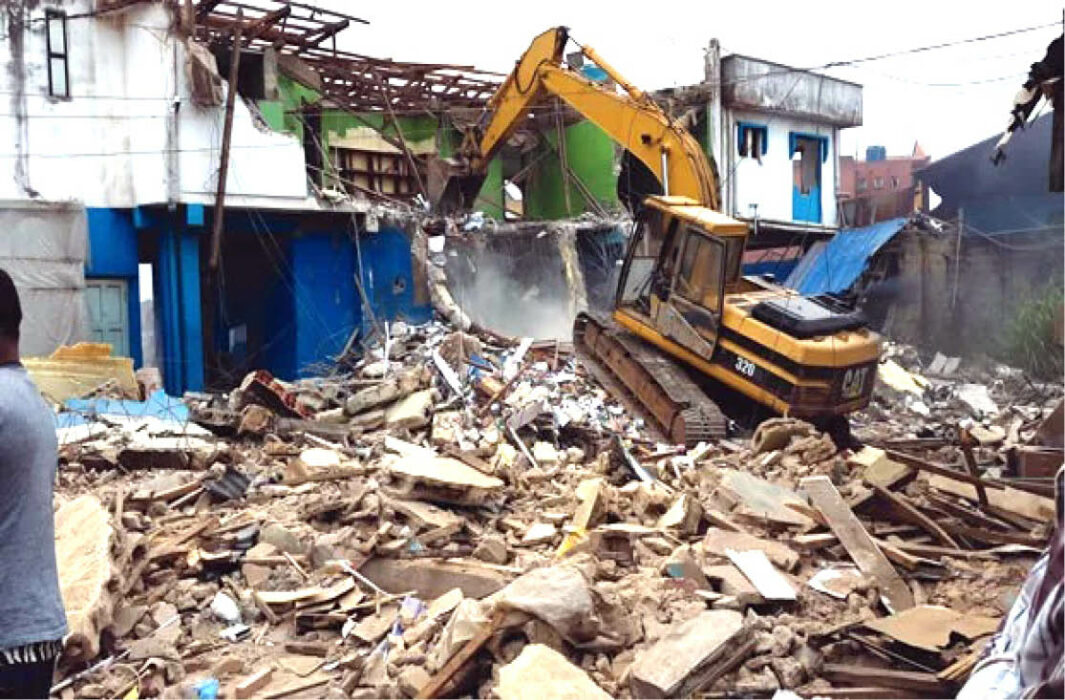
A wave of demolitions sweeping across Lagos—stretching from Ikota and Lekki to Oworonshoki and Ajao Estate—is beginning to send deep tremors through Nigeria’s financial system. What started as a government campaign to reclaim drainage channels and waterways is now exposing a dangerous fault line at the heart of the banking sector: the fragility of real estate collateral.
For thousands of homeowners, the devastation is immediate. However, for Nigerian banks, the financial aftershocks could prove to be long-lasting. Many of the demolished buildings were tied to active mortgages or pledged as collateral for business loans. With those structures reduced to rubble, the value of those securities collapses instantly.
In banking, property collateral is a safety net—one that evaporates the moment a bulldozer arrives.
“The risk is systemic,” said Tunde Johnson, head of retail banking at a mid-tier financial services group in Lagos. “If this happens in clusters—and we’re already seeing clusters—it doesn’t take much for five per cent of a mortgage book to go bad at once. That alone can tip a bank into crisis.”
Behind the scenes, lenders are scrambling. Internal memos reviewed by industry sources reveal that banks are quietly contacting customers in high-risk zones, demanding updated government approvals or threatening to classify their accounts as exposed. Some banks are reassessing their real estate loan portfolios, considering interest-rate hikes or even suspending fresh lending in certain districts altogether.
The bigger fear is a wave of strategic defaults. Once a building securing a loan is no longer in existence, many borrowers stop paying. The standoff threatens to clog Nigeria’s already slow judicial system with lawsuits. Banks may accuse clients of presenting faulty approvals, while borrowers insist that lenders failed to conduct proper due diligence before accepting the properties as collateral.
Lagos-based economist Charles Ogunleye sees the crisis as the inevitable consequence of long-standing institutional decay. “We built a credit system on shaky land records and hurried approvals,” he said. “Now that the government is reversing tolerated illegalities, both families and lenders are taking the hit.”
The Lagos State government insists the demolitions are lawful and necessary, aimed at correcting years of tolerated infractions that worsened flooding. But many affected residents insist they received official approvals—documents that now appear to be incomplete, fraudulent, or inconsistently recognisedrecognised by shifting administrations.
Business lawyer Amara Ezenwa believes the underlying problem is systemic.
“Land titles and approvals change with every administration. Without compensation, these demolitions become financial death sentences for ordinary people,” she said.
The timing could not be worse. Nigeria is grappling with rising inflation, a fragile currency, and a surge in non-performing loans across various sectors. Analysts warn the housing-finance ecosystem may require intervention by the Central Bank of Nigeria (CBN) and the Nigeria Deposit Insurance Corporation (NDIC) to prevent a freeze in the mortgage market.
Experts are calling for urgent reforms, including stronger land record verification, mandatory mortgage indemnity insurance, and government compensation in cases where approvals were obtained legitimately.
If years of poor oversight and fractured governance enabled the rise of illegal structures, it is the banking system that is now paying the price. As one senior banker put it bluntly:
“We’re being forced to confront the unthinkable—what do you do when the government itself destroys your collateral?”
What happens next will shape more than the Lagos skyline. It will test the resilience and credibility of Nigeria’s financial system. With hundreds of homes already down and more under review, the demolitions carry a stark warning: the cost of ignoring planning laws is measured not only in lives displaced, but in loans lost—and a credit market shaken to its core.
We’ve got the edge. Get real-time reports, breaking scoops, and exclusive angles delivered straight to your phone. Don’t settle for stale news. Join LEADERSHIP NEWS on WhatsApp for 24/7 updates →
Join Our WhatsApp Channel