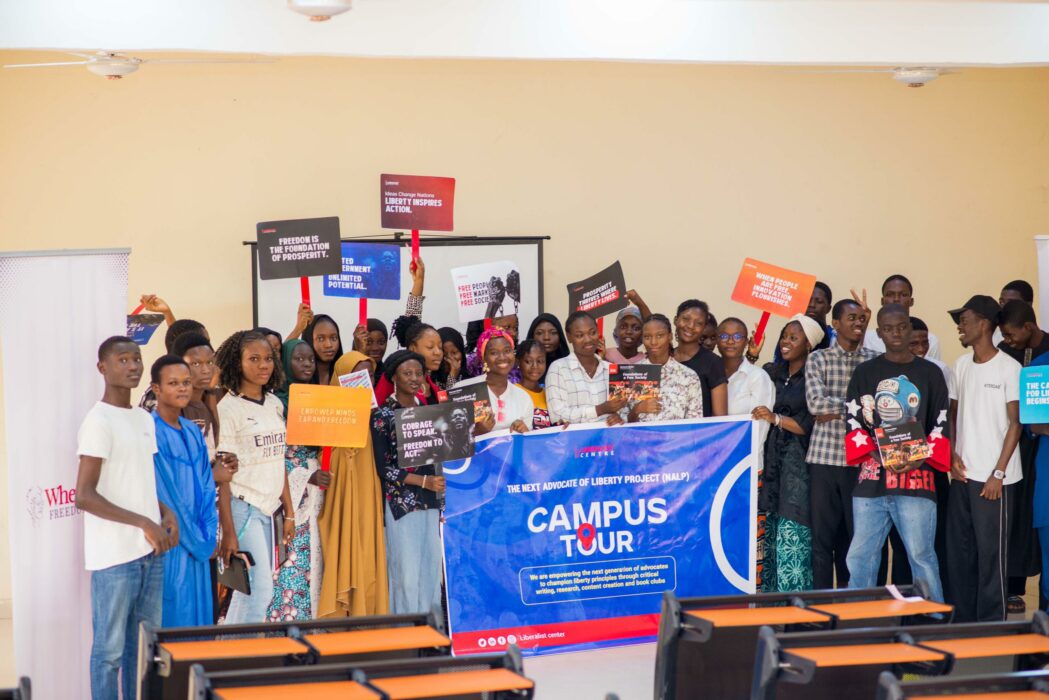
The Liberalist Centre for Education, a nonprofit organisation, has concluded a two-day sensitisation programme tagged ‘the Next Advocate Liberty Project’ at the University of Abuja.
Over 40 students were enlightened on liberty, pro-freedom ideas and how to chart better pathways for people to thrive economically during the event hosted at the Faculty of Communications and Media Studies.
Participants identified challenges facing local markets in the West African nation, particularly the issue of competition and mixed economy work.
Speaking during the event, Eric Mobu, director of programs for the Centre, said the initiative aimed to “empower Nigerian university students with the knowledge and practical tools to understand, apply, and advocate for liberty-based principles as solutions to local and national challenges.”
Mobu explained that the next phase of the project will be implemented across two other campuses of Kaduna State University and Nasarawa State University.
In a book review session moderated by Mobu, speakers explored the major themes of ‘An Introduction to Capitalism’ by Eamon Butler, a popular British economist and director of global think-tank Adam Smith Institute.
The speakers included Mohammed Taoheed, a researcher with DUBAWA, the verification project of the Centre for Journalism, Innovation and Development (CJID), Favour Adeboye, the programmes intern at the Liberalist Centre.
Adeboye stressed that critical sectors like oil, electricity in Nigeria operate under a less capitalist system, making less room for competition. She pushes for a society where capitalism and healthy competition can make citizens have a plethora of fair prices and choices to make amidst a low purchasing power.
On his part, Mohammed stated that while he believes African countries like Nigeria and Kenya would embrace the idea of capitalism to an extent, it would go a long way if they can shift properly to it to spread liberty and prosperity.
Abdullah Tijani, the executive director of the Liberalist Centre, introduced the student’s to the fundamental principles of individual rights, free markets and limited government.
The session detailed why it matters for young people to become the bold voices for freedom and how reporting on such could be amplified. “Pro- freedom journalism is a type of journalism that supports people’s freedom, focuses on political freedom/rights, free trade, and smaller government,” he said
Ihedirioha Favour, a 200 level student of UniAbuja’s department of journalism, said that the programme expanded her horizons on what her fundamental human rights are and how she can stand up for it.
“I learnt that everyone has rights such as the right to education, freedom of expression. We are born with these rights and no one can take it away from us. Rights cannot be separated from humans; they are the basic things of life. Anything that person is forced to do is basically wrong,” she said.
Another participant, Olaiya Sarah, also shared her experience after the training. Corroborating Favour, she said: “[This training] taught me that we need to be independent ourselves in order to search for freedom. We should speak out at all times and share our views on things that we don’t feel comfortable with.”
“We need to be broad in thinking, not shallow. Anytime a new policy is introduced in the country, we need to participate in dialogue and conversations around it because at the end of the day, our people bears the brunt of it,” she added.
We’ve got the edge. Get real-time reports, breaking scoops, and exclusive angles delivered straight to your phone. Don’t settle for stale news. Join LEADERSHIP NEWS on WhatsApp for 24/7 updates →
Join Our WhatsApp Channel